

Enviro News Asia, Namibia – Indigenous communities in Namibia’s Bwabwata National Park have completed the annual harvesting of devil’s claw, a medicinal plant widely used in the global herbal medicine market.
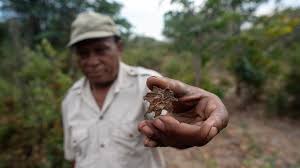
Members of the Khwe Indigenous community, led by community representative Teon Rongwani of the Kyaramacan Association, spent several weeks in the savannah collecting the underground tubers of devil’s claw species Harpagophytum procumbens and Harpagophytum zeyheri. The plant grows in arid savannah environments across southern Africa and is difficult to locate because it develops deep beneath the soil.
Harvesters must travel long distances across the dry landscape to find the plant and carefully dig out the secondary tubers while leaving the mother root intact to allow the plant to regenerate. After harvesting, the collectors refill the large holes to prevent injuries to wildlife and to support plant regrowth.
Between 5,000 and 10,000 harvesters across Namibia depend on devil’s claw as a key source of livelihood. The plant is recognized for its anti-inflammatory properties and is widely used to treat joint pain and digestive problems. Locally, communities prepare it as herbal tea, while internationally it is processed into medicinal tablets and powders.
Namibia supplies around 90 percent of the global devil’s claw market, exporting most of the product to Europe, with Germany among the leading importers.
However, devil’s claw is classified as a protected species, and unsustainable harvesting and illegal trade pose serious threats to the plant population and surrounding wildlife habitats.
To address these challenges, the Sustainable Wildlife Management (SWM) Programme, led by the Food and Agriculture Organization of the United Nations (FAO) and funded by the European Union and the French Development Agency, works with local organizations including World Wildlife Fund Namibia, the Kyaramacan Association, and neighboring conservancies.
The programme provides training, harvesting permits, and sustainable management guidelines to ensure that devil’s claw collection remains legal and environmentally responsible.
In addition, the FAO-led Dryland Sustainable Landscapes Impact Program (DSL-IP), funded by the Global Environment Facility and implemented by the Namibian government, trains communities in Good Agricultural and Collection Practices (GACP+). These practices include recording harvest volumes, restoring soil after digging, and protecting the mother root of the plant.
The initiatives also support resource surveys, sustainable harvest quotas, fair trade buyer agreements, and efforts to reduce illegal cross-border harvesting.
Revenue from devil’s claw harvesting helps fund the operations of communal conservancies that protect wildlife while improving the livelihoods of Indigenous communities.
Through these programs, FAO and its partners aim to strengthen sustainable value chains that connect Indigenous harvesters in Namibia’s drylands with the global herbal medicine industry while protecting biodiversity and traditional knowledge systems. (*)