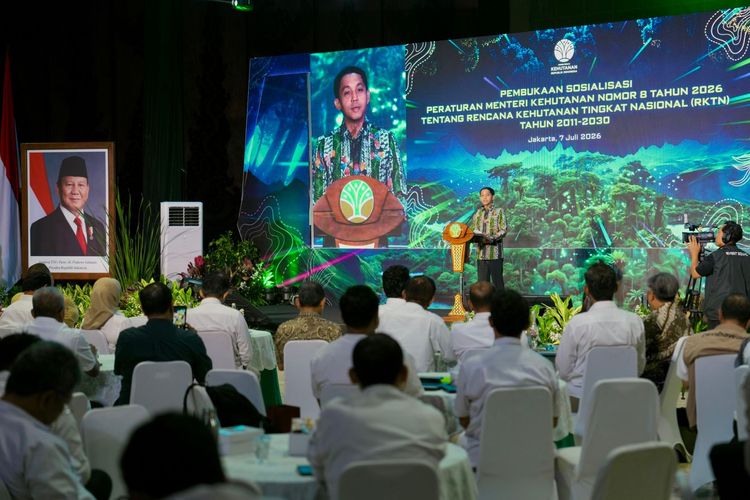
Enviro News Asia, Jakarta – Indonesia The Ministry of Forestry officially held the socialization of Forestry Ministerial Regulation No. P.8/2026 on the Second Amendment to Forestry Ministerial Regulation No. P.9/2011 on the National Forestry Plan (RKTN) 2011–2030, a strategic step taken to adapt to rapid development dynamics, climate change, and national commitments to environmental conservation while advancing community welfare.
Minister of Forestry Raja Juli Antoni said in his remarks that the drafting of the RKTN involved a lengthy process of high dedication and active engagement from various ministries and agencies, regional governments, and experts, stressing the importance of consistency in executing the plan from the national level down to the field.
“My message is singular: be consistent. Be consistent with what we have planned. Only by implementing this plan well and consistently can we realize the President’s vision of balance between economy and ecology,” he said.
The Minister outlined three main orientations entrusted by the President: forests must be sustainably managed as the primary responsibility; development must not stop, with green growth to be promoted as a new engine of economic growth; and community welfare is a certainty.
Director General of Forestry Planology Ade Tri Ajikusumah explained that the RKTN 2011–2030 is a long-term macro-level planning document for the forestry sector that serves as a backdrop for Provincial Forestry Plans (RKTP) and Provincial Spatial Plans (RTRWP). He called on all provincial forestry agency heads from 38 provinces to immediately adjust their respective RKTPs. The relationship between the RKTN and its subordinate plans is hierarchically complementary, with the national macro plan serving as the guide while detailed regional data will serve as valuable input for the next RKTN revision.
The socialization was attended by a range of strategic partners including the Geospatial Information Agency (BIG), the Land Bank Agency, the Coordinating Ministry for Food Affairs, the Ministry of Environment, the Ministry of Home Affairs, the National Research and Innovation Agency (BRIN), Perhutani, Inhutani, senior officials, and regional forestry agency representatives. Synergy among all stakeholders is considered key to ensuring Indonesia’s forests remain sustainable and deliver the greatest possible benefits for people’s welfare. (*)