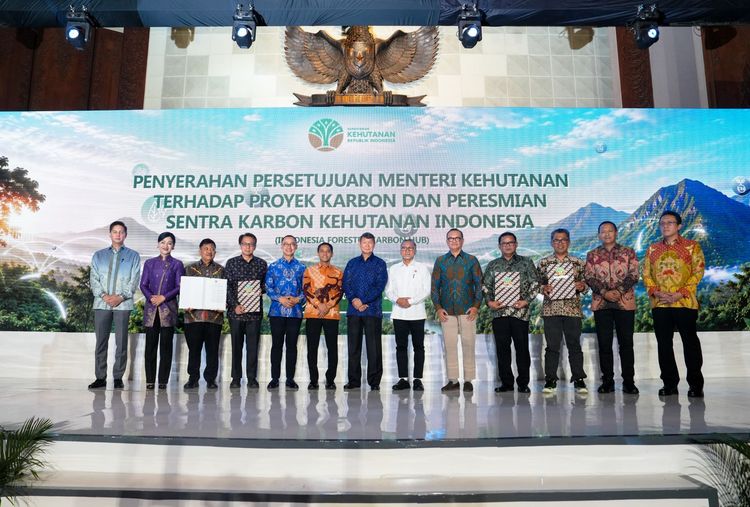
Enviro News Asia, Jakarta – The Indonesian government officially marked a new milestone in global climate change governance with the launch of the Indonesia Forestry Carbon Hub (Sentra Karbon Kehutanan Indonesia) and the handover of Forestry Minister approvals for the issuance of carbon units under a Non-Greenhouse Gas Emission Reduction Certificate (Non-SPE GRK) scheme to a number of forestry projects ready for operation.
The strategic move, carried out in Jakarta on Monday (7/6), represents concrete and rapid execution of the strong leadership and direction of President Prabowo Subianto, simultaneously shifting the national forestry sector’s business paradigm to ensure forest conservation and community welfare.
At a press conference, Minister of Forestry Raja Juli Antoni said that in this initial phase, approvals were granted to verified pilot projects covering an area of approximately 225,000 hectares.
“The total potential for emission reductions from these initial projects reaches around 30 million tonnes of CO2 equivalent, with an estimated economic transaction value of Rp 5 trillion and potential non-tax state revenue (PNBP) of around Rp 500 billion,” the Minister said.
The forestry projects that successfully secured ministerial approvals under Forestry Ministerial Regulation No. 6 of 2026 include PT Global Alam Lestari (Sumatra Merang Peatland Project, ID 1899), PT Rimba Makmur Utama (Katingan Peatland Restoration and Conservation Project, ID 1477), PT Mohairson Pawan Khatulistiwa (The Mayas Project, ID 3591), and a community-based carbon trading implementation in the Bujang Raba Jambi landscape supported by the Komunitas Konservasi Indonesia (KKI) Warsi.
System integration was also strengthened through cooperation with global carbon standards body Verra. The Minister explained that on July 9, the government will also launch the Carbon Unit Registry System (SRUK), which through an API connection will seamlessly link data from the Verra Registry, SRUK, and the Indonesia Stock Exchange (IDX) using blockchain technology to ensure full transparency and end-to-end traceability.
Coordinating Minister for Food Affairs Zulkifli Hasan, who also delivered remarks at the event, underlined the government’s commitment to cutting the bureaucratic obstacles that have long frustrated investors.
“In the past, everything was difficult and largely prohibited. Now, under President Prabowo’s direction, we are coordinating the reform of nearly 35 regulations, whether Government Regulations, Presidential Regulations, or Presidential Instructions, all aligned to simplify processes, ensure transparency, and eliminate sectoral ego to drive inclusive green economic growth,” Zulkifli said.
In line with the hub’s launch, Financial Services Authority (OJK) Board of Commissioners Chairman Friderica Widyasari Dew confirmed the financial services sector’s full readiness to support the domestic carbon market. OJK has launched the Indonesian Sustainable Finance Taxonomy (TKBI) and developed a financing playbook as a guide for concrete pilot project-based financing. OJK is also revising POJK No. 14 of 2023 to strengthen carbon exchange regulation and oversight, and exploring the development of carbon-based financial products utilizing cash flows from forestry carbon credit and agroforestry commodity sales, while ensuring financing structures deliver fair benefits for local communities as the frontline guardians of forests.
Presidential Special Envoy for Climate and Energy Hashim Djojohadikusumo expressed high appreciation for the cross-ministry and agency collaboration that successfully established this high-integrity carbon governance framework, conveying an important message from President Prabowo on the ambitious target of restoring 12.7 million hectares of degraded land in Indonesia.
“Those 12.7 million hectares of degraded land must immediately be programmed for restoration, restoration, and restoration. This is a concrete subject for the carbon market. We invite global investors to invest in this land restoration, and in return they will receive certified carbon credits through the credible mechanism we are witnessing today,” Hashim said. (*)