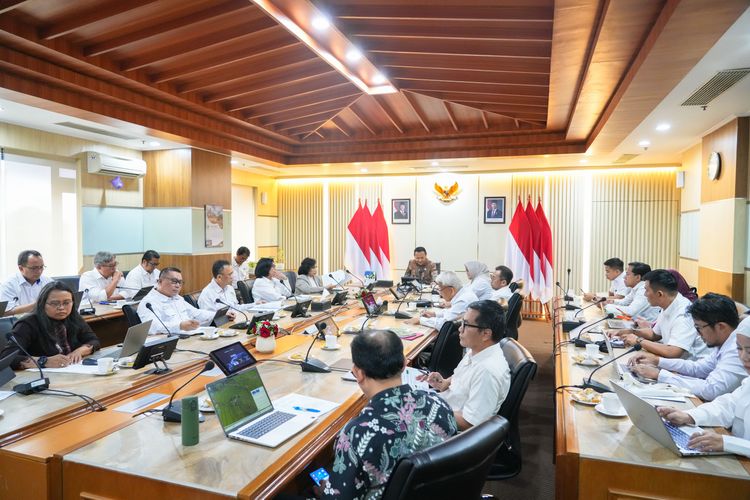
Enviro News Asia, Jakarta — Indonesia is preparing a National Investment Plan for Production and Protection Forests for 2026–2030 to strengthen sustainable forest management, support the country’s FOLU Net Sink 2030 target and improve community welfare.
The Ministry of Forestry, through its Directorate General of Sustainable Forest Management (PHL), is developing the plan with support from the Multistakeholder Forestry Programme (MFP) Phase 5. The plan is intended to translate national forestry policies into measurable programs and field-level actions.
Vice Minister of Forestry Rohmat Marzuki said production and protection forests play strategic roles in achieving environmental, economic and social objectives.
“Production and protection forests are not only buffers for ecological balance but also sources of livelihood for millions of people. Their management must therefore be planned, measurable and capable of delivering tangible benefits for the environment, the economy and communities,” Rohmat said.
Indonesia has more than 120 million hectares of state forest. About 66.7 million hectares, or approximately 57%, are classified as production forests, while around 29.1 million hectares, or 25%, are designated as protection forests.
The ministry said several forestry indicators have shown positive progress. The national deforestation rate declined from 462,000 hectares in 2019 to around 175,000 hectares in 2024. Forest and land rehabilitation reached 217,974 hectares in 2024, as the government pursues a broader target to rehabilitate 12 million hectares of degraded land.
“While these achievements are encouraging, we cannot be complacent. There is still a gap to close toward 2030. This plan is designed so that every forest management measure moves in the same direction and strengthens the others,” Rohmat said.
The National Investment Plan is designed to connect national policies, including Indonesia’s Nationally Determined Contribution (NDC), the National Forestry Plan (RKTN) and the FOLU Net Sink 2030 target, with implementation on the ground.
The plan has four main objectives: identifying priority interventions, calculating funding requirements and carbon outcomes, mapping stakeholder roles, and preparing a portfolio of programs that can be implemented.
In production forests, the strategy focuses on securing industrial raw material supplies, expanding multi-business forestry activities and supporting the transition to renewable energy.
In protection forests, the plan prioritizes optimizing ecosystem and carbon services, protecting watersheds and developing sustainable conservation financing.
The plan consists of eight interconnected work packages covering spatial planning, forest management, carbon reduction and community livelihoods.
The packages include sustainable roundwood production, alternative strategic commodities for construction and energy, non-timber forest products and ecosystem services, carbon absorption and storage, village forest governance, community-based agroforestry, and the contribution of forests to food security.
The government expects the plan to generate impacts across three pillars: Planet, Prosperity and People.
On the environmental side, the forestry sector is targeted to achieve net emissions of minus 140 million tonnes of CO2 equivalent by 2030.
Economically, the government aims to increase the value of forestry exports from the 2022 baseline of US$12.6 billion.
For communities, the Social Forestry program is targeted to expand from 8.1 million hectares to 12.7 million hectares, alongside efforts to strengthen food and energy security through village forests and protect the rights of Indigenous communities.
“Communities must become the main actors in protecting forests while directly benefiting from Social Forestry, village forests and agroforestry,” Rohmat said.
Ade Mukadi, Executing Agency of MFP5 and Director of Forest Products Processing and Marketing at the Directorate General of Sustainable Forest Management, said the plan was developed using a Theory of Change approach.
The approach maps the links between resources, activities and immediate outputs and the broader systemic changes and long-term impacts needed to support Indonesia’s FOLU Net Sink and NDC targets.
The investment plan is expected to provide a framework for aligning government programs, investment and stakeholder participation in production and protection forest management through 2030. (*)