Enviro News Asia, Semarang — Indonesia’s Ministry of Environment and Environmental Control Agency (KLH/BPLH) is preparing a new regulation on water farming as part of efforts to address worsening land subsidence in major urban areas. The proposed policy would require groundwater users not only to obtain permits for extraction but also to replenish the water they withdraw by returning it to the ground.
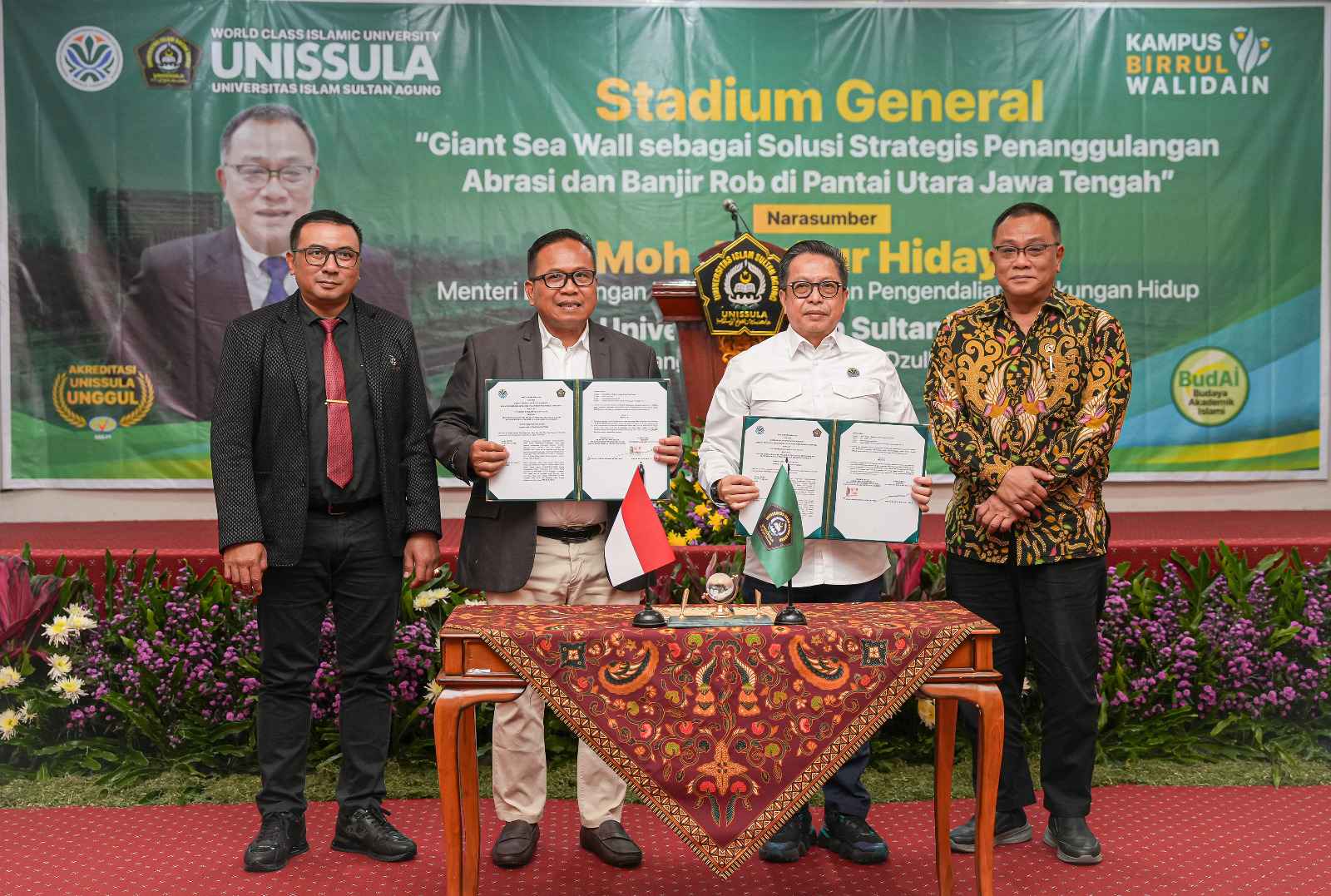
The initiative was announced by Minister of Environment and Head of the Environmental Control Agency, Moh Jumhur Hidayat, following a public lecture at the Sultan Agung Islamic University (Unissula) in Semarang on 2 June 2026. The lecture focused on the proposed Giant Sea Wall project as a strategy to address coastal erosion and tidal flooding along the northern coast of Central Java.
According to Minister Jumhur, excessive groundwater extraction has been identified by scientists as one of the primary drivers of land subsidence in Indonesia’s major cities. He stressed that infrastructure projects such as the Giant Sea Wall alone will not solve the problem unless groundwater management is improved.
“Many countries have already developed mechanisms and regulations governing groundwater extraction, but Indonesia has yet to establish comprehensive rules in this area. The Ministry of Environment is preparing regulations on water farming that will include monitoring mechanisms and sanctions,” Jumhur said.
Water farming refers to a circular water management approach in which rainwater and surface runoff are collected, stored, and infiltrated back into the ground to replenish groundwater reserves. The proposed regulation aims to ensure that groundwater extraction is balanced by groundwater recharge activities, thereby reducing environmental risks and supporting long-term water security.
The minister explained that groundwater depletion can occur rapidly when extraction is not accompanied by adequate recharge measures. Under the planned framework, individuals, businesses, and institutions that extract groundwater would be required to undertake water replenishment activities instead of paying additional fees to the government.
“The principle is simple: water taken from the earth must be returned to the earth. If it is not replenished, groundwater extraction contributes directly to land subsidence,” Jumhur said.
The proposed regulation would apply different requirements depending on the scale of water use. For residential areas and office complexes, water farming measures could include rainwater harvesting systems and the construction of infiltration facilities such as biopores to increase groundwater recharge.
For larger-scale users, including industrial estates and commercial operations, compliance could involve building reservoirs, retention ponds, artificial lakes, or other water storage infrastructure. Another option under consideration is requiring companies to establish vegetation cover across designated areas to enhance water absorption and maintain ecosystem functions.
Environmental authorities would regularly monitor compliance to ensure that groundwater recharge obligations are effectively implemented and maintained over time.
Minister Jumhur emphasized that protecting groundwater resources is essential for maintaining environmental balance and reducing the risks associated with land subsidence, particularly in rapidly growing urban regions.
“Groundwater conservation is fundamentally about preserving the ecosystem. Through water farming, we can protect groundwater reserves, maintain environmental sustainability, and reduce the threat of land subsidence for future generations,” he said. (*)