Enviro News Asia, Jakarta — Indonesia’s Ministry of Forestry is seeking to integrate social forestry programs with health and employment protection schemes to improve the welfare of millions of people living in and around forest areas.
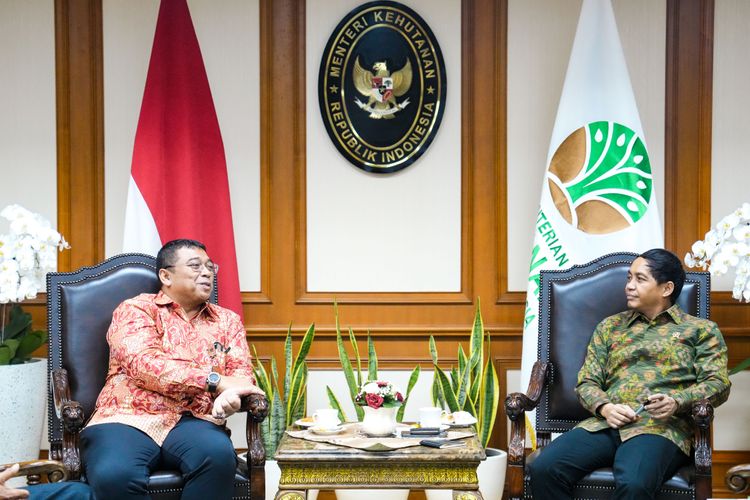
The initiative was discussed during a meeting between Forestry Minister Raja Juli Antoni and BPJS Health Supervisory Board member Stevanus Adrianto Passat in Jakarta on 2 June 2026.
During the meeting, Minister Raja Juli Antoni emphasized that social forestry policies should go beyond granting communities access to forest management. He said the program must also serve as a pathway to better livelihoods, social protection, and improved quality of life for people living near forest landscapes.
According to the minister, approximately 1.4 million households currently have access to social forestry areas. Based on an average household size of three people, around 4.2 million individuals are expected to undergo field verification. Those meeting government poverty criteria will be proposed as beneficiaries of the national health insurance subsidy program under BPJS Health.
“Social forestry should not only provide access to forest resources but also ensure that surrounding communities receive the social protection and public services they need,” Raja Juli Antoni said.
The verification process will be conducted to ensure that health insurance assistance reaches eligible recipients and aligns with beneficiary criteria established by the Ministry of Social Affairs.
Beyond healthcare protection, the ministry is also encouraging successful Social Forestry Business Groups (KUPS) to strengthen their institutional structures and formalize their business operations. Communities with established and economically viable enterprises will be encouraged to enroll in the national employment insurance system managed by BPJS Employment.
“For vulnerable communities, we are facilitating access to health protection. For those whose businesses have grown and become economically stronger, we want to encourage participation in employment protection programs,” the minister explained.
The ministry believes that stronger business institutions will enable social forestry groups to manage forest-based economic activities more productively, sustainably, and responsibly. This approach is expected to transform social forestry into a broader instrument for economic empowerment and social inclusion.
During the discussion, Raja Juli Antoni also highlighted the challenges many forest communities face in accessing healthcare services. Geographic isolation, limited infrastructure, and long travel distances to medical facilities remain significant obstacles for residents living near forest areas.
“We hope healthcare facilities can be developed closer to forest villages. Distance remains one of the biggest barriers to healthcare access for communities living around forest areas,” he said.
The minister noted that healthcare facilities can be developed within forest areas through Indonesia’s Forest Area Utilization Approval (PPKH) mechanism. Under existing regulations, provincial governments may submit proposals for public-interest facilities such as health centers, potentially accelerating service delivery to remote communities.
The Ministry of Forestry views collaboration with BPJS Health, BPJS Employment, the Ministry of Social Affairs, local governments, and other stakeholders as a strategic step toward building a stronger social protection system for forest-dependent communities.
Through integrated social forestry data, field verification, business development, and improved access to healthcare services, the government hopes to ensure that communities surrounding forest areas receive more tangible and lasting benefits from Indonesia’s forestry policies. (*)