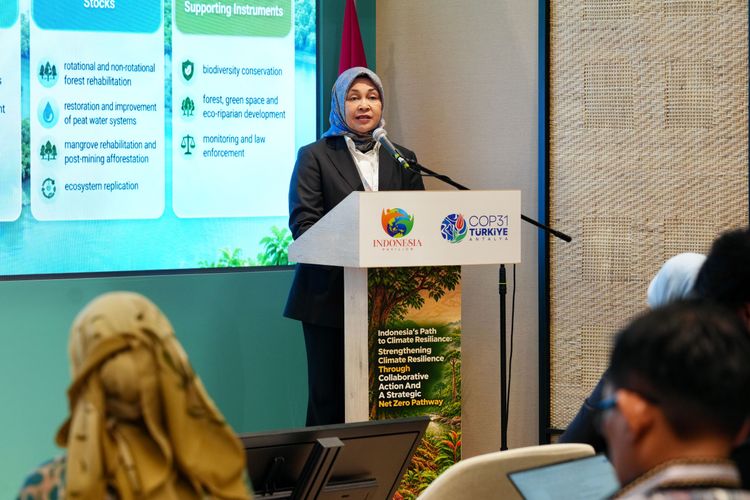
Enviro News Asia, Antalya — Indonesia is promoting a shift in forest and land rehabilitation from tree-planting programmes towards comprehensive and sustainable ecosystem restoration, integrating watershed management, forest rehabilitation and mangrove recovery to strengthen landscape resilience to climate change.
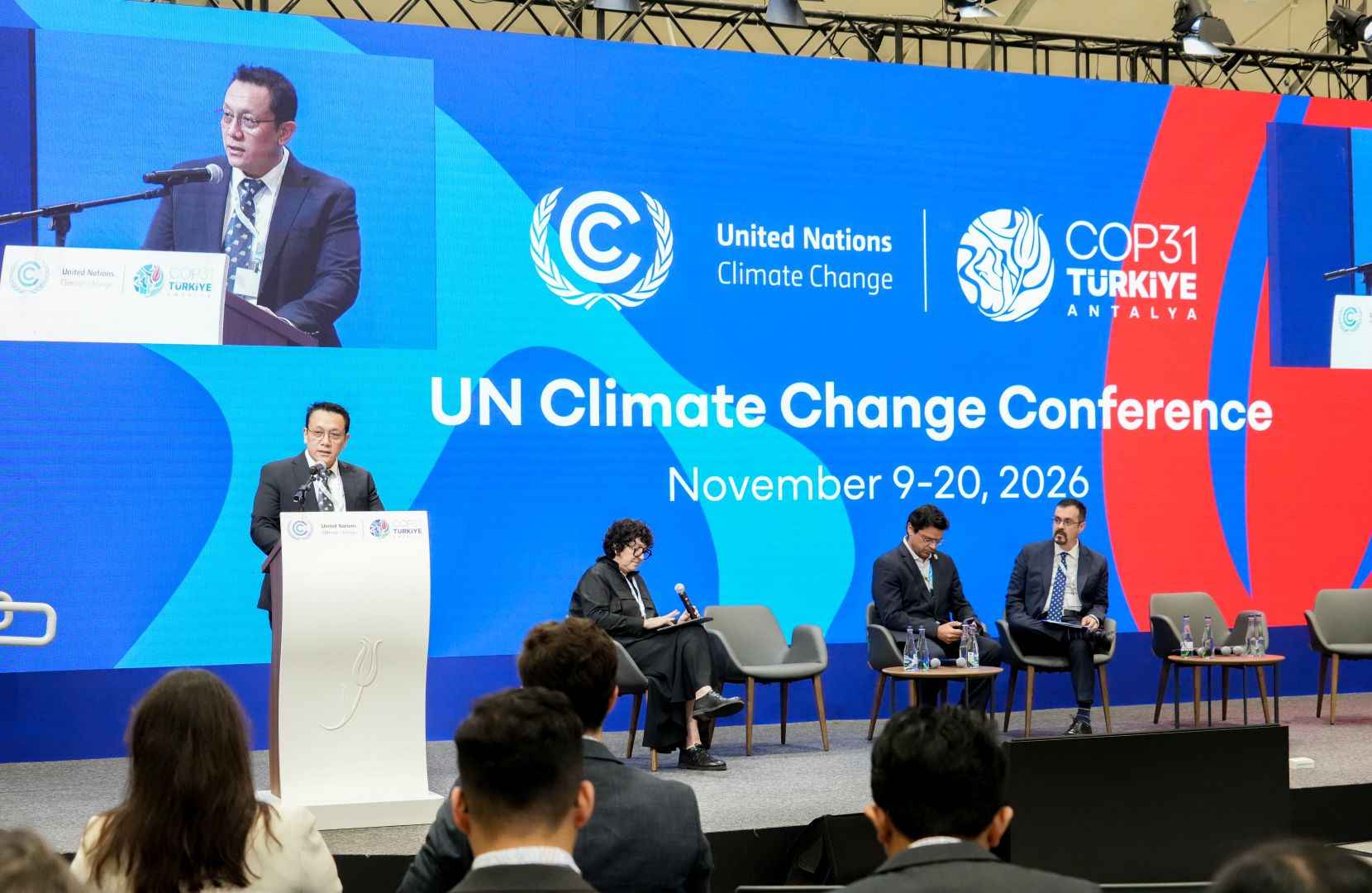
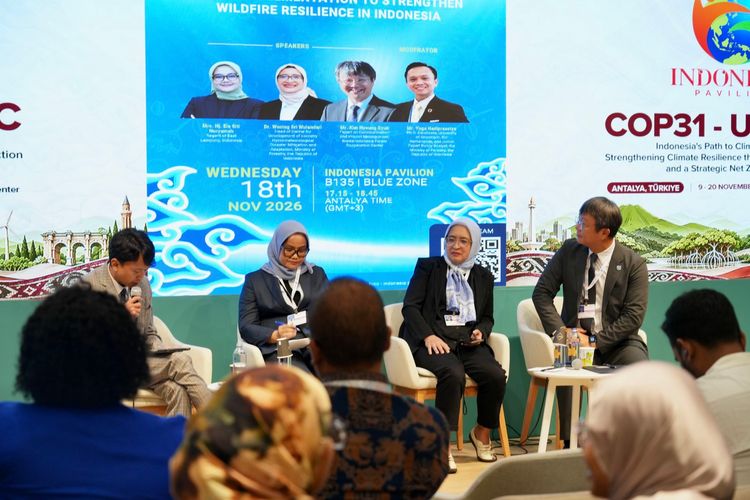
The approach was discussed during a session titled “Beyond Planting: From Watersheds to Mangroves for Climate-Resilient Landscapes” at the Indonesia Pavilion during the 31st United Nations Climate Change Conference (COP31) in Antalya, Türkiye, on Tuesday (Nov. 17, 2026).
Dyah Murtiningsih, director general of Watershed Management and Forest Rehabilitation at the Ministry of Forestry, said landscape-based rehabilitation needed to be expanded to support Indonesia’s FOLU Net Sink 2030 target.
The strategy combines emissions reductions through forest protection with increased carbon absorption through forest rehabilitation, peatland restoration, mangrove recovery and the restoration of other degraded ecosystems.
Indonesia faces the challenge of restoring approximately 12 million hectares of degraded land, with estimated financing needs reaching US$42 billion.
To address this gap, the Ministry of Forestry is seeking to strengthen funding through government budgets, international cooperation, results-based payments, private investment and philanthropy. Carbon financing and sustainable investment instruments are also seen as opportunities to support long-term rehabilitation, including maintenance and monitoring to ensure successful outcomes.
During the forum, the ministry emphasized that rehabilitation success should not be measured solely by the number of trees planted or the area restored. It should also be assessed through improvements in water regulation, vegetation cover, biodiversity protection, carbon stocks and the social and economic benefits received by communities.
This requires integrated management of upstream, midstream and downstream watershed areas, with stronger connections to coastal ecosystems.
From a scientific perspective, Chay Asdak, a watershed management expert at Padjadjaran University, said landscape restoration could provide a common approach to addressing climate change, land degradation and biodiversity conservation.
He highlighted the importance of economic incentives for communities managing land, including agroforestry, payments for ecosystem services and nature-based business financing. These mechanisms can help ensure that ecosystem protection goes hand in hand with improved livelihoods.
Nikolas N. Surjobasuindro, director of Mangrove Rehabilitation at the Ministry of Forestry, said Indonesia had approximately 3.44 million hectares of mangrove ecosystems.
Through the 2021–2030 National Mangrove Rehabilitation Roadmap, Indonesia has set a target of rehabilitating 600,000 hectares of mangroves. The programme prioritizes stronger community livelihoods, multi-stakeholder collaboration, climate change mitigation and diversified funding sources.
The ministry is also developing the World Mangrove Center as a platform for international cooperation, knowledge exchange and capacity building in mangrove management.
Rochimah Nugrahini, head of the Serayu Opak Progo Watershed Management Agency, presented practical rehabilitation experience involving collaboration among the government, businesses and farmer groups.
In the Menoreh area, the partnership has supported planting across approximately 1,656 hectares, involving more than 901,000 multipurpose trees. The programme has also generated around 87,000 workdays, demonstrating how landscape-based rehabilitation can deliver environmental benefits while creating economic opportunities for local communities.
On the financing side, Kyu-uk Lee of the Global Green Growth Institute (GGGI) said restoration funding should cover more than planting activities. It must also support maintenance, monitoring and verification of results.
Carbon financing and blended finance schemes could provide alternatives for supporting the entire restoration cycle, provided they maintain environmental integrity, reliable measurement of results and fair benefit-sharing with communities.
Noriaki Sakaguchi of the Japan International Cooperation Agency (JICA) shared more than three decades of Indonesia-Japan cooperation in mangrove rehabilitation, including the application of silvofishery, which integrates aquaculture activities with mangrove protection.
Mempawah Regent Erlina of West Kalimantan also presented local mangrove protection and restoration efforts through Mempawah Mangrove Park. The initiative connects conservation with environmental education, ecotourism and community participation.
The session, moderated by Nur Azis of the ministry’s Directorate General of Watershed Management and Forest Rehabilitation, also included discussions with international participants on the development of the World Mangrove Center, lessons from Indonesia’s mangrove management practices and potential rehabilitation cooperation with Bangladesh.
Speakers agreed that expanding restoration efforts required integrated policies, sustainable financing, scientific support and active community participation.
Through the COP31 forum, the Ministry of Forestry reaffirmed that forest and land rehabilitation must move beyond planting targets towards measurable and sustainable ecosystem recovery.
Integrating watershed management, forest rehabilitation and mangrove restoration is expected to strengthen climate resilience, support Indonesia’s FOLU Net Sink 2030 target and ensure that forests and coastal ecosystems continue to benefit the environment and local communities. (*)