

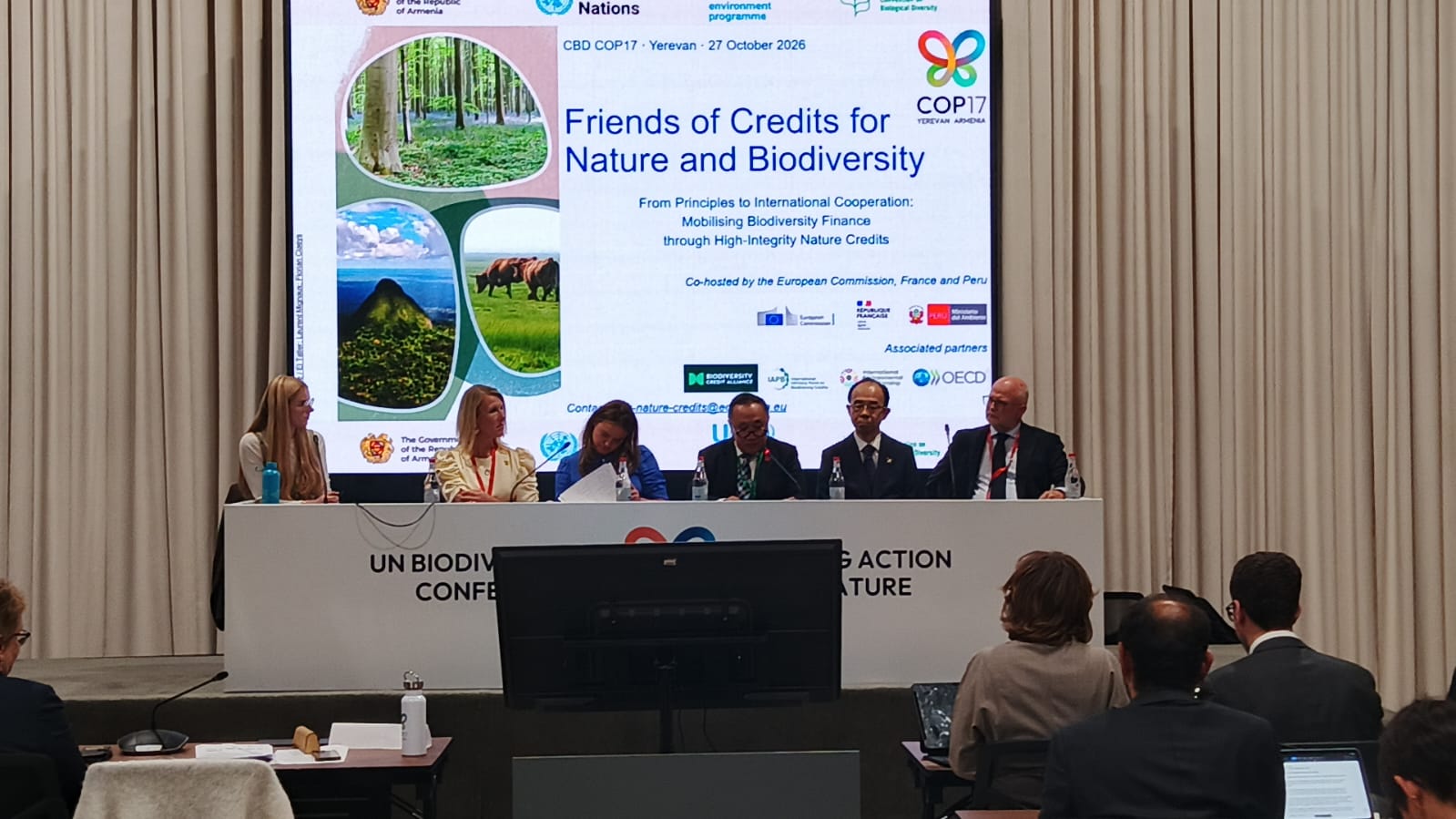
Enviro News Asia, Yerevan — Indonesia has called for reforms to financial incentives and stronger biodiversity funding mechanisms to support global conservation targets at the 17th Conference of the Parties to the Convention on Biological Diversity (COP17 CBD) in Yerevan, Armenia.
The Indonesian delegation highlighted fiscal policy reforms, green financing innovations and science-based partnerships as key measures to advance the Kunming-Montreal Global Biodiversity Framework (KM-GBF). The conference was held from Oct. 9 to 30, 2026.
Led by Noer Adi Wardojo, Deputy for Pollution and Environmental Damage Control at the Ministry of Environment and the Environmental Control Agency (KLH/BPLH), the delegation presented Indonesia’s national strategy for implementing Target 18 of the KM-GBF.
The strategy was outlined at a forum titled “Reforming Biodiversity-Harmful Financial Flows: Accelerating Action Towards Target 18,” initiated by the Dutch government alongside the launch of the global Friends of Target 18 initiative.
Noer Adi said fiscal policies and public incentives were fundamental to protecting ecosystems in megadiverse countries such as Indonesia. These measures, he said, must support the conservation of forests, wetlands and marine areas while safeguarding communities whose livelihoods depend on natural resources.
“Target 18 is not merely an environmental commitment for Indonesia; it is also an integral part of sound fiscal policy and sustainable long-term development planning,” he said.
Incentive Reform and Green Financing
Indonesia outlined three main areas of progress in implementing Target 18 domestically.
First, the government is integrating strategic policy frameworks through the Indonesian Biodiversity Strategy and Action Plan (IBSAP) 2025–2045, led by KLH/BPLH in coordination with the Ministry of National Development Planning (Bappenas). The plan aims to reform incentives that harm nature and expand incentives that support biodiversity conservation.
Second, Indonesia has mapped 43 positive incentive instruments across government ministries, comprising 19 fiscal and 24 non-fiscal instruments. These are intended to encourage biodiversity-friendly practices in productive sectors.
Third, the government is strengthening sustainable financing through Ecological Fiscal Transfers (EFT) for regional administrations, biodiversity budget tagging developed with the Ministry of Finance since 2024, and innovative financial instruments such as Green Sukuk.
The next phase of reform will focus gradually and equitably on sectors placing significant pressure on biodiversity, while protecting the livelihoods of local communities and smallholder farmers.
Science-Based Regulations and IUCN Partnership
Alongside financial reforms, Indonesia also strengthened international cooperation through a forum at the International Union for Conservation of Nature (IUCN) pavilion titled “Collaborative Action for Global Impact: Multistakeholder Partnerships and IUCN Constituents Driving Biodiversity Success in Indonesia.”
As a megadiverse country with extensive tropical forests, mangroves, peatlands, karst landscapes and wetlands, Indonesia is continuing to strengthen its national regulatory framework.
Following regulations aimed at protecting forests, peatlands and mangroves, the government is finalising comprehensive regulations for karst ecosystems and freshwater lakes. The proposed frameworks are intended to establish standards for environmental restoration, ecological integrity and sustainable management.
Noer Adi said the regulatory work would help ensure consistent protection and restoration standards across vulnerable ecosystems.
He also highlighted the importance of Indonesia’s strategic partnership with IUCN. Scientific expertise and technical support from the organisation help identify early signs of environmental degradation and potential ecosystem collapse, enabling the government to develop proactive, evidence-based interventions.
Through its participation in COP17 CBD, Indonesia called on international partners to strengthen practical cooperation, align financing policies with scientific evidence and safeguard ecosystems for the well-being of future generations. (*)