

Enviro News Asia, Jakarta — Indonesia recorded 154 high-confidence forest and land fire hotspots on Oct. 29, an increase of 36 from the previous day’s 118, prompting the Forestry Ministry to strengthen monitoring and firefighting operations, particularly in Central Kalimantan.
Data from the ministry’s SiPongi monitoring system, based on NASA Terra/Aqua, SNPP and NOAA-20 satellite observations at 9 p.m. local time, showed that 18 hotspots had emerged across six priority provinces for fire control. Central Kalimantan accounted for 17, while South Sumatra recorded one.
West Kalimantan, Jambi, South Kalimantan and Riau continued to report zero high-confidence hotspots.
The ministry said the increase required renewed vigilance and stronger field responses, especially in Central Kalimantan. However, satellite-detected hotspots indicate surface-temperature anomalies and cannot be directly equated with the number of fires or the total area burned. All detections must be verified through patrols and ground checks.
According to the Forestry Ministry’s fire control command post report for Oct. 29, operations were continuing at several locations in Central Kalimantan.
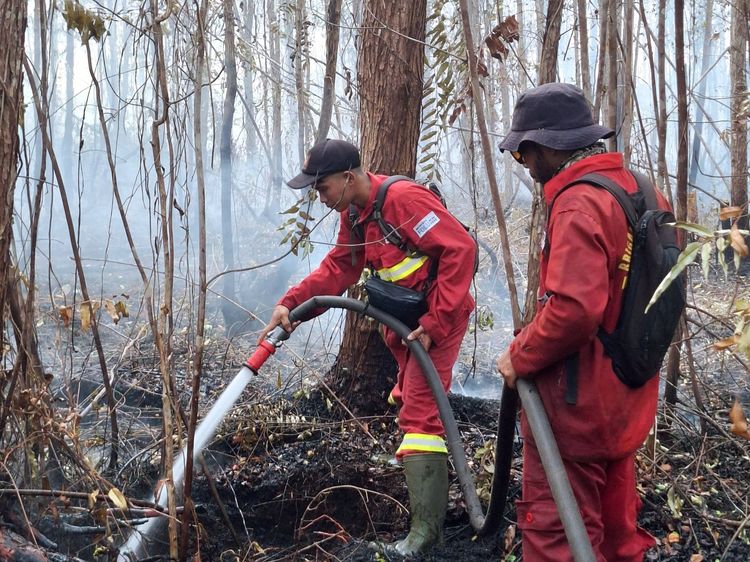
At the Tumbang Nusa Special Purpose Forest Area (KHDTK) in Pulang Pisau district, Manggala Agni firefighting teams were wetting the land, conducting patrols and monitoring conditions to prevent fires from recurring. In Sakakajang and Tanjung Taruna, teams continued to encounter substantial smoke rising from peatland areas, requiring further suppression efforts.
Operations were also under way in Tanjung Puting National Park, particularly around Sei Sekonyer–Tanjung Harapan in West Kotawaringin district. The fire involved underground peat combustion, with embers still not fully extinguished in the latest report. Manggala Agni teams continued firefighting with support from nearby water sources.
Conditions varied across other provinces. In South Sumatra, joint teams had successfully extinguished the fire in Talang Rimba, Ogan Komering Ilir. However, smoke remained in Timbangan, Ogan Ilir, where further searches for embers and suppression were required in peatland areas.
In Jambi, conditions had improved. Fires in Tanjung Village, Muaro Jambi, were declared extinguished, while active flames in Simpang Datuk, East Tanjung Jabung, had also been put out. Some areas still showed light smoke, prompting continued monitoring by Manggala Agni and other response teams.
In South Kalimantan, a fire in Nusa Indah Village, Tanah Laut, had been extinguished. At Landasan Ulin Barat, Banjarbaru, the fire in the area being handled was under control, although thick smoke remained visible at several points. Suppression and monitoring operations therefore continued.
In East Kalimantan, teams conducted ground checks and mopping-up operations in Bontang Lestari to ensure the fire was fully extinguished. In Santan Tengah Village, Kutai Kartanegara, Manggala Agni teams and local residents continued firefighting because the blaze had not been completely put out.
Firefighting operations also continued in Sulawesi. In Matialemba Village, Poso, Central Sulawesi, the fire had been extinguished, while suppression efforts remained under way in Berdikari Village, Sigi. In Puncak Indah, East Luwu, South Sulawesi, the fire was declared extinguished.
A total of 61 aircraft remained on standby to support fire control operations. The fleet comprised 24 aircraft for patrols, CASA operations and weather modification, alongside 37 helicopters assigned to water bombing.
Aerial operations continued alongside ground firefighting, land wetting, searches for remaining embers and mopping-up activities.
The Forestry Ministry stressed that hotspot numbers could change rapidly. The effectiveness of fire control should therefore not be judged solely by increases or decreases in satellite detections, but by actual field conditions.
The priorities are to ensure that all flames and embers are extinguished, prevent fires from recurring, protect communities and safeguard forest areas and biodiversity. (*)