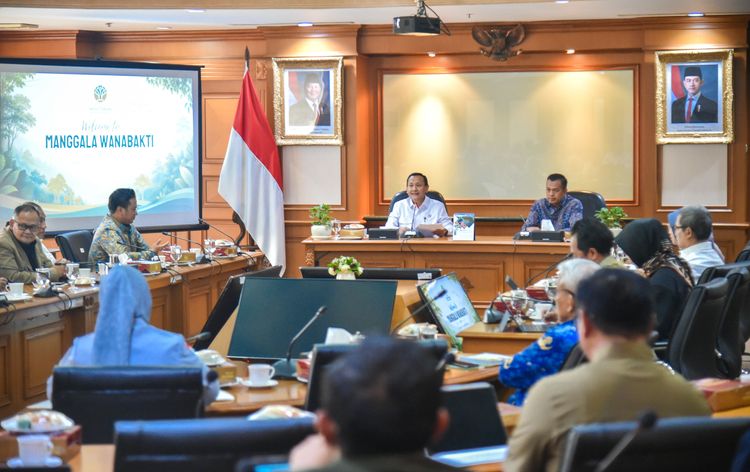
Enviro News Asia, Jakarta — Indonesia’s Ministry of Forestry is accelerating the updating of forest and land rehabilitation planning data to strengthen restoration efforts, respond to changing landscape conditions, and prepare revisions to national watershed rehabilitation plans.
The initiative, led by the Directorate General of Watershed Management and Forest Rehabilitation (PDASRH), aims to improve the accuracy of the General Plan for Forest and Land Rehabilitation in Watersheds (RURHL-DAS) and support the preparation of Annual Forest and Land Rehabilitation Plans (RTnRHL).
Muhammad Zainal Arifin, Secretary of the Directorate General of PDASRH, said the RURHL-DAS serves as the primary reference for determining rehabilitation priorities, implementation sites, monitoring, and evaluation under the Ministry of Environment and Forestry Regulation No. 10 of 2022.
He emphasized that the document is essential for supporting water security, food security, and mitigation of hydrometeorological disasters.
The ministry noted that continuous changes in land conditions, including the emergence of new degraded areas, require regular updates and synchronization of spatial data alongside socio-economic information from local communities.
To support this effort, the Directorate of Mangrove Rehabilitation, through the Mangroves for Coastal Resilience (M4CR) program, is assisting with coordination and alignment of rehabilitation planning in four priority provinces: Riau, North Sumatra, East Kalimantan, and North Kalimantan.
The program also supports the preparation of annual operational planning documents by Watershed Management Agencies (BPDAS) to ensure rehabilitation activities remain consistent with national policies and targets.
Director of Mangrove Rehabilitation Nikolas Nugroho Surjobasuindro said the M4CR program combines mangrove restoration with assessments of local socio-economic conditions to ensure rehabilitation activities are community-based and environmentally sustainable.
Looking ahead, the ministry plans to strengthen site validation through a Decision Support System (DSS), enabling rehabilitation priorities to be determined using comprehensive multi-criteria analysis.
The system will integrate land cover data, previous rehabilitation records, concession areas, land tenure information, and carbon development potential to improve planning accuracy and long-term sustainability.
The revised RURHL-DAS is scheduled for completion in 2027 and is expected to provide a more up-to-date and implementable planning framework for forest and land rehabilitation nationwide.
As part of the next phase, the M4CR program will conduct intensive technical training in its four priority provinces to improve institutional capacity and accelerate annual rehabilitation planning.
The Mangroves for Coastal Resilience (M4CR) program is a national initiative managed by the Ministry of Forestry through the Directorate General of PDASRH, in collaboration with several government agencies and regional administrations, with financial support from the World Bank.
The program targets the rehabilitation of 32,634 hectares of mangroves by 2027 while promoting community-based restoration, climate resilience, and sustainable mangrove-based local economies.(*)