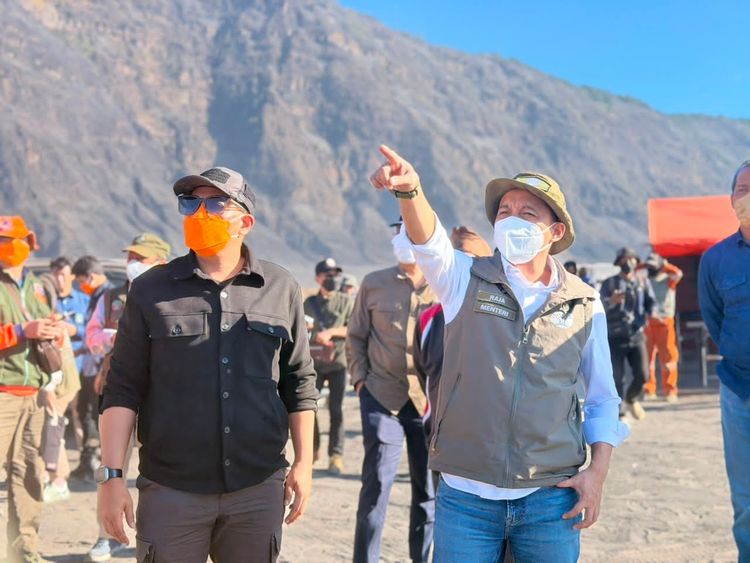
Enviro News Asia, London – Minister of Forestry Raja Juli Antoni has reaffirmed Indonesia’s commitment to building a strong, sustainable, and globally competitive conservation system through the development of investment-based innovative financing for conservation areas and biodiversity protection, delivering the message at the Peusangan Elephant Conservation Initiative (PECI) Roundtable Meeting held in London during London Climate Action Week 2026.
Addressing representatives of governments, financial institutions, international organizations, and development partners, the Minister stressed that Indonesia is building a new approach to conservation management that no longer relies entirely on public financing but instead opens space for credible, high-integrity investment that delivers real benefits for communities, nature, and the climate.
“Indonesia is not merely drafting a financing strategy. We are building a new paradigm of conservation governance, one in which national parks achieve financial independence, communities become primary partners, the private sector plays a meaningful role, and the state provides a strong regulatory framework to ensure all mechanisms operate in an accountable and sustainable manner,” Raja Juli Antoni said.
As part of the direction set by President Prabowo Subianto, the Indonesian government has established a Task Force on Innovative Financing for National Park Management and Iconic Species Conservation, chaired by the Presidential Special Envoy for Climate and Energy Hashim S. Djojohadikusumo, with the support of Presidential Special Envoy for Trade and Multilateral Cooperation Mari Elka Pangestu, and the Minister of Forestry serving as Deputy Chair for Regulatory Reform.
The Task Force is targeting at least 13 national parks and two iconic species conservation landscapes to achieve financing independence by 2030, pursuing a dual strategy of regulatory reform and institutional strengthening alongside the mobilization of investment through innovative financial instruments and strategic partnerships.
The Minister explained that the approach rests on four main pillars: the development of innovative financing instruments, regulatory reform, strategic communications, and the strengthening of governance and secretariat functions, all designed to ensure conservation financing development proceeds in a measurable, transparent manner with a strong social and institutional foundation.
Indonesia also introduced the concept of “Natural Ecosystems as a New Asset Class,” an approach that treats natural ecosystems as strategic assets capable of generating sustainable economic benefits while maintaining their ecological functions. Instruments under development include carbon credits, biodiversity credits, species conservation bonds, ecotourism, bioprospecting, non-timber forest product utilization, and various public-private partnership schemes.
As the flagship pilot project, Indonesia presented the Peusangan Elephant Conservation Initiative in Aceh, designed to demonstrate that wildlife protection, habitat connectivity, and community economic development can proceed in an integrated manner within a single conservation landscape. PECI serves as a proof-of-concept that investment-based conservation financing can deliver measurable benefits, strengthen the protection of the Sumatran elephant, maintain landscape sustainability, and create economic opportunities for local communities.
The Minister invited the global investment community, development partners, philanthropic institutions, and stakeholders to collaborate in supporting Indonesia’s conservation financing transformation.
“We welcome partnerships in the form of expertise support, technology transfer, program implementation support, and mutually agreed innovative financing. Global collaboration will accelerate our efforts to protect biodiversity while creating sustainable economic benefits,” he said.
Through these steps, Indonesia is asserting its position as a leading country in developing nature-based finance solutions that integrate biodiversity protection, community empowerment, and climate action within a single sustainable development framework. (*)