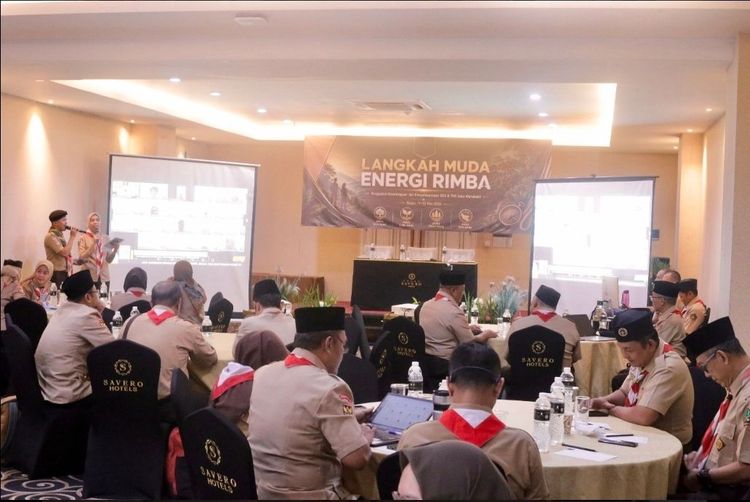
Enviro News Asia, Bogor — Saka Wanabakti continues to strengthen its role as a platform for developing adaptive, modern, and future-ready forestry youth through the Institutional Strengthening and Reform of Special Skill Requirements (SKK) and Special Skill Badges (TKK) program held in Bogor on 11–12 May 2026.
The hybrid event, organized by the National Leadership Secretariat of Saka Wanabakti with support from Project Leverage, brought together 240 participants from the Gerakan Pramuka National Headquarters, Saka Wanabakti National Leadership, units within Indonesia’s Ministry of Forestry, regional coordinators, technical teams, and various stakeholders involved in forestry youth development.
Acting Head of the Forestry Human Resources Extension and Development Agency, Indra Exploitasia, emphasized that reforming the SKK and TKK framework had become an urgent necessity in line with rapid developments in the forestry sector.
“The current SKK and TKK guidelines were developed more than twenty years ago, while the forestry sector has evolved significantly. We are now entering the Forestry 4.0 era, which demands forestry youth with stronger competencies, practical skills, leadership, and adaptability to technological advancements,” he stated.
Head of the Center for Forest Conservation Youth Development and Secretary General of the National Leadership of Saka Wanabakti, Luckmi Purwandari, said the initiative aimed to formulate a more relevant, applicable, and forward-looking SKK and TKK framework aligned with the needs of today’s forestry generation.
On the first day, participants received scouting and organizational management training from representatives of the National Scout Movement Headquarters. Discussions focused on strengthening the direction of Saka Wanabakti development, institutional strategies, scouting principles, and adaptive training programs that respond to youth development trends and current environmental challenges.
On the second day, discussions centered on transforming the SKK and TKK framework through a Triple Track Path approach covering eco-preneurship, specialist professional competencies, and volunteerism. The approach is expected to produce Saka Wanabakti members who not only understand forestry concepts theoretically but also possess applied competencies, professional competitiveness, green entrepreneurship skills, and strong social and environmental awareness.
Participants were divided into four Forest Innovation Teams based on Saka Wanabakti divisions: Krida Tata Wana, Krida Bina Wana, Krida Reksa Wana, and Krida Guna Wana. Assisted by technical experts, each team evaluated, revised, merged, and proposed new SKK and TKK models suited to current forestry development needs.
The technical presentations also highlighted the importance of shifting the learning paradigm from merely “knowing” toward “creating impact” through practical, innovation-based, and problem-solving approaches in the field. The redesigned SKK framework is expected to deliver measurable outcomes connected to employment opportunities, community service, and green economy development.
The forum additionally discussed the development of national standards for training methods, program duration, assessment rubrics, and competency certification mechanisms to ensure more measurable and adaptive forestry youth development systems.
Through this initiative, Saka Wanabakti is expected to transform into a more modern, collaborative, adaptive, and impactful forestry youth development system capable of supporting sustainable forestry development and forest conservation efforts across Indonesia. (*)