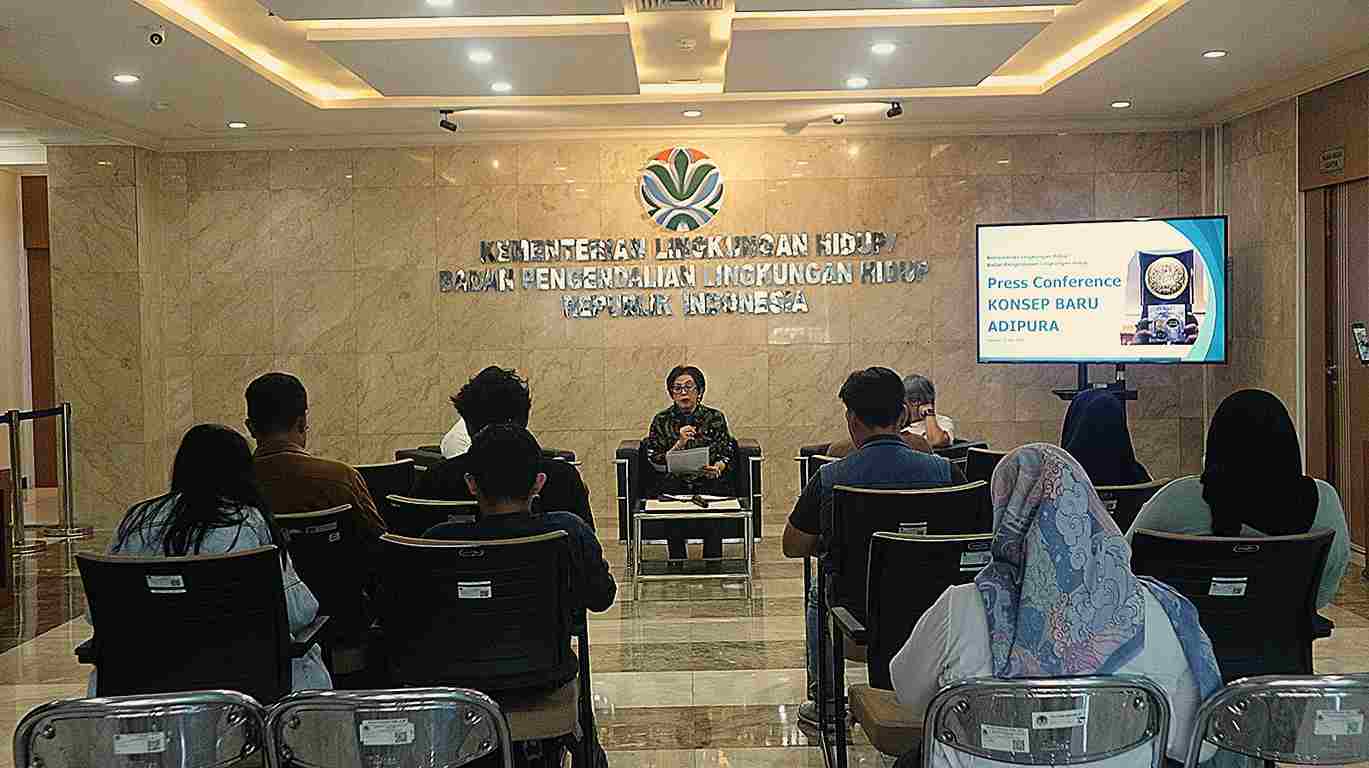
Enviro News Asia, Jakarta — The Ministry of Environment/Environmental Management Agency (KLH/BPLH) has officially launched a new assessment framework for the Adipura Program, a primary instrument for evaluating local government performance in waste management.
This transformation is a key component of the broader national environmental reform agenda and serves as a response to President Prabowo Subianto’s directive outlined in the National Medium-Term Development Plan (RPJMN) 2025–2029 to achieve 100% proper waste management across Indonesia by 2029.
The Adipura Program is no longer merely a symbol of clean cities, but now serves as a strategic indicator of modern, equitable, and sustainable waste governance.
The assessment no longer focuses solely on urban aesthetics but is based on three fundamental dimensions: waste management and cleanliness systems (50%), regional budgeting and policy (20%), and the readiness of human resources (HR) and supporting infrastructure (30%).
This new concept places significant emphasis on waste reduction at the source, strengthening community roles, and implementing more progressive sorting and recycling systems.
“Adipura is no longer just an award, but a tool for transformation. Cities that fail to make progress will be openly labeled as Dirty Cities. This is not a punishment, but a strong warning that environmental neglect is a betrayal of the future,” stated Minister of Environment Hanif Faisol Nurofiq in his official statement.
As a concrete step, all cities and regencies are required to participate in a data-based assessment process monitored through technologies such as satellite imagery and aerial surveys.
Areas that still operate final disposal sites (TPA) using open dumping methods will automatically be excluded from Adipura classification.
Conversely, cities that allocate more than 3% of their regional development and expenditure budget (APBD) to waste management, have adequate human resources and facilities, and operate sanitary landfill-based TPAs equipped with leachate and methane gas processing systems will receive high incentives.
The new Adipura assessment process will begin in July with socialization efforts across all 38 provinces and 514 cities/regencies.
Technical guidance and mentoring phases will follow from August to October 2025, with field monitoring conducted from November 2025 to January 2026 using a combination of on-site data, aerial surveys, and remote sensing technology.
The official assessment will take place in January 2026, with results announced publicly in February 2026 through KLH/BPLH’s official channels.
During the 2025 National Coordination Meeting on Waste, attended by over 1,000 stakeholders, this new Adipura assessment was introduced as a strategic national policy.
The central government is also accelerating the revision of Presidential Regulation No. 35 of 2018 to expand the development of Waste-to-Energy (WTE) facilities, strengthen collaboration with industries, and build a resilient recycling supply chain as the foundation of a national circular economy.
To achieve the national waste management target of 51% by 2025, a fundamental transformation in governance and monitoring systems is essential.
The new Adipura assessment is part of the effort to correct policy direction, clarify regional responsibilities, and serve as a wake-up call for more than 343 open dumping TPAs still in operation to immediately cease outdated and polluting practices that violate environmental regulations.
However, the success of Adipura cannot be determined by local governments alone. Communities play a vital role in driving real change—from separating waste at home, supporting waste banks, to rejecting illegal dumping in their neighborhoods.
Active citizen participation will directly impact assessment scores, particularly in waste reduction at the source and community-based waste management systems. (*)