The Ministry of Forestry has reaffirmed its commitment to protecting Tesso Nilo National Park (TNTN) in Riau Province from all forms of illegal activities. This statement comes in response to growing public concern over the condition of the park, which serves as a critical habitat for endangered species such as the Sumatran elephant and tiger.
Sapto Aji Prabowo, Director of Area Conservation at the Directorate General of Natural Resources and Ecosystem Conservation (KSDAE), emphasized that there is no tolerance for encroachment, illegal logging, or forest land conversion within the TNTN area.
“We reiterate that there is no room for illegal activities in this nature conservation area. Firm actions will continue to be taken to restore, protect, and manage Tesso Nilo National Park,” he stated in an official release on Wednesday, June 12, 2025.
Established as a national park in 2004, TNTN spans 81,793 hectares and is known for its high biodiversity. However, the park is currently facing serious challenges.
According to recent data, only around 24% of the area—approximately 19,000 hectares—remains as natural forest. The rest has been converted into settlements and illegal oil palm plantations.
As part of concrete actions, the government has conducted joint operations with law enforcement authorities to prosecute individuals involved in forest destruction. These efforts include dismantling illegal huts, seizing heavy equipment, destroying illegal oil palm plantations, and arresting encroachers.
“We are also promoting ecosystem restoration. As of 2021, approximately 3,585 hectares have been rehabilitated through restoration programs, watershed rehabilitation, and forest recovery initiatives led by the TNTN management authority,” Sapto explained.
In addition to legal enforcement, the government is prioritizing community-based approaches. Active participation from both local and migrant communities is encouraged through capacity building and partnerships with local governments.
This approach is supported by the establishment of the Tesso Nilo Ecosystem Revitalization Team.
The government is also advancing a collaborative management model involving NGOs, academics, and other stakeholders.
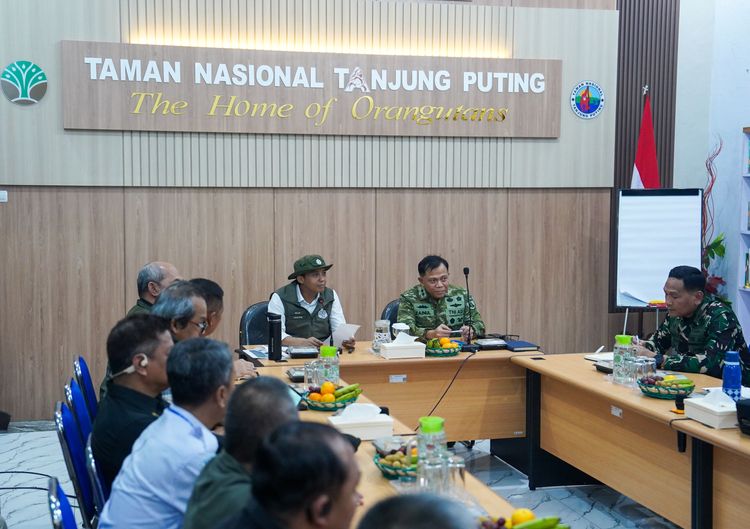
Furthermore, the central government has established a Forest Area Enforcement Task Force (Satgas PKH) through Presidential Regulation No. 5 of 2025.
The task force is chaired by the Minister of Defense, with the Deputy Attorney General for Special Crimes serving as Chief Executive. The task force is mandated to address violations, impose administrative fines, reclaim control over forest areas, and restore state assets within forest territories.
“Tesso Nilo is a vital symbol of Indonesia’s conservation efforts. We will continue to safeguard and restore this area through an integrated legal and social approach,” Sapto concluded.(*)