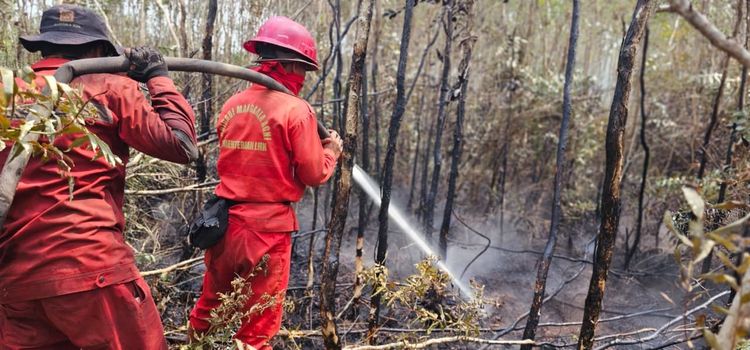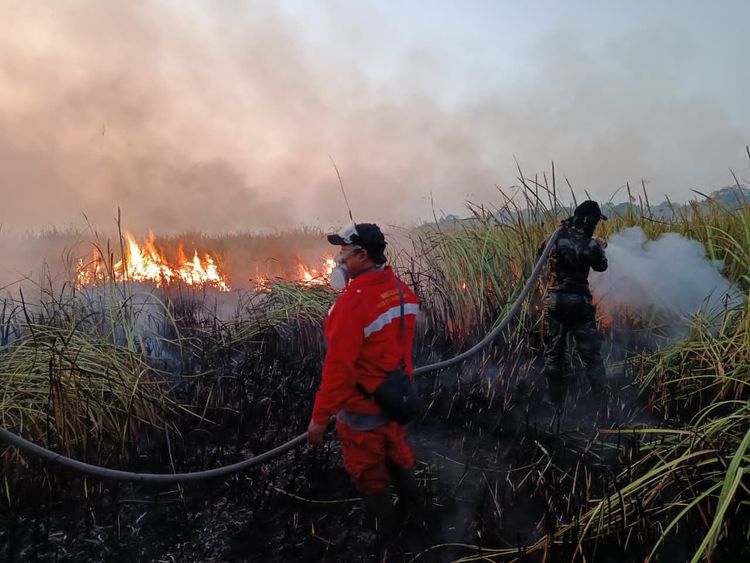
Enviro News Asia, Banjar — Indonesia’s Ministry of Forestry is continuing efforts to control forest and land fires (karhutla) in Banjar Regency, South Kalimantan, after peatland areas remained smoky despite the disappearance of visible flames.
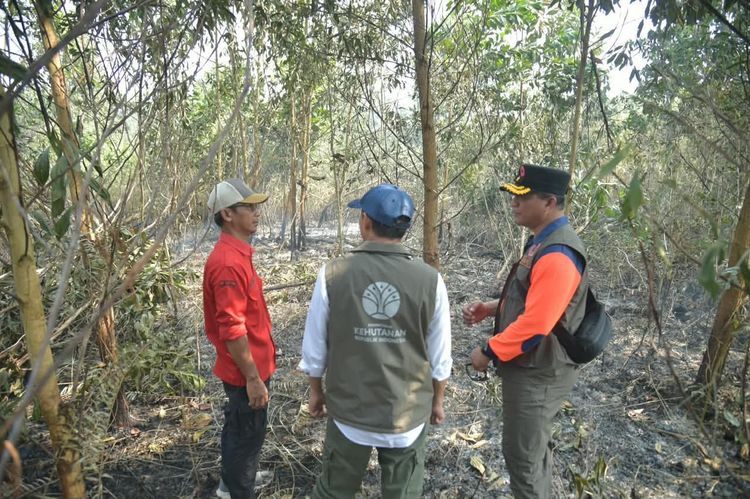
Forestry Minister Raja Antoni inspected the affected area in Penggalaman, Banjar, on Sunday, August 23. The burned area was estimated at around 36 hectares and is located outside a designated forest area bordering a protected forest.
The Minister said peatland fires require thorough treatment because fire can continue burning beneath the surface even after visible flames have disappeared. “Because this is a peatland area, there is no fire on the surface, but smoke is still coming from below. Therefore, the work must be carried out thoroughly to ensure that the fire does not re-emerge,” Raja Antoni said.
The situation remains challenging as South Kalimantan continues to experience dry conditions. Ministry data showed that the number of hotspots in the province fell sharply from 157 on August 21 to 11 at 9 p.m. on August 22. However, the number increased again to 44 hotspots at 6 a.m. on August 23.
The hotspots were detected across several areas, including Banjar Regency, Banjarbaru City, Hulu Sungai Selatan Regency, and Tapin Regency.
Raja Antoni attributed the previous decline in hotspots to joint firefighting operations involving ground forces and aerial support. Manggala Agni, the Indonesian Military (TNI), the National Police (Polri), regional disaster management agencies (BPBD), and the National Disaster Management Agency (BNPB) have been deployed to control the fires.
Aerial water-bombing operations have also played an important role. Authorities carried out 176 water-bombing sorties in a single day, which Raja Antoni said had proven effective in reducing hotspots across South Kalimantan.
Despite the decline, the Minister urged all stakeholders to remain vigilant as El Niño conditions are still affecting the country, with its peak expected in September. The continuing dry weather could increase the risk of renewed fires, particularly in peatland areas where underground combustion can persist even after surface fires have been extinguished.
The situation highlights the importance of maintaining ground patrols, monitoring hotspots and conducting post-fire cooling operations to prevent fires from reigniting. Effective coordination among government agencies, firefighting teams, security forces and local communities will remain essential as Indonesia enters the peak period of the dry season.
For Indonesia, peatland fire management requires not only rapid suppression but also continuous monitoring and prevention. Early detection, adequate water availability and sustained field operations are critical to preventing small fires from developing into larger environmental and public health emergencies. (*)