Enviro News Asia, New York — Civil society organizations and climate advocates have criticized the latest climate finance report released by the Organisation for Economic Co-operation and Development, arguing that developed countries remain far from meeting the real financial needs of developing nations facing escalating climate impacts.
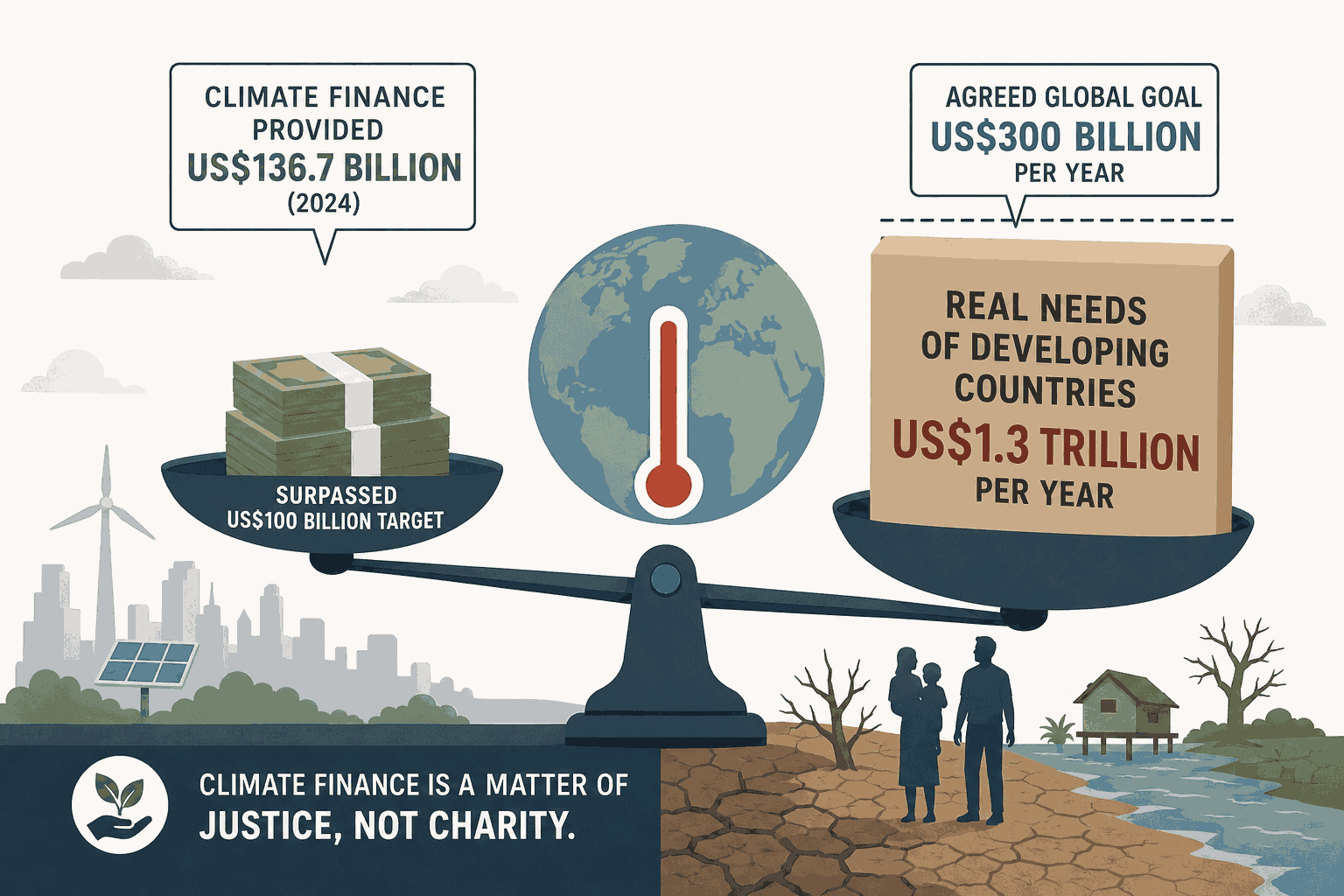
The report, published on May 21, 2026, stated that developed countries provided and mobilized approximately US$132.8 billion in climate finance in 2023 and US$136.7 billion in 2024, officially surpassing the long-standing US$100 billion annual climate finance target.
However, climate justice groups stressed that the figures remain significantly below the newly agreed global climate finance goal of US$300 billion per year and far below the estimated US$1.3 trillion required annually by developing countries to support mitigation, adaptation, and loss and damage responses.
The criticism comes amid growing geopolitical tensions and economic instability linked to the ongoing conflict in the Middle East, which observers say is further increasing financial pressure on vulnerable developing countries while reducing their capacity to invest in climate resilience.
Executive Director of Climate Action Network International, Tasneem Essop, said the OECD figures mask deeper structural problems in global climate finance.
“While developed countries technically exceeded the US$100 billion target, the numbers reflect accounting loopholes, donor escape routes, and continued dependence on loans and private finance rather than predictable public funding,” Essop said.
She emphasized that vulnerable countries urgently need grant-based and non-debt-creating climate finance instead of additional loans that could worsen debt burdens.
Several climate policy experts and civil society representatives from Africa, Asia, Europe, and Latin America echoed similar concerns, warning that adaptation finance remains severely underfunded despite intensifying climate impacts worldwide.
National Coordinator of Climate Action Network Zimbabwe, Wellington Madumira, said African communities continue to face worsening droughts, floods, food insecurity, and displacement despite contributing the least to global greenhouse gas emissions.
Meanwhile, Programme Officer at Centre for Science and Environment, Sehr Raheja, highlighted that most private climate finance continues flowing toward middle-income countries and mitigation projects rather than climate-vulnerable communities requiring adaptation support.
Executive Director of Sustainable Environmental Development Watch, Nobert Nyandire, argued that climate finance should be viewed as a matter of justice and historical responsibility rather than charity.
Climate organizations also criticized developed countries for simultaneously increasing military spending and cutting Official Development Assistance while claiming progress on climate finance commitments.
Representatives from organizations including CARE International, ActionAid International, Greenpeace International, and CAN Europe warned that continued reliance on loan-based financing risks undermining resilience efforts in climate-vulnerable regions.
Senior climate advocates further emphasized that developed countries remain off track in meeting commitments to scale up adaptation finance and adequately fund mechanisms addressing climate-related loss and damage.
Despite criticism, some policy analysts acknowledged that the increase in climate finance demonstrates that coordinated international action remains possible if stronger political commitment is maintained.
Senior Policy Advisor at E3G, Lily Hartzell, said achieving the future US$300 billion annual climate finance target by 2035 would require sustained collaboration, planning, and stronger commitments from wealthier countries.
The debate over climate finance is expected to remain central in upcoming international climate negotiations as developing countries continue pushing for more equitable, transparent, and accessible funding mechanisms to address the growing climate crisis. (*)