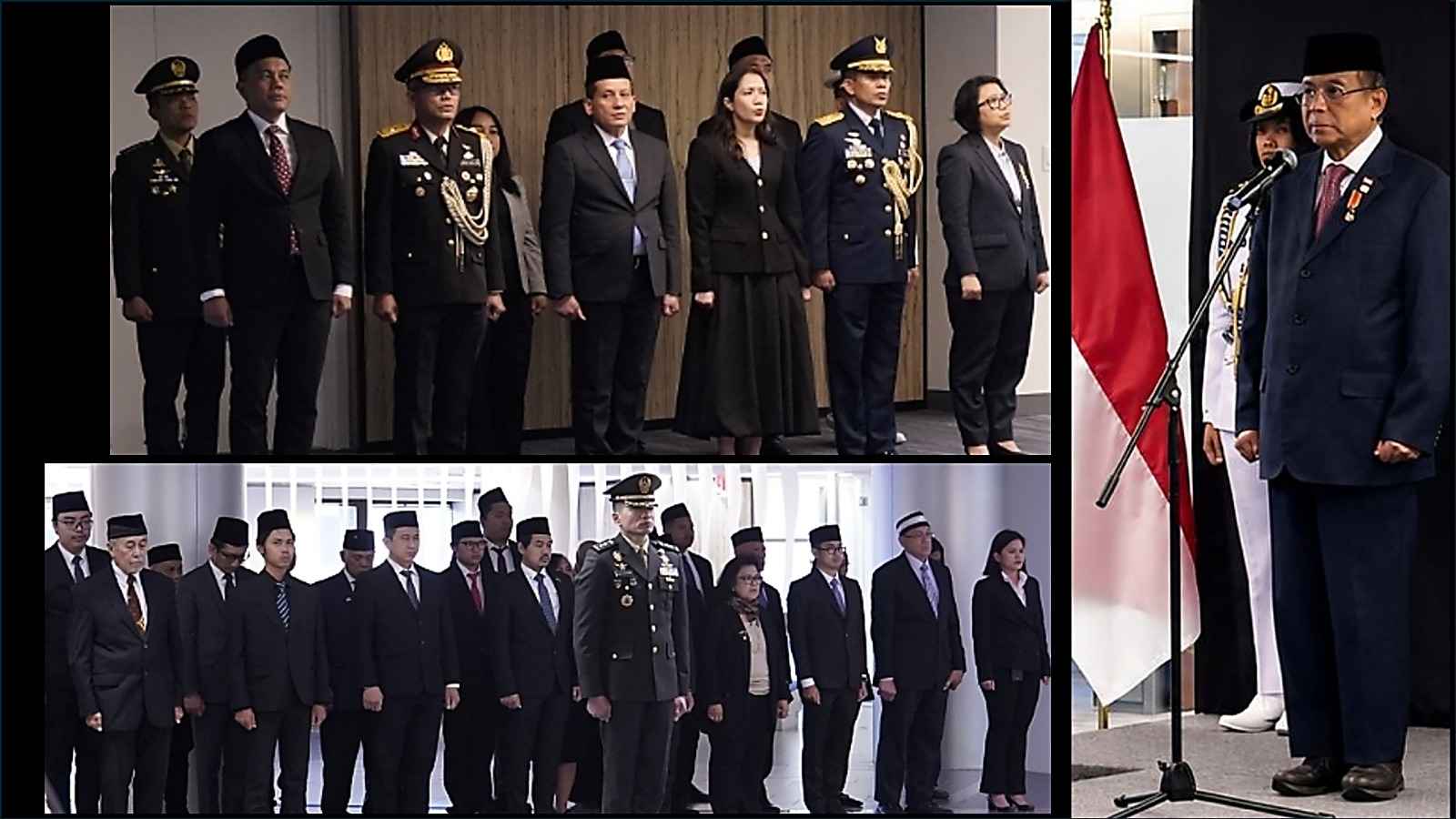
Enviro News Asia, Washington, D.C. — Indonesia’s Ambassador to the United States, Indroyono Soesilo, highlighted the enduring relevance of President Soekarno’s historic address on Pancasila before a Joint Session of the United States Congress at the Capitol in Washington, D.C., as Indonesia commemorated Pancasila Day on 2 June 2026 at the Indonesian Embassy in Washington.
Speaking before embassy officials and staff during the ceremony themed “Pancasila: Uniting the Nation, Foundation of World Peace,” Ambassador Indroyono recalled that Soekarno’s speech, delivered on 17 May 1956, received widespread attention and positive responses from the American public and media.
According to the Ambassador, an opinion article published by The New York Times on 20 May 1956 observed a shift in United States policy perspectives—from a strong emphasis on military concerns toward a more sympathetic understanding of Asian nationalism and economic development. The newspaper concluded that the United States should assist newly independent and non-aligned nations in strengthening their sovereignty without imposing political conditions.
Indroyono noted that despite Soekarno’s criticism of Western colonialism during the speech, American media outlets generally covered the address favorably, viewing it as a continuation of his longstanding anti-colonial stance. He also cited TIME magazine’s warm coverage of the event, including Soekarno’s statement to U.S. lawmakers:
“May I be frank? … We of Indonesia are in the stage of national turmoil through which America passed some 150 years ago. We ask you to understand.”
The Ambassador pointed out that the United States was celebrating the 180th anniversary of its independence in 1956, while in 2026 the country marks its 250th anniversary. He emphasized that the substance of Soekarno’s message remains highly relevant in contemporary international relations.
During the ceremony, Ambassador Indroyono also revisited the historical process that led to the birth of Pancasila. He explained that discussions on the philosophical foundation of the Indonesian state began during the first session of the Investigating Committee for Preparatory Work for Indonesian Independence (BPUPKI), held from 29 May to 1 June 1945 at the Chuo Sangi In Building, now known as the Pancasila Building of the Ministry of Foreign Affairs.
On 1 June 1945, Soekarno introduced five foundational principles that he named “Pancasila,” derived from the Sanskrit words panca (five) and sila (principles). To refine the concept, BPUPKI established the Committee of Nine, comprising Soekarno, Mohammad Hatta, Abikoesno Tjokrosoejoso, Agus Salim, Wahid Hasjim, Mohammad Yamin, Abdul Kahar Muzakir, A.A. Maramis, and Achmad Soebardjo.
The committee subsequently drafted the Jakarta Charter on 22 June 1945, which further elaborated the state ideology. Following Indonesia’s proclamation of independence, the Preparatory Committee for Indonesian Independence (PPKI) formally adopted the final formulation of Pancasila on 18 August 1945 and incorporated it into the Preamble of the 1945 Constitution. At that stage, the first principle was revised to become “Belief in the One Supreme God,” a formulation that remains in effect today.
Concluding his remarks, Ambassador Indroyono called on participants to honor Indonesia’s founding fathers, independence pioneers, freedom fighters, and those who defended the nation’s sovereignty. He said their sacrifices laid the foundation for the continued existence and unity of the Republic of Indonesia. (*)