

Enviro News Asia, Houston — Indonesia’s state-owned energy company Pertamina has initiated a breakthrough effort to develop ethanol and sustainable aviation fuel (SAF) derived from urban waste as part of the country’s broader clean energy transition agenda.
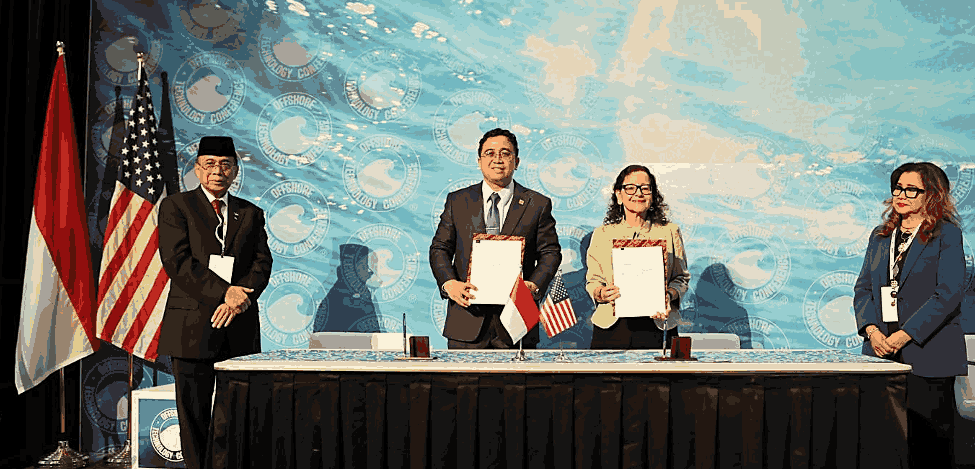
The initiative was marked by the signing of a technology cooperation agreement between Pertamina Vice President Director Oki Muraza and Jennifer Holmgren, President and CEO of LanzaTech Corp., during the Offshore Technology Conference 2026 in Houston on 5 May 2026.
The signing ceremony was witnessed by Indonesia’s Ambassador to the United States Indroyono Soesilo and Indonesian Consul General in Houston Ourina Ritonga.
The collaboration aligns with Indonesia’s Presidential Regulation No. 109 of 2025 concerning urban waste management through environmentally friendly renewable energy technologies. The regulation encourages the conversion of municipal waste into electricity, bioenergy, renewable fuels, and other derivative products.
Indonesia’s Minister of Environment Moh. Jumhur Hidayat has also identified waste management as one of the government’s priority programs, highlighting the urgency of developing sustainable waste-to-energy solutions.
Under the planned technology scheme, municipal waste will first be sorted and shredded before being converted into synthesis gas, or syngas. The gas contains carbon compounds such as carbon monoxide, carbon dioxide, and hydrogen. After purification, the syngas will undergo a fermentation process using specialized microbes capable of converting carbon gases into ethanol.
The process resembles conventional fermentation used in food and beverage production, but instead of fermenting sugar, the microbes metabolize carbon-rich gas generated from urban waste.
For Pertamina, the technology could open a new chapter in Indonesia’s biofuel development strategy. Currently, much of the country’s biodiesel production relies heavily on palm oil-based feedstock, with Indonesia already advancing toward a B50 biodiesel blend policy, where 50 percent of diesel fuel content comes from palm oil derivatives.
Waste-based ethanol is expected to provide an alternative and potentially more sustainable feedstock for future renewable fuel production while reducing dependence on conventional biofuel sources.
In addition to ethanol production, the technology also offers the potential to produce Sustainable Aviation Fuel, a lower-emission alternative to conventional jet fuel that is increasingly being adopted by the global aviation industry to reduce carbon emissions.
The initiative reflects Indonesia’s growing efforts to transform urban waste from an environmental burden into a strategic energy resource that supports circular economy development, renewable energy expansion, and the country’s long-term net-zero emissions target. (*)