Enviro News Asia, Jakarta — PT PLN Energi Primer Indonesia (PLN EPI) is exploring decentralized waste management as a way to turn municipal waste into energy and other value-added products while supporting a circular economy.
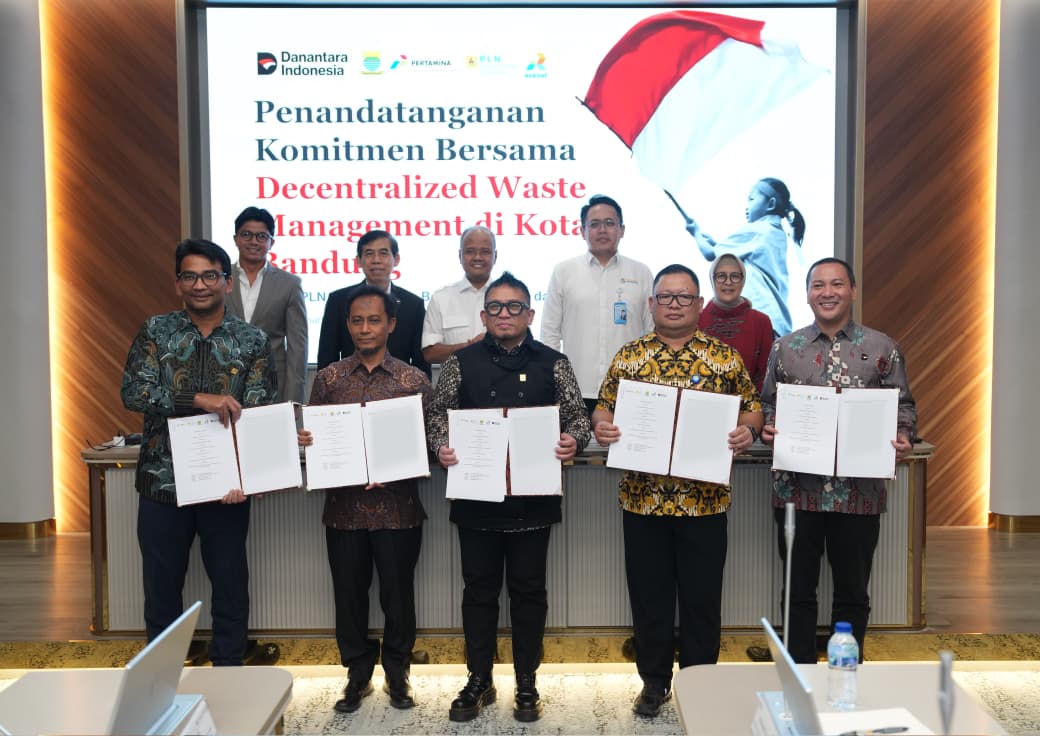
PLN EPI, PT Danantara Development Management Fund (DDMF), PT Rekayasa Industri (Rekind), PT Pertamina Power Indonesia (PNRE), and the Bandung City Environmental Agency signed a joint commitment to develop a Decentralized Waste Management (DWM) model in Bandung.
The signing took place at Wisma Danantara Indonesia in Jakarta on September 14, 2026, and was witnessed by representatives of the Indonesia Investment Authority (BPI Danantara). The agreement marks an initial step toward assessing the potential for decentralized waste management through coordination, technical studies, site identification and evaluation.
The initiative aims to process waste closer to its source while exploring opportunities to convert processed waste into energy and other products with economic value.
M. Rachmat Kaimuddin, Managing Director of Development Investment at DDMF, said the initiative should move beyond studies toward field implementation. Bandung is among the initial locations being prepared to test the decentralized model before potential replication in other regions.
“Waste management cannot be addressed only through discussions and studies. It must be demonstrated through implementation in the field,” Rachmat said.
The joint commitment covers the identification of waste management challenges, needs and priorities in Bandung, as well as assessments of alternative processing technologies.
The parties will evaluate technical, environmental, social, economic, commercial, financial, legal, institutional and governance aspects. They will also identify potential sites based on land readiness, accessibility, utilities, spatial planning and environmental conditions.
The assessment will examine waste sources, volumes, characteristics, continuity, transportation and supply mechanisms. The parties will also explore potential uses and markets for the resulting products.
PLN EPI will serve as a prospective buyer or off-taker of products generated through the DWM system. The company will provide indicative product requirements and specifications and conduct initial assessments covering technical characteristics, quality, quantity, continuity, logistics and potential use within the primary energy supply chain.
PLN EPI Biomass Director Hokkop Situngkir said the DWM initiative aligns with the company’s efforts to expand the use of waste-based energy resources.
PLN EPI has been developing a biomass supply chain to support partial fossil fuel substitution in power generation through co-firing.
“At PLN EPI, we substitute fossil-based materials with bio-based materials to support our energy needs through co-firing,” Hokkop said.
PLN has used approximately 2.5 million tonnes of biomass over the past year, with around 99 percent sourced from agricultural waste. Indonesia’s agricultural waste potential is estimated at approximately 80 million tonnes annually, indicating substantial opportunities to convert waste into energy and other value-added products.
“Of the potential we have presented, we have only deployed 2.5 million tonnes. Our agricultural waste potential can reach around 80 million tonnes per year,” Hokkop said.
The biomass ecosystem also involves businesses across various regions. PLN EPI currently has approximately 180 active contracts within its biomass supply chain, with around 60 percent involving young entrepreneurs.
BPI Danantara Chief Technology Officer Sigit Puji Santosa said DWM is intended to complement rather than replace centralized waste-to-energy (WTE) facilities.
“WTE is centralized to utilize energy, while this is decentralized waste management. It does not replace WTE; it is complementary,” Sigit said.
The decentralized model could be applied in areas that lack the economic scale or other conditions required to support large-scale WTE facilities. Processing waste closer to its source could also reduce the need to transport waste over long distances.
For the initial Bandung development, the model will involve four Waste Management Centers, or Sentra Waste Management (SWK). Each center is projected to process approximately 300 tonnes of waste, giving the four centers a combined potential capacity of around 1,200 tonnes.
“The four SWKs can process 1,200 tonnes. This is what we will implement,” Sigit said.
Sigit said the parties are targeting the development of one or two DWM locations by December 2026 or January 2027, with Bandung among the priority locations. The initiative could subsequently expand to four or five locations.
The proposed DWM ecosystem will cover the entire process from upstream to downstream, including waste sorting and feedstock supply, processing technology, utilization of processed products, and the development of cooperation and financing models.
However, the joint commitment remains an initial development stage and does not constitute a final decision to construct a project. The parties will first conduct studies, identify locations, test concepts and technologies, and develop cooperation models before moving toward implementation.
For PLN EPI, the initiative could expand the use of waste-based energy while contributing to waste management through a circular economy approach.
By returning waste to the value chain as a resource and energy source rather than treating it solely as residual material, the initiative could connect waste management with energy security and sustainable environmental development. (*)