Enviro News Asia, Tangerang — PT PLN Energi Primer Indonesia (PLN EPI) is developing a village-based biomass ecosystem through its BIODES innovation to strengthen sustainable biomass supplies for coal-fired power plants using cofiring technology.
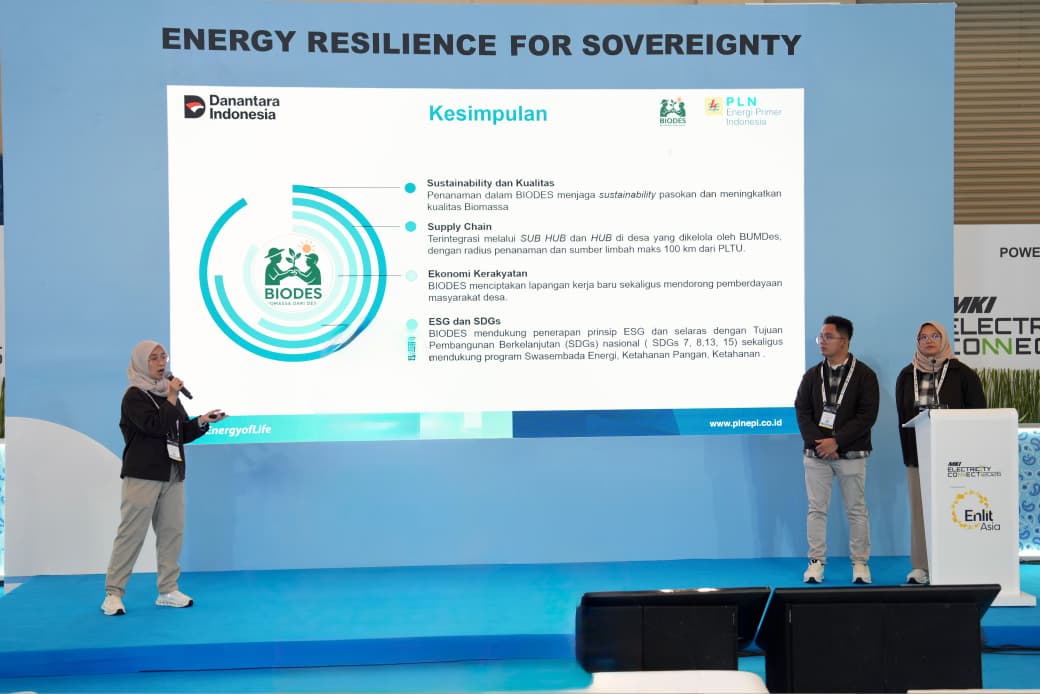
The company presented BIODES, or Biomass from Villages, at the Knowledge Hub Enlit Asia MKI Electricity Connect 2026 at the Indonesia Convention Exhibition (ICE) BSD City, Tangerang, on September 29, 2026.
BIODES integrates village biomass resources, integrated agriculture, community empowerment and supply-chain management. Under the model, villages serve not only as sources of raw materials but also as active participants in biomass production and distribution involving farmers, village-owned enterprises (BUMDes), suppliers and power plants.
The initiative responds to challenges in securing sufficient and sustainable biomass supplies for the cofiring program. Based on 2022 data from the Ministry of Energy and Mineral Resources used in developing BIODES, readily available waste-based biomass has limitations in both volume and supply continuity. Its potential is estimated to reach a saturation point at around 2.4 million tons, while the 2025–2034 Electricity Supply Business Plan (RUPTL) still requires an estimated additional 7.6 million tons to meet its cofiring targets.
PLN EPI Corporate Secretary Mamit Setiawan said BIODES forms part of the company’s effort to build a sustainable biomass ecosystem by optimizing resources available at the village level.
“BIODES is a manifestation of PLN EPI’s commitment to building a biomass ecosystem that not only meets energy needs but also creates added value for communities and the environment,” Mamit said.
Through BIODES, PLN EPI has developed six main approaches: optimizing village biomass resources, planting energy crops through intercropping, developing spoke-hub-based supply chains, improving biomass quality and quantity, introducing marketplace-based digitalization, and integrating villages with industry.
Khalda Az Zahra, Biomass Strategy and Business Development Officer at PLN EPI and a member of the BIODES team, said the initiative does not rely solely on existing agricultural, plantation and forestry waste.
The model also promotes productive energy crops integrated with food crops through intercropping, allowing biomass supply development to operate alongside economic benefits and food security for rural communities.
PLN EPI began implementing BIODES in Cilacap Regency in 2023 on 106 hectares of land. The program has progressed through several stages, including surveys and community outreach, integrated farming, harvesting and collection at sub-hubs, biomass production through BUMDes, and delivery to the Adipala coal-fired power plant.
The company is also using digitalization to integrate the biomass supply chain.
Under the SUB-HUB and HUB model, biomass from multiple village-level sources can be collected, processed and consolidated before being transported to power plants. PLN EPI expects the model to improve logistics efficiency while maintaining biomass quality, quantity and supply continuity.
The company projects that BIODES could provide an additional 15,000 tons of biomass annually, involve around 330 farmers, utilize 106 hectares of marginal land and create 25 new jobs.
The program is also projected to increase the income of smallholder farmers by up to Rp100,000 per worker per day. From an environmental perspective, PLN EPI estimates that the initiative could contribute to reducing greenhouse gas emissions by approximately 6,750 tons of CO2 equivalent while supporting Indonesia’s net-zero emissions target, energy self-sufficiency and food security.
The benefits of energy-crop cultivation have already been experienced by communities participating in BIODES implementation in Cilacap. Keleng Village Head Arsidi said energy crops could provide an alternative source of income when yields from major agricultural commodities decline.
He cited irregular weather and a corn crop failure in 2026 as examples, saying the cultivation of gliricidia (gamal) and kaliandra had provided additional income for residents during the lean season.
PLN EPI plans to replicate BIODES in other regions based on local biomass potential and geographic characteristics. Following its initial implementation in Cilacap, the roadmap includes expansion to villages in Central Java, West Java and East Java, followed by cooperation with supplier partners outside Java and wider deployment at coal-fired power plants using cofiring.
The company aims to gradually expand the model to as many as 100 villages, strengthening biomass supply while creating opportunities for businesses beyond electricity sales.
Through BIODES, PLN EPI seeks to position biomass not only as a partial substitute for coal in power generation but also as a driver of village-based economic development. The integration of agriculture, community empowerment, digitalization and energy demand is expected to create a more sustainable biomass supply chain while generating economic and environmental benefits.
PLN EPI said the innovation also supports its Environmental, Social and Governance (ESG) principles and contributes to the Sustainable Development Goals, particularly SDG 7 on affordable and clean energy, SDG 8 on decent work and economic growth, SDG 13 on climate action and SDG 15 on life on land. (*)