Enviro News Asia, Vienna — The International Atomic Energy Agency (IAEA) has expressed its support for Indonesia’s efforts to implement a national nuclear energy program, including preparations for the country’s first nuclear power plant.
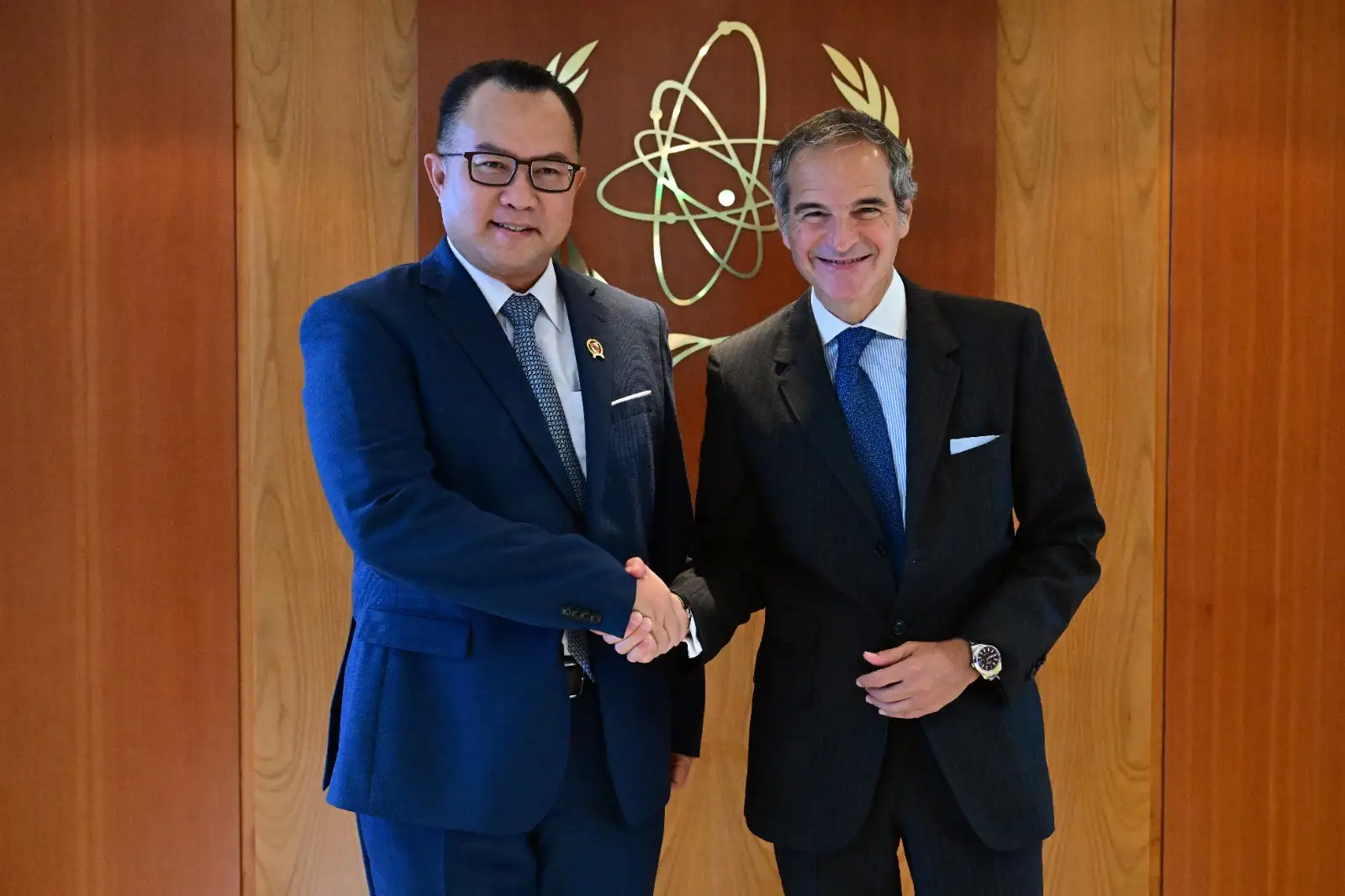
The support was discussed during a bilateral meeting between National Research and Innovation Agency (BRIN) Chairman Arif Satria and IAEA Director General Rafael Mariano Grossi on the sidelines of the IAEA General Conference in Vienna, Austria, on September 15, 2026.
Arif expressed appreciation for the IAEA’s continued support for Indonesia’s nuclear energy development and for the implementation of several IAEA flagship programs in the country, including NUTEC Plastics, Atoms4Food, Atoms for Net Zero and ATLAS.
“These programs have provided benefits for Indonesia as well as other IAEA member states,” Arif said.
He said the Indonesian government is strengthening various aspects of its national nuclear energy program, including preparations for the construction of its first nuclear power plant. The development is intended to support the country’s clean energy transition and its Net Zero Emission (NZE) target.
Several strategic areas require comprehensive preparation, including infrastructure development, feasibility studies for potential sites, human resource capacity, technology selection and procurement planning in line with international standards.
Against this backdrop, Indonesia has formally requested IAEA assistance to support the implementation of its national nuclear energy program. The assistance is expected to include missions by experts from various IAEA technical departments to provide substantive and comprehensive input to Indonesian stakeholders.
Indonesia has also formally requested a follow-up mission under the Integrated Nuclear Infrastructure Review (INIR) program in 2027 to strengthen the country’s readiness for nuclear energy infrastructure.
Arif also highlighted the need to strengthen national human resource capacity, particularly in advanced nuclear reactor technologies, including Small Modular Reactors (SMRs) and large-scale nuclear reactors.
Grossi responded by expressing the IAEA’s commitment to prioritizing missions and technical assistance for Indonesia. The agency also offered to provide technically neutral assessments of commercial nuclear reactor technologies and their suitability for Indonesia’s development conditions and targets.
The IAEA said it would accompany Indonesia through the various stages of nuclear energy development, noting that Indonesia could serve as a reference for other countries in the region.
The agency also offered support through its SMR platform, which covers scientific development, operational aspects and nuclear safety requirements related to small modular reactor technologies.
Beyond energy, the IAEA expressed readiness to strengthen cooperation with Indonesia’s Ministry of Health through the Rays of Hope program. The initiative is expected to support capacity building in radiation oncology.
The IAEA also invited Indonesian practitioners to participate in scientific forums focusing on the development of radiation oncology in developing countries.
The bilateral meeting reaffirmed Indonesia and the IAEA’s commitment to strengthening cooperation in the safe, peaceful and responsible use of nuclear science and technology. The cooperation is also intended to support Indonesia’s national development agenda and clean energy transition.
Arif attended the meeting with Indonesia’s Ambassador to Vienna and Permanent Representative to the United Nations in Vienna, as well as representatives from BRIN, the Ministry of Energy and Mineral Resources (ESDM), the Nuclear Energy Regulatory Agency (BAPETEN) and state electricity company PT PLN (Persero). (*)