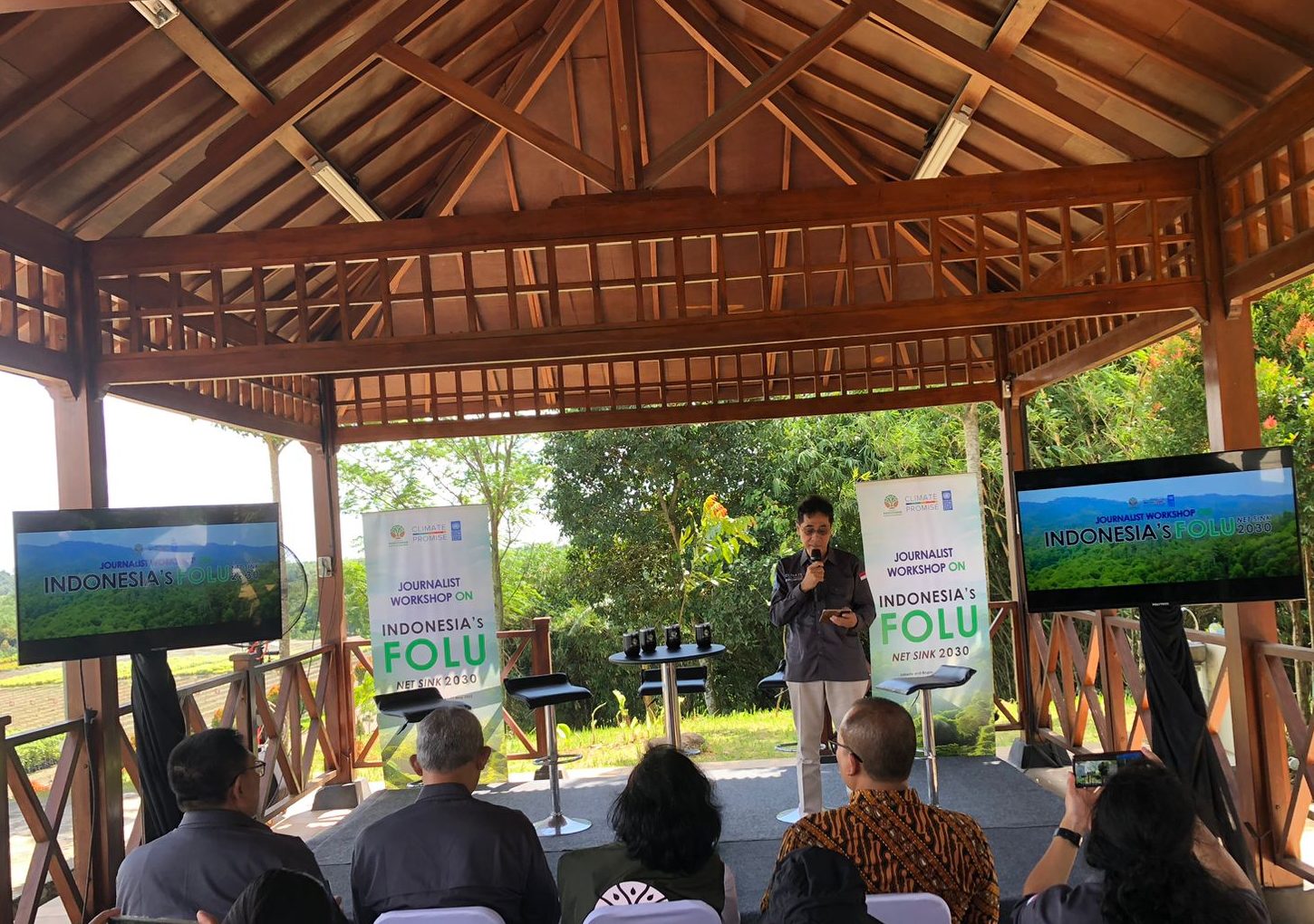
Enviro News Asia, Bogor – Dr. Agus Justianto, Senior Advisor to the Indonesia’s FOLU Net Sink 2030 Task Force, emphasized the critical role of journalists in ensuring the success of Indonesia’s major agenda to reduce greenhouse gas (GHG) emissions through the Forestry and Other Land Use (FOLU) sector.
In his remarks during the second day of the Journalist Workshop on Indonesia’s FOLU Net Sink 2030 held at the Rumpin Nursery in Bogor on Saturday (May 17, 2025), Agus stated that the success of the FOLU Net Sink 2030 agenda does not rely solely on government policies or technical support, but is heavily influenced by the ability to build widespread public understanding.
“Journalists are the bridge between complex policy and public comprehension,” said Agus. “Through strong and accurate narratives, the media can highlight inspiring stories from the field, portray existing challenges, and raise public awareness to engage in climate action.”
The FOLU Net Sink 2030 agenda represents Indonesia’s commitment to making the forestry and land use sector a net carbon sink by the year 2030. This means the sector is expected to absorb more GHG emissions than it releases, significantly contributing to the national emission reduction targets.
Key strategic actions under this agenda include forest rehabilitation, reduction of deforestation and forest degradation, improved land governance, and biodiversity protection.
The journalist workshop is part of a broader Positive Campaign for the FOLU Net Sink 2030, aimed at strengthening public communication through media. The initiative is a collaboration between the Ministry of Forestry, UNDP, and other development partners to deliver valid, transparent, and unbiased information to the public.
Agus emphasized that a positive narrative does not mean concealing challenges, but rather highlighting hope and encouraging collective behavioral change. “Collaboration is key. Government, civil society, the private sector, and the media must move in unison—not just sharing information, but also sharing responsibility,” he remarked.
He expressed hope that the workshop would mark the beginning of a long-term partnership between the Ministry of Forestry and the media in voicing efforts to reduce emissions and protect the environment.
“Protecting forests, restoring ecosystems, and reducing emissions isn’t just about saving the planet—it’s about saving life itself,” Agus concluded.
Meanwhile, Krisdianto, Head of the Public Relations and International Cooperation Bureau of the Ministry of Forestry, explained that one of the key pillars in achieving the FOLU Net Sink 2030 is forest restoration and rehabilitation. Therefore, the role of nurseries is highly strategic.
“The Rumpin Modern Nursery is a tangible manifestation of the government’s commitment to developing a well-planned, measurable, and sustainable system for producing millions of high-quality tree seedlings every year—whether for forest rehabilitation, reclamation of degraded land, or labor-intensive programs involving local communities,” he said.
Krisdianto expressed hope that the visit to the Rumpin Nursery would provide journalists with a deeper understanding of how technical work is closely connected to broader issues such as climate change, the green economy, and community welfare. *