

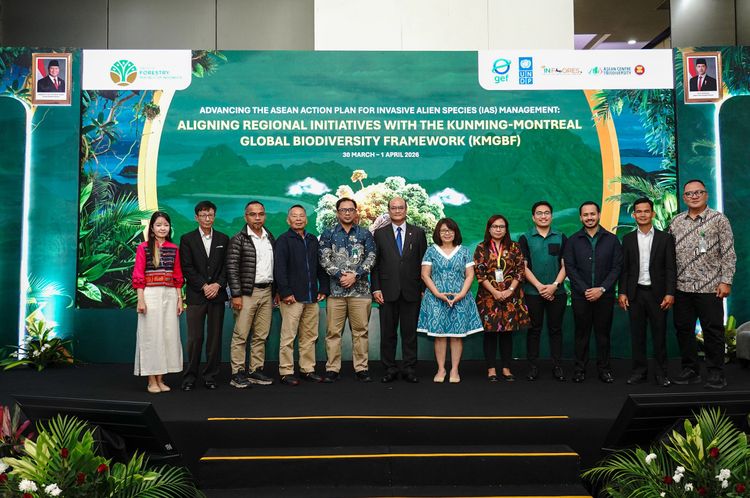
Enviro News Asia, Jakarta — ASEAN member states have agreed to accelerate efforts to control invasive alien species (IAS) through a new regional initiative, AIM-ASEAN (Accelerating IAS Management in ASEAN), following a three-day workshop held in Jakarta.
The initiative was developed through collaboration between the Ministry of Forestry of Indonesia, the ASEAN Centre for Biodiversity, the ASEAN Secretariat, and representatives from several ASEAN countries and Timor-Leste. The workshop aimed to align regional actions with the Kunming-Montreal Global Biodiversity Framework, particularly Target 6, which seeks to reduce the introduction and spread of priority invasive species by at least 50 percent by 2030.
The AIM-ASEAN project is designed to strengthen regional coordination, biosecurity systems, early detection mechanisms, technical capacity, and sustainable financing to address the growing threat of invasive species across the region.
During the workshop, participants agreed on six key components of the initiative: governance and coordination through the establishment of an ASEAN IAS Task Force; development of integrated data systems and early warning mechanisms; standardization of biosecurity and risk assessment protocols; capacity building through regional training and knowledge exchange; pilot implementation in selected sites, including Komodo National Park; and the development of sustainable financing strategies involving public, private, and international partners.
Officials emphasized that invasive species are a major driver of biodiversity loss, contributing to approximately 60 percent of global extinctions. For archipelagic countries such as Indonesia and other ASEAN members, the risks are particularly significant due to high ecological vulnerability and increasing regional connectivity through trade, transport, and tourism.
Participants also conducted a field visit to Muara Angke Wildlife Reserve, where they observed the impacts of invasive species on coastal ecosystems and discussed community-based management and restoration efforts.
The outcomes of the workshop will be followed by the finalization of the AIM-ASEAN Project Concept Note, which will be submitted to international funding mechanisms such as the Global Environment Facility and the Global Biodiversity Framework Fund.
The initiative reflects ASEAN’s collective commitment to protecting biodiversity, strengthening regional resilience, and ensuring effective, coordinated action against invasive species threats. (*)