Enviro News Asia, Sukabumi — Rohmat Marzuki conducted a working visit to Taman Nasional Gunung Halimun Salak (TNGHS) on April 7, 2026, to strengthen wildlife conservation and forest ecosystem protection in Java. During the visit, he officially named a newly hatched Elang Jawa “Garda Nusantara.”
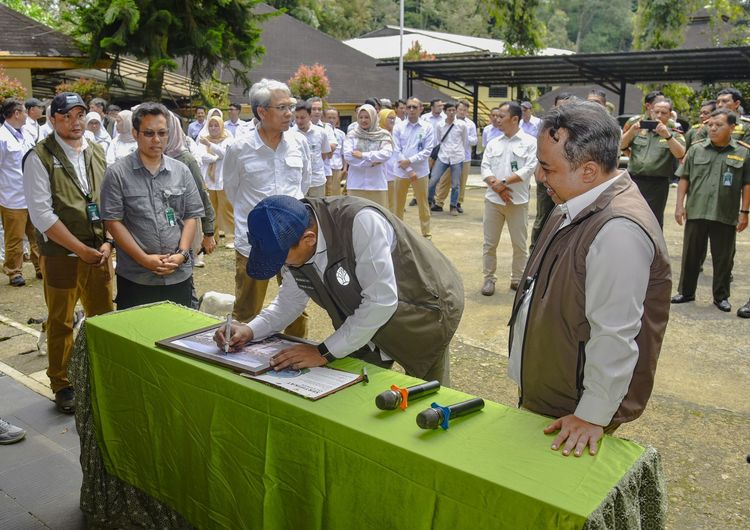
The naming ceremony began with a live observation of the bird through an online monitoring system at the TNGHS office. Following the observation, the vice minister formally recorded the name on a certificate, symbolizing the state’s commitment to protecting the species.
Rohmat stated that the name “Garda Nusantara” reflects the hope that the Javan hawk-eagle will serve as a guardian of Indonesia’s natural environment from the skies. He emphasized that the species represents more than wildlife, as it is closely associated with the Garuda, Indonesia’s national emblem.
He explained that the Javan hawk-eagle, as a top predator, plays a crucial role in maintaining ecological balance and serves as a key indicator of forest ecosystem health across Java.
The vice minister also highlighted recent research indicating an increasing population trend of the species across the island. The improvement has been supported by collaborative conservation efforts between the Ministry of Forestry and various environmental organizations, particularly in mountainous habitats such as TNGHS, which provide ideal nesting conditions due to the presence of tall trees.
He expressed optimism that strengthened protection measures in TNGHS will support continued population growth, with “Garda Nusantara” symbolizing the protection of Indonesia’s forests.
In addition to wildlife conservation activities, Rohmat carried out a tree-planting initiative by planting Durian Rancamaya seedlings at the TNGHS office. The activity underscores the importance of forest functions as life-support systems while promoting the utilization of local resources. (*)