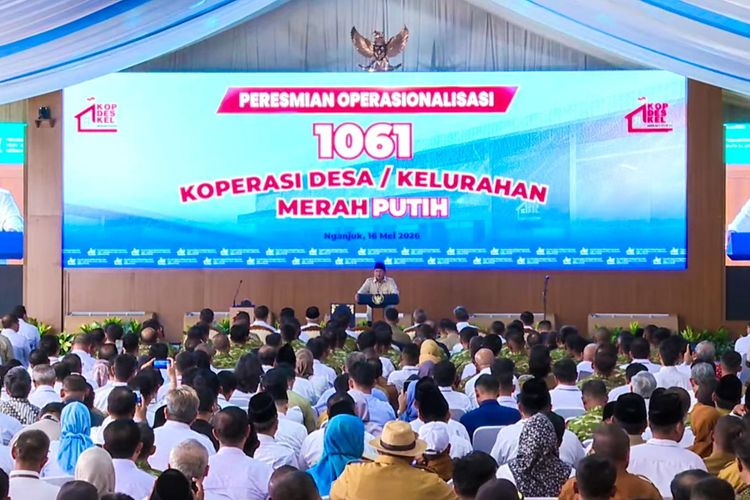
Enviro News Asia, Jakarta — President Prabowo Subianto officially launched 1,061 Village and Urban Cooperatives (Koperasi Desa/Kelurahan Merah Putih/KDKMP) in Nganjuk Regency, East Java, on Saturday, May 16, 2026, as part of a national effort to strengthen village-based people’s economy and community institutions through social forestry programs.
On the same day, the President also led the Second Quarter Simultaneous Corn Harvest in Bribin Hamlet, Tuwiri Wetan Village, Merakurak District, Tuban Regency, highlighting the government’s broader commitment to food security and rural economic empowerment.
“With the blessing of Bismillahirrahmanirrahim, on this Saturday, May 16, 2026, I, Prabowo Subianto, President of the Republic of Indonesia, officially inaugurate the operationalization of 1,061 Village and Urban Cooperatives Merah Putih,” the President declared during the symbolic inauguration ceremony.
President Prabowo stated that the cooperatives are expected to strengthen Indonesia’s rural economy and support village self-reliance. He also expressed optimism that at least 20,000 similar cooperatives could become operational by August this year.
Forestry Vice Minister Rohmat Marzuki, representing the Minister of Forestry, emphasized the forestry sector’s contribution to the strategic national program through the strengthening of Social Forestry Business Groups (Kelompok Usaha Perhutanan Sosial/KUPS).
According to the Ministry of Forestry, the KDKMP program aligns closely with the government’s efforts to transform social forestry institutions into stronger, more professional, and competitive community-based economic entities.
The ministry also highlighted the strategic role of social forestry programs in supporting national corn self-sufficiency through agroforestry practices, community-based corn production, and institutional strengthening of KUPS.
In East Java alone, social forestry programs currently involve 133,792 households across 198,326 hectares of land under 438 Social Forestry Decrees.
Previously, on December 23, 2025, the Ministry of Forestry and the Ministry of Cooperatives signed a memorandum of understanding aimed at strengthening cooperative institutions and human resource capacity in the forestry sector, particularly for KUPS development.
By the end of 2025, the Ministry of Forestry had granted social forestry management access covering more than 8.3 million hectares to communities surrounding forest areas through over 11,000 Social Forestry Decrees nationwide.
From these programs, more than 16,000 Social Forestry Business Groups have been established across Indonesia, generating national economic value exceeding Rp1.29 trillion.
Vice Minister Rohmat Marzuki stated that strengthening cooperatives is a strategic step to support downstream processing of social forestry products while improving the welfare of rural communities living around forest areas.
“Social Forestry not only provides communities with access to forest management, but also ensures that they possess strong economic institutions. The presence of Kopdes Merah Putih is expected to accelerate the transformation of KUPS into independent and modern business entities that create added value for local communities,” Rohmat said.
He added that cooperatives could play a critical role in strengthening business chains ranging from production and processing to marketing and financing access. The initiative also supports President Prabowo’s Asta Cita development agenda, particularly in strengthening rural economies, creating jobs, and promoting sustainable natural resource management.
The Ministry of Forestry expressed optimism that synergy between the Social Forestry Program and Kopdes Merah Putih would accelerate community-based green economic development while strengthening social and economic resilience in villages surrounding forest areas. (*)