Enviro News Asia, Arizona — Indonesia is strengthening international collaboration to accelerate the development of its semiconductor industry through strategic partnerships involving the Bandung Institute of Technology, Arizona State University, and Arm.
The initiative focuses on building Indonesia’s semiconductor ecosystem, including chip design development, talent cultivation, curriculum integration, and train-the-trainer programs for semiconductor assembly, testing, and packaging activities.
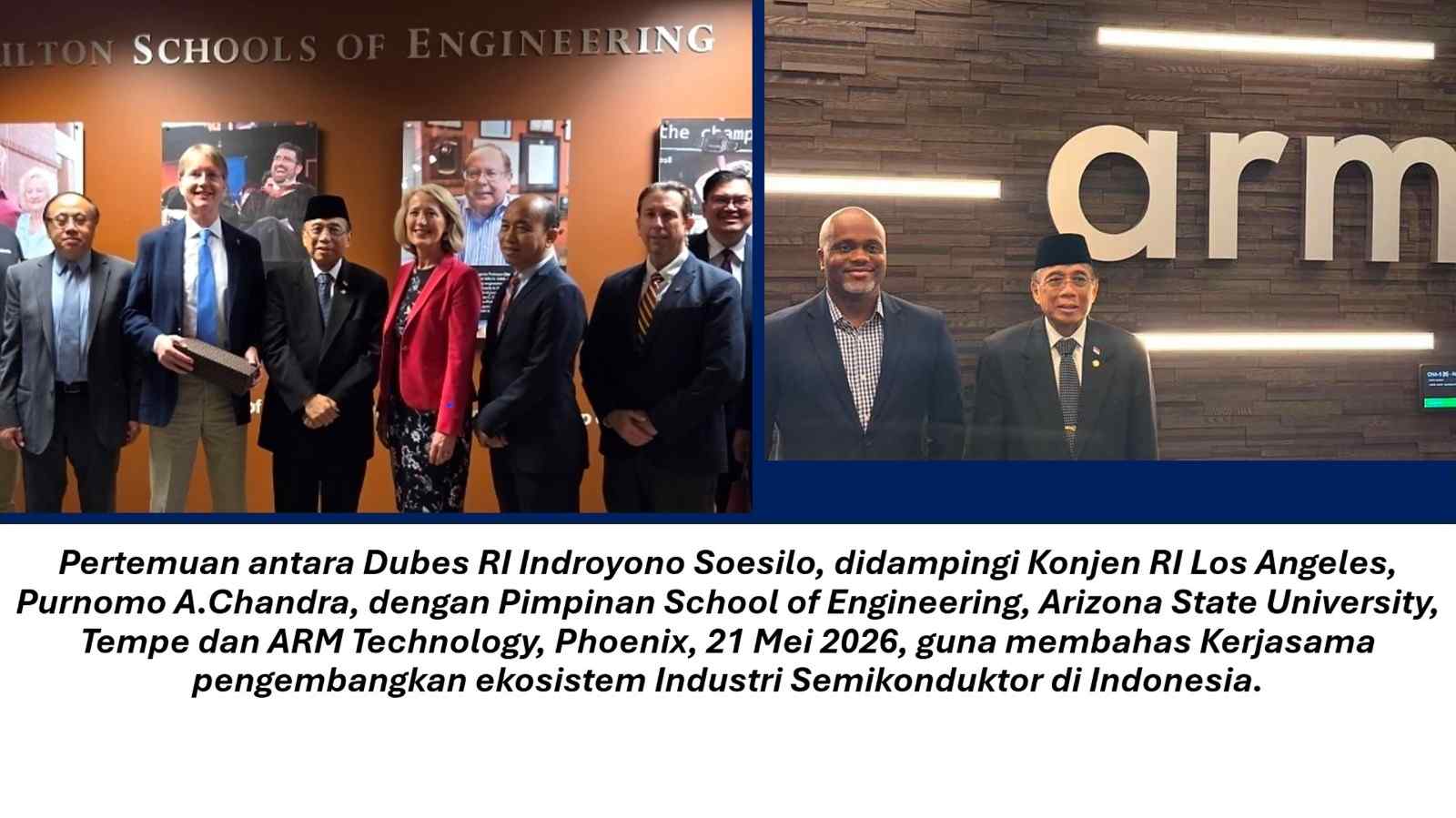
The collaboration was highlighted by Indonesian Ambassador to the United States Indroyono Soesilo following meetings with leaders of Arizona State University and Arm Technology in Tempe and Phoenix, Arizona, on May 21.
Under the partnership framework, the Bandung Institute of Technology (ITB) is expected to become Indonesia’s national hub for chip design and semiconductor talent development, supported by academic and industrial cooperation with ASU and Arm.
The collaboration includes curriculum integration, accelerated master’s programs, dual-degree initiatives, and joint semiconductor research projects aimed at strengthening Indonesia’s technological capabilities in the global semiconductor supply chain.
Arizona State University is recognized as one of the leading institutions supporting the United States semiconductor ecosystem under the implementation of the Global CHIPS Act. The university maintains strong partnerships with major semiconductor companies, including TSMC, Intel, Microchip Technology, and Arm.
The initiative also receives support from mining company Freeport-McMoRan, headquartered in Phoenix, Arizona, which has operated in Papua, Indonesia, for nearly six decades.
Through the ITB–ASU–Arm partnership, Indonesia aims to move beyond being solely a technology consumer and instead become a designer and creator of higher value within the global semiconductor industry.
At the technical level, ITB has established an IC Design Center focused on integrated circuit design and semiconductor talent development to produce microchips for applications ranging from ICT infrastructure to medical devices.
The university is also involved in downstream industrial studies related to silica processing into silicon wafers, which are considered essential for Indonesia’s future photovoltaic and semiconductor industries.
While ASU contributes educational expertise and global ecosystem support, Arm provides intellectual property and processor architecture capabilities that are expected to accelerate Indonesia’s semiconductor innovation ecosystem.
Semiconductors are critical materials used to produce chips, processors, memory systems, sensors, and solar panels that power modern digital technologies. The global semiconductor industry is valued at hundreds of billions of dollars and is projected to reach US$1 trillion by 2030.
Arizona has emerged as one of the major semiconductor manufacturing centers in the United States, driven by billions of dollars in federal and private investment for chip fabrication facilities.
Although Indonesia is not yet a major semiconductor producer, the country’s domestic semiconductor market is projected to reach approximately US$2.79 billion by 2025, with significant potential in assembly, testing, and packaging activities due to its large market, workforce availability, and strategic geographic location. (*)