Enviro News Asia, Denpasar — Indonesia’s Ministry of Forestry has uncovered an illegal elephant ivory trading network in Bali following a cyber patrol operation that monitored wildlife trafficking activities on social media platforms. The case, handled by the Directorate General of Forestry Law Enforcement (Gakkumhut), has now reached the prosecution stage after investigators completed the case file and secured a declaration of completeness (P-21) from public prosecutors.
The investigation began when the Cyber Patrol Team of the Forestry Law Enforcement Center for Java, Bali, and Nusa Tenggara detected Facebook posts advertising items suspected to be made from protected wildlife parts. Following digital surveillance and field verification, authorities conducted inspections in Tampaksiring, Gianyar Regency, on 14 April 2026, followed by a joint operation with the Bali Regional Police’s Civil Servant Investigator Supervisory Unit on 15 April.
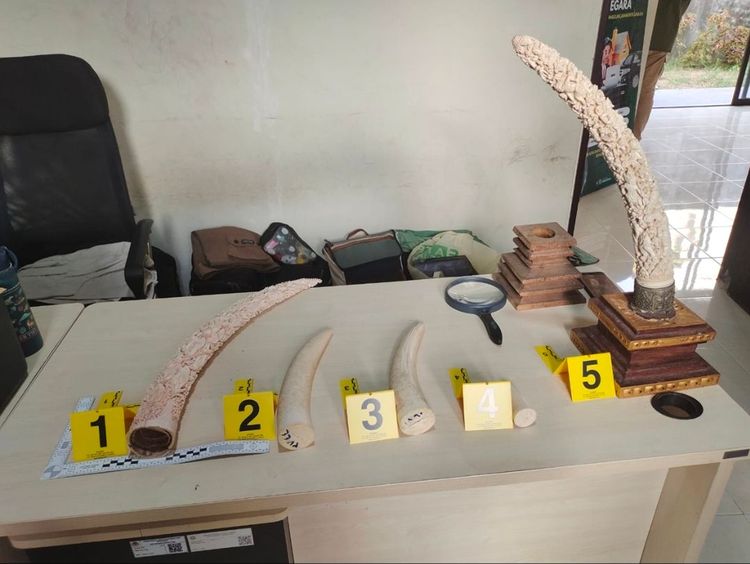
During the operation, officers seized a number of handicrafts, carvings, and decorative items believed to be made from elephant ivory. The evidence was collected from two locations in Gianyar and became a crucial element in proving that protected wildlife parts were still being traded in the form of souvenirs, collectibles, and artisanal products.
Based on the findings and subsequent investigation, authorities named an individual identified by the initials IKS as a suspect. Investigators also obtained court approval for the seizure of evidence and completed witness examinations, forensic assessments, and coordination with prosecutors before the case was declared ready for trial.
The suspect has been charged under Indonesia’s Law No. 32 of 2024, which amended Law No. 5 of 1990 on the Conservation of Biological Natural Resources and Ecosystems. The legislation prohibits the possession, storage, transportation, sale, and trade of protected wildlife specimens, body parts, or products derived from protected species.
Director General of Forestry Law Enforcement, Dwi Januanto Nugroho, emphasized that the case reflects Indonesia’s commitment to combating wildlife trafficking and protecting biodiversity.
“The trade in elephant ivory and other protected wildlife parts remains a serious threat to Indonesia’s natural heritage. As long as these products are viewed as valuable collectibles or decorative items, illegal hunting and trafficking will continue to find a market,” he said.
According to Nugroho, law enforcement efforts are not only aimed at prosecuting offenders but also at eliminating market demand and raising public awareness that protected wildlife should never be treated as commercial commodities.
Meanwhile, Head of the Forestry Law Enforcement Center for Java, Bali, and Nusa Tenggara, Aswin Bangun, noted that cases involving processed wildlife products require particularly careful investigation because the original biological material is often disguised as artwork, ornaments, or decorative objects.
“With the case file now complete, we are preparing to transfer the suspect and evidence to the public prosecutor. We also remind the public that protected wildlife parts remain illegal to trade, even when they have been transformed into carvings, souvenirs, or collectible items,” Bangun stated.
The Ministry of Forestry urged the public not to purchase, possess, collect, commission, or sell any products derived from protected wildlife species, including elephant ivory. Authorities also encouraged citizens to report any suspected wildlife trafficking activities, whether conducted in person or through online platforms, via official reporting channels. (*)