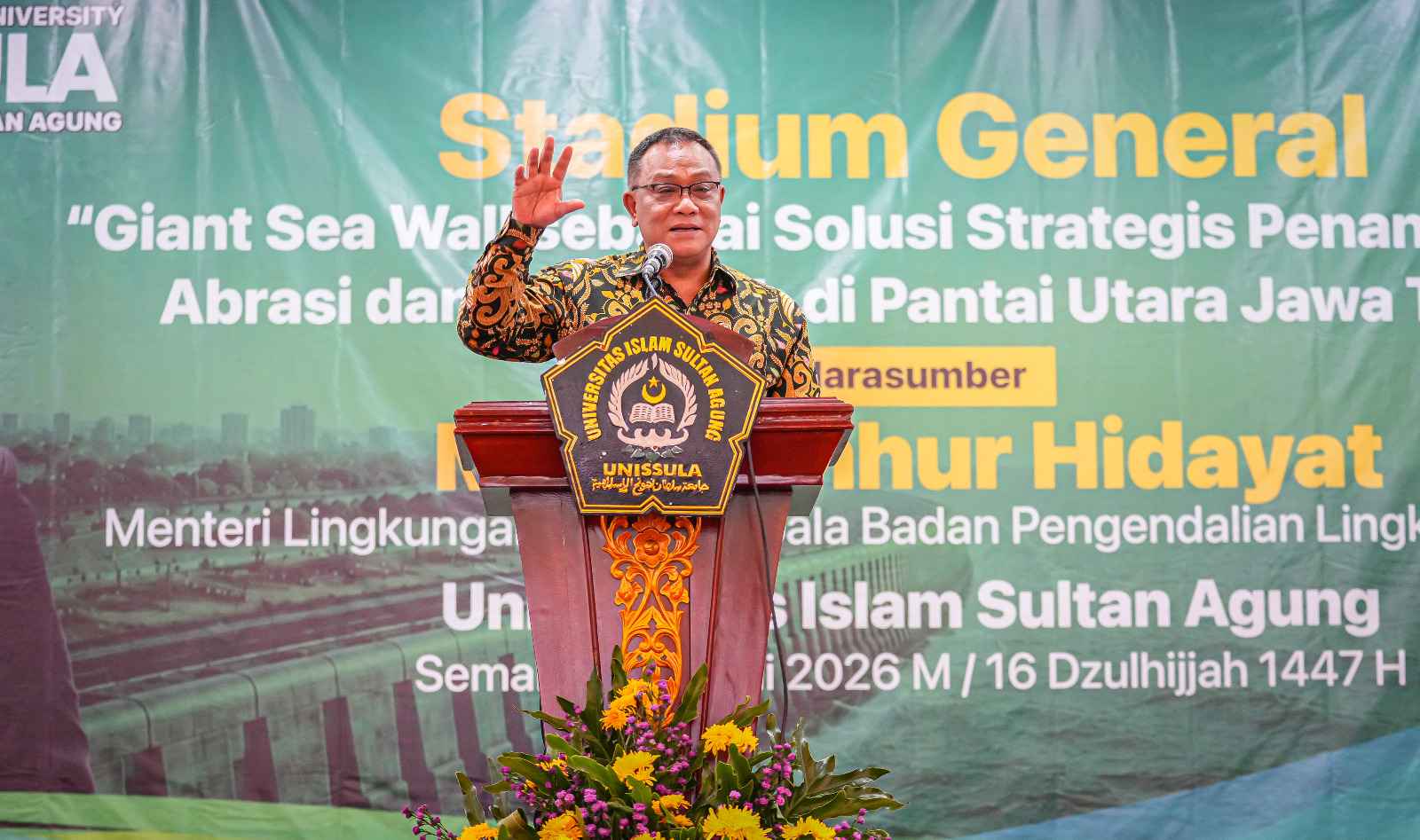
Enviro News Asia, Semarang — Indonesia’s Minister of Environment and Head of the Environmental Control Agency, Moh Jumhur Hidayat, has emphasized that the proposed Giant Sea Wall project along the northern coast of Central Java will only be effective if it is supported by comprehensive ecosystem restoration efforts, particularly mangrove rehabilitation and strict groundwater management.
Speaking during a public lecture at Sultan Agung Islamic University on 2 June 2026, Jumhur warned that coastal communities across the Pantura region are facing escalating threats from coastal erosion, tidal flooding, and land subsidence. These environmental pressures have already disrupted residential areas, industrial zones, ports, agriculture, and fisheries that underpin the regional economy.
According to the minister, the primary challenge is not solely rising sea levels but the rapid rate of land subsidence occurring in several coastal cities.
“Sea level rise is occurring at approximately 2.1 millimeters per year, while land subsidence in the Semarang–Demak area can reach between 0.01 and 0.15 meters annually,” Jumhur said. He noted that ground levels in some locations are sinking by as much as 10 to 15 centimeters per year, creating an urgent need for stronger intervention measures.
While describing the Giant Sea Wall as a strategically important infrastructure project, Jumhur stressed that it should not be viewed as a standalone solution. He cautioned that continued excessive groundwater extraction, poor spatial planning, and degradation of coastal ecosystems could undermine the wall’s long-term effectiveness.
To address these challenges, the Ministry is promoting a hybrid coastal defense approach that combines engineered infrastructure—including sea walls, pumping stations, and polder systems—with nature-based solutions such as mangrove restoration, estuary protection, groundwater regulation, and stricter land-use controls.
Jumhur highlighted the critical role of mangrove ecosystems in coastal protection, describing them as natural barriers that can significantly reduce wave energy while supporting biodiversity and local livelihoods.
“Mangroves are natural coastal defenses. Mangrove forests can reduce wave heights by 13 to 66 percent over a distance of 100 meters, while also restoring fish habitats and supporting coastal economies,” he said.
The minister also reaffirmed the government’s commitment to ensuring that all Giant Sea Wall developments comply with rigorous environmental safeguards. He stated that every project must undergo comprehensive Strategic Environmental Assessments (SEA) and Environmental Impact Assessments (EIA), supported by scientific evidence, transparent public participation, and protections for fishermen, fish farmers, women, and other vulnerable coastal communities.
“Giant Sea Walls can form part of the solution for protecting the northern coast of Java, but they must not become the only solution. Physical infrastructure must be integrated with groundwater control, mangrove restoration, spatial planning, strict environmental assessments, and protection of coastal communities,” Jumhur concluded.
The Ministry hopes that this integrated approach will not only reduce the risks posed by coastal erosion and tidal flooding but also safeguard the long-term economic sustainability of communities whose livelihoods depend on Indonesia’s coastal ecosystems. (*)