


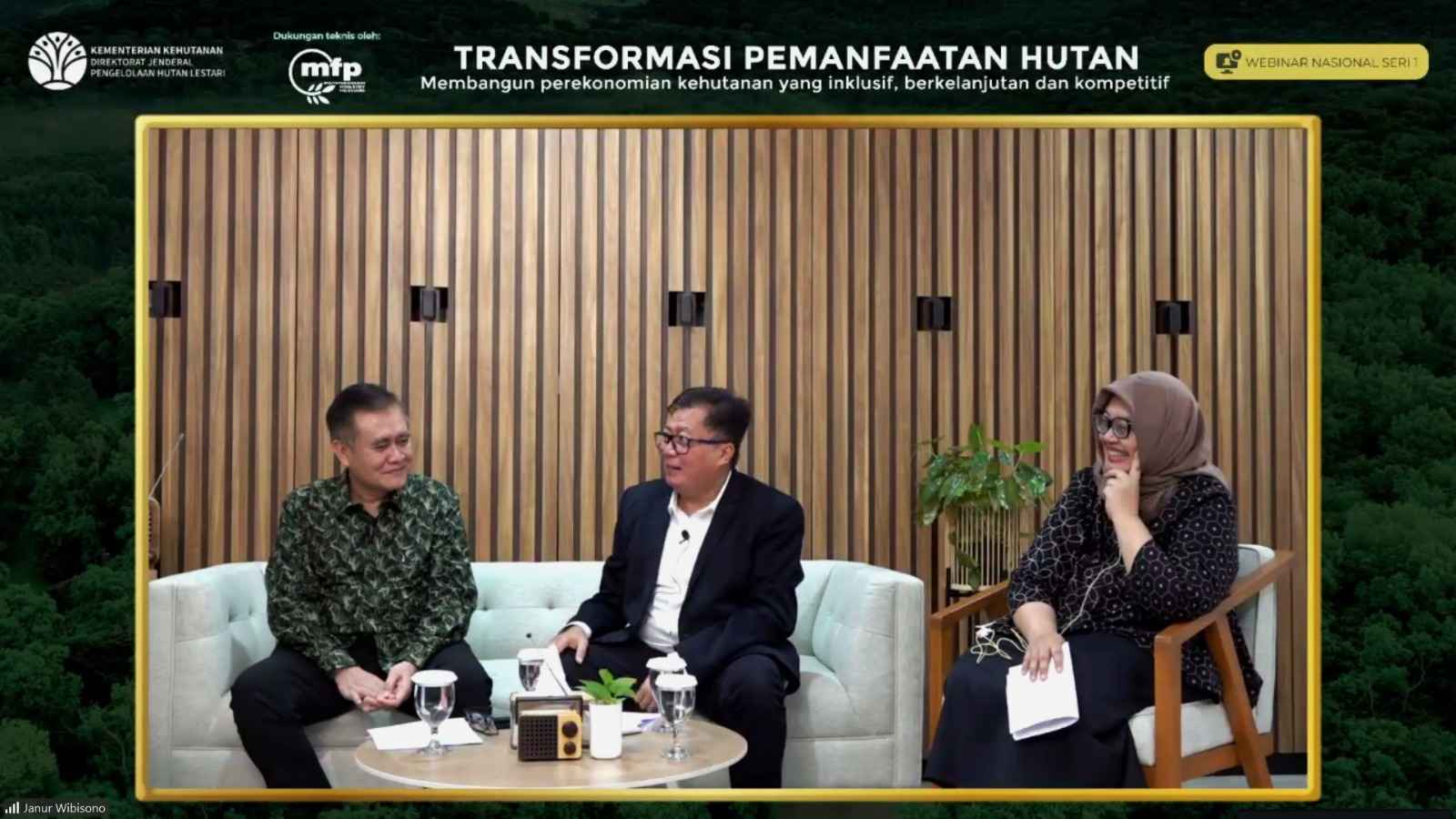
Enviro News Asia, Jakarta – The Ministry of Forestry, through the Directorate General of Sustainable Forest Management, has launched a national webinar series titled “Forest Utilization Transformation” running through June and July, as part of efforts to fundamentally reform the way the country’s forests are used. The first session, held on Thursday (6/18), focused on the urgency of improving operational policy to build a more inclusive, sustainable, and competitive forest economy.
The webinar serves as a key platform for public consultation on the revision of Environment and Forestry Ministerial Regulation No. 8 of 2021 on Forest Management and Forest Utilization Planning in Protected Forests and Production Forests, known as P.8. The revision is considered urgent to address the future challenges facing Indonesia’s forestry sector amid today’s rapidly shifting dynamics.
Director General of Sustainable Forest Management Laksmi Wijayanti said P.8 was issued as a derivative of the Job Creation Law, elaborated through Government Regulation No. 23 of 2021. The spirit of that law is to ensure that natural resource utilization creates an economy that absorbs labor while improving community welfare. After five years of implementation, she said, it is time to review whether it is operating as intended.
“The revision of P.8 will examine a range of cross-cutting issues, including area boundaries, overlaps, benefit distribution to communities, business operational procedures, investment ease, licensing, and markets. The revision will also fine-tune the Multi-Business Forestry (MUK) concept to improve its success rate. Forests must deliver high real benefits so that all parties are motivated to conserve them. The benchmarks are reduced degradation, increased income from forests, and reduced poverty in surrounding areas,” Laksmi said.
She added that Indonesia is currently in the midst of massive geopolitical shifts and must leverage the comparative advantage of its natural resources, with forests representing a vast and significant natural resource base, making the P.8 revision critical to responding to these dynamics.
The Ministry of Forestry stressed that forest utilization must be harmonious with and supportive of habitat restoration efforts, meaning that its implementing provisions must break existing deadlocks and reduce risks.
The session, moderated by senior journalist and communications specialist Rahma Alia, featured two respondents. Academic input was provided by the Dean of the Faculty of Forestry and Environment at IPB University, Prof. Dr. Ir. Dodik Ridho Nurochmat, M.Sc.F.Trop., IPU, while challenges and aspirations from the real sector were presented by Secretary General of the Indonesian Forest Entrepreneurs Association (APHI), Purwadi Soeprihanto.
Prof. Dodik underlined that the primary challenge in forest utilization is the still very low direct economic value of forests compared to other land uses.
“Currently, the direct economic value of forests stands at only around Rp 4 million per hectare per year, far below oil palm plantations, which reach around Rp 40 million per hectare per year, or ten times as much. This leads some parties to prefer converting forests to other, more profitable land uses,” Prof. Dodik explained.
He also stressed the importance of shifting the mindset on forestry non-tax state revenue from a commodity-based approach to an area-based one covering packages of forest utilization, which would encourage small-scale economic growth and reduce administrative burdens.
Purwadi said the heart of P.8 is multi-business forestry, representing the most significant departure from the previously timber-centric regulation. He said the spirit of multi-business forestry aligns with shifting global consumer demand toward regenerative products, and that it must encompass timber, non-timber forest products, and environmental services, grounded in considerations of economic scale, community and environmental benefits, and the Sustainable Development Goals.
“However, the implementation of regenerative MUK at the field level remains partial and fragmented. The utilization of non-timber forest products by license holders and communities is still small in scale, making it economically unviable. Distribution and logistics are also problematic because products are scattered across vast areas, resulting in high economic costs and uncompetitive market prices,” Purwadi explained.
He proposed a landscape approach as the solution, integrating multiple forest business permit holders, social forestry groups, village forests, small industries, vendors, and other parties within a single landscape. This approach is expected to generate aggregated products attractive to financing and easier to develop downstream, thereby accelerating the implementation of multi-business forestry.
Through this public consultation forum, the Ministry of Forestry has committed to absorbing all constructive input from stakeholders to ensure future forest utilization implementation runs optimally, accountably, and with real impact on the national economy.
The consultation series will run across 11 weekly thematic webinar sessions involving government, academics, business actors, civil society, regional governments, community groups, and other stakeholders, with technical support from the Multistakeholder Forestry Programme Phase 5 (MFP5).
“Revising P.8 is not merely revising a regulation, but transforming the paradigm of forestry governance from controlling activities through procedures and bureaucracy to governance based on trust, process simplification, digitalization, and shared responsibility among government, communities, and license holders,” Laksmi concluded. (*)