Enviro News Asia, Jakarta – New research has revealed a remarkable function of peat swamp forests that goes far beyond their well-known role as the world’s largest carbon stores. A study published in the international journal Climate Dynamics by Springer Nature in 2026 shows that peat ecosystems also function as natural steam engines that strengthen rainfall formation and help maintain climate stability in tropical regions.
Head of BRIN’s Center for Climate and Atmospheric Research Albertus Sulaiman, the study’s principal investigator, said the findings change the way the ecological functions of peat swamp forests are understood.
“This research shows that peat swamp forests are not only carbon warehouses, but also function like natural steam engines that strengthen land-sea wind circulation and help maintain the daily rhythm of rainfall in tropical coastal areas,” Albertus said.
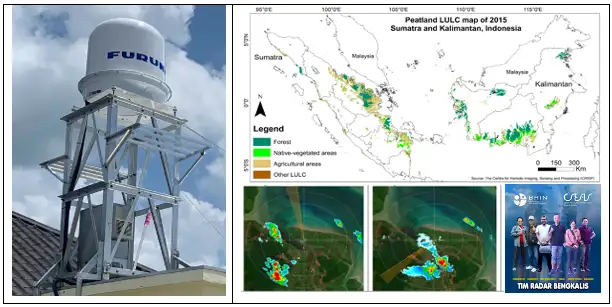
The research was conducted by a joint team from BRIN together with Kyoto University, Kobe University, Hokkaido University, IPB University, and GMIT Mongolia, with Bengkalis Island in Riau Province selected as the study site. The low-lying island was chosen because nearly its entire area is still dominated by natural peat swamp ecosystems, making it a natural laboratory for understanding the interaction between peatland and the atmosphere.
To obtain highly detailed data, the team installed a Japanese-made X-band polarimetric weather radar at the STAIN Bengkalis complex in February 2020, capable of mapping rainfall distribution every five minutes at a resolution of hundreds of meters within approximately 50 kilometers, a level of precision still rarely available in Indonesia.
Observations from May to December 2024 revealed highly consistent daily rainfall patterns. Rainfall in Bengkalis’s inland areas generally occurs in the afternoon, while coastal and marine areas experience rain from midnight to before dawn, reflecting a regularly operating land-sea wind circulation system.
To understand the cause, researchers developed atmospheric mathematical models using three different scenarios: a coastal area without an island; an area with an island and a strait; and a peat island area incorporating the influence of peat’s characteristic moisture. “Simulation results showed that the existence of Bengkalis Island creates simultaneous wind convergence from the sea and the strait, making rain cloud formation far stronger,” Albertus said.
He explained that the unique characteristic of constantly moist peatland generates large amounts of water vapor. When this vapor condenses into clouds, the latent heat released strengthens updrafts, drawing more moist air from the sea toward land, making atmospheric circulation stronger than in non-peat areas.
The findings also provide new scientific evidence for the concept of the biotic pump, a hypothesis that forests through evapotranspiration can help drive atmospheric circulation and influence regional rainfall distribution. Results in Bengkalis showed consistent patterns between theory, models, and radar observations.
Albertus said the research has major implications for peatland management policy. If peat is drained, cleared, or burned, the resulting damage goes beyond the loss of carbon stocks to also include the loss of its ecological function as a rainfall regulator.
“Protecting peat is not only about protecting carbon, but also about protecting rainfall. Peat degradation has the potential to disrupt regional hydrological cycles and in the long term could affect the stability of the tropical climate system,” he said.
The research team recommended direct measurement of latent heat flux in the field using the eddy covariance method and the incorporation of peat’s influence on rainfall formation into global climate models to improve rainfall prediction accuracy across Indonesia’s Maritime Continent. (*)