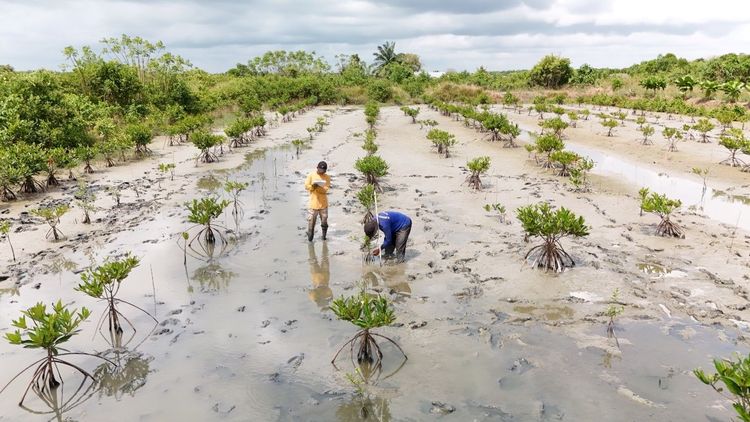
Enviro News Asia, Langkat – Indonesia’s Ministry of Forestry (Kemenhut), in collaboration with development partners and local communities, has restored 352.2 hectares of degraded mangrove ecosystem in the Karang Gading and Langkat Timur Laut Wildlife Reserve in North Sumatra, strengthening biodiversity conservation and coastal ecosystem resilience.
The restoration program, announced on July 27, is part of a long-term effort to rehabilitate the 14,827-hectare wildlife reserve, the only conservation area in North Sumatra that contains a mangrove ecosystem. The reserve provides critical habitat for protected species, including the Northern River Terrapin (Batagur borneoensis), dolphins, silvered langurs, Brahminy kites, white-bellied sea eagles, and numerous migratory birds, while also protecting nearby communities from coastal erosion and flooding.
The ecosystem has faced decades of degradation caused by illegal encroachment, shrimp and fish ponds, oil palm plantations, and settlements. By 2022, approximately 3,385 hectares, or 22.83 percent of the reserve, required ecological restoration.
Since 2023, restoration activities have been supported through cooperation between the Governments of Indonesia and Germany under the KfW Forest Programme VI. The initiative includes mangrove rehabilitation, habitat protection, community outreach, biodiversity monitoring, and SMART Patrol operations covering 15,000 hectares to strengthen law enforcement and identify conservation threats.
In 2024, restoration efforts included the removal of aquaculture ponds across 50 hectares, the clearing of 5,150 oil palm trees on 41 hectares, the planting of mangroves on 150 hectares, and the production of 360,000 mangrove seedlings. The program expanded in 2025 with the cultivation of more than 1.13 million mangrove seedlings, the removal of 10,125 oil palm trees across 81 hectares, and mangrove planting on an additional 202.2 hectares, bringing the total restored area to 352.2 hectares.
The Ministry said restoration activities have been carried out with the active participation of 19 local community groups and forest farmer associations, which support seedling production, planting, maintenance, and monitoring of the conservation area. Their involvement has strengthened community-based conservation while promoting sustainable ecosystem recovery.
Looking ahead, the Ministry plans to produce more than 1.12 million mangrove seedlings and restore an additional 398 hectares in 2026, including former oil palm plantations, abandoned fish ponds, and degraded open land. If completed, the total restored mangrove area under the 2024–2026 program will reach approximately 750 hectares.
The Ministry emphasized that the restoration initiative aims not only to recover mangrove habitats but also to enhance protection for endangered wildlife, improve conservation management, and strengthen the role of local communities in safeguarding one of Indonesia’s most valuable coastal ecosystems. (*)