

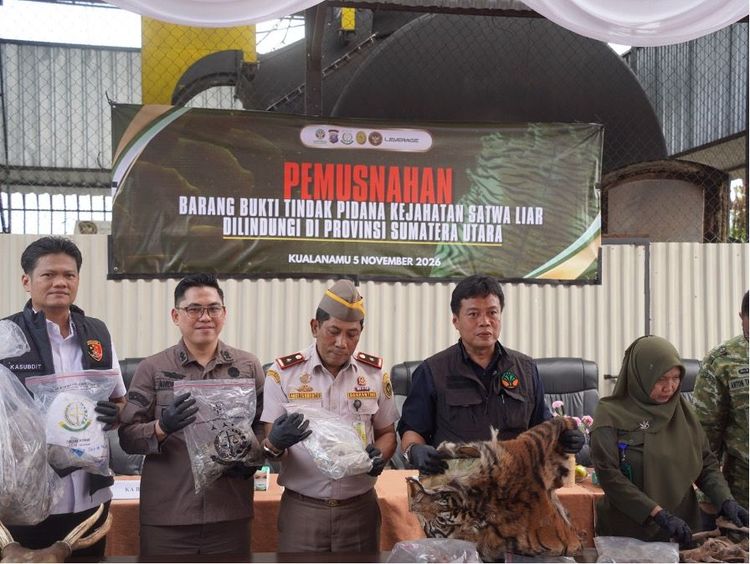
Enviro News Asia, Medan — Indonesia’s Forestry Ministry destroyed 779 kilograms of pangolin scales and other body parts from protected wildlife in Deli Serdang, North Sumatra, on Nov. 5, 2026, following the conclusion of court proceedings in cases involving illegal wildlife hunting and trade.
The evidence, linked to cases with legally binding court rulings, also included one Sumatran tiger skin (Panthera tigris sumatrae), three bags of tiger bones, one taxidermied sun bear (Helarctos malayanus) and five bear claws.
Other items destroyed included three pairs of serow horns and one serow skin (Capricornis sumatraensis), one deer antler, one muntjac antler and 27 sacks of skins from various snake species.
The destruction was carried out by the Forestry Ministry’s Directorate General of Forestry Law Enforcement in cooperation with several agencies, including the North Sumatra Natural Resources Conservation Agency (BBKSDA), the North Sumatra High Prosecutor’s Office, North Sumatra Police, the Sumatra High Court, the North Sumatra Animal, Fish and Plant Quarantine Agency, and the North Sumatra Regional Office of the Directorate General of Customs and Excise.
The ministry said the disposal complied with final court rulings and applicable regulations. Minister of Environment and Forestry Regulation No. P.26/2017 governs the handling of evidence in environmental and forestry crimes, including the destruction of animal parts that may carry disease or have deteriorated. It also allows certain evidence to be used for scientific purposes through legally authorized procedures.
Forestry Law Enforcement Director General Dwi Januanto Nugroho said the destruction highlighted the need to strengthen prevention at the source, before wildlife became victims of hunting and trafficking.
“The hundreds of kilograms of pangolin scales and other wildlife body parts destroyed today demonstrate the seriousness of threats posed by crimes against Indonesia’s biodiversity,” Dwi said. He stressed that authorities must act earlier to prevent wildlife crimes in their natural habitats, rather than intervening only after animals have been hunted and traded.
Dwi also said President Prabowo Subianto’s commitment to expanding the Forestry Police to 70,000 personnel was a strategic step toward strengthening forest and wildlife protection. The government aims to increase the force to 21,000 personnel by 2027.
He said additional personnel would improve early detection, patrol capacity and cooperation with communities and law enforcement agencies to prevent poaching and disrupt illegal wildlife trade networks.
North Sumatra BBKSDA Head Novita Kusuma Wardani said the destruction reflected the government’s commitment to conserving and protecting endangered species.
She said every illegally traded animal body part represented a threat to wildlife populations and emphasized the need for comprehensive protection, from habitat conservation and anti-poaching measures to stronger controls against illegal trade.
North Sumatra Head of the Animal, Fish and Plant Quarantine Agency Andi PM Yusmanto AM highlighted the importance of stronger quarantine inspections to prevent wildlife smuggling and reduce the risk of disease transmission.
He said illegal wildlife trade threatens biodiversity and can also create public and animal health risks. Cooperation among agencies is essential to detect and prevent the smuggling of wildlife and animal parts through entry and exit points.
The operation also received support from the Law Enforcement for Sustainable Viable Ecosystems and Biodiversity Resilience through Multi Sectors Engagement (LEVERAGE) project, operating under the Forestry Ministry’s Directorate General of Forestry Law Enforcement.
The project supports law enforcement capacity-building, inter-agency coordination and evidence-based approaches to tackling wildlife crime. The ministry said these efforts were intended to restrict opportunities for traffickers and strengthen long-term biodiversity protection.
The Forestry Ministry reaffirmed its commitment to enforcing laws against crimes involving protected wildlife and strengthening cross-sector cooperation to conserve Indonesia’s biodiversity for present and future generations. (*)