Enviro News Asia, Nairobi — The United Nations Environment Programme (UNEP) has warned that the global transition away from fossil fuels could deepen existing inequalities and create new social injustices if governments fail to integrate human rights protections into climate policies.
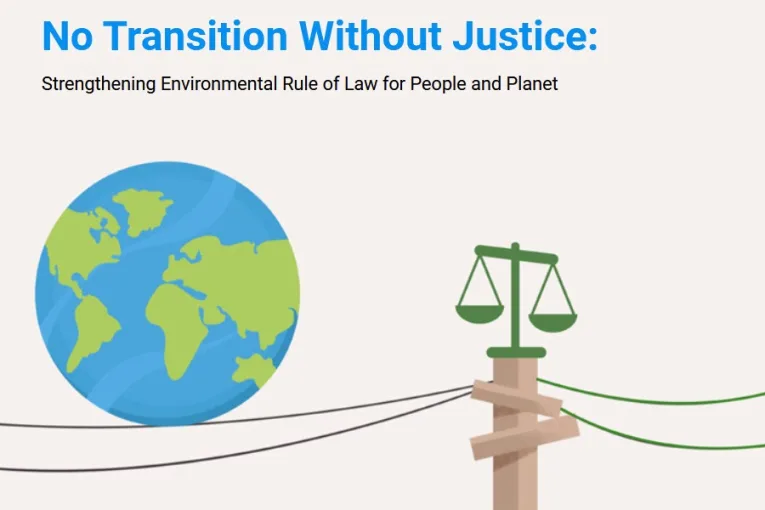
The warning is outlined in UNEP’s latest report, No Transition Without Justice: Strengthening Environmental Rule of Law for People and Planet, which emphasizes that climate action must be accompanied by social justice to ensure no community is left behind during the shift to a low-carbon economy.
According to the report, a just transition is defined as the move toward environmentally sustainable economies while protecting workers, vulnerable communities, and marginalized groups from disproportionate environmental and economic burdens. UNEP argues that environmental policies that prioritize rapid emissions reductions without considering social impacts risk widening inequality rather than addressing it.
The report states that climate transitions become unjust when affected communities are excluded from decision-making processes, when governments prioritize speed over fairness, and when environmental objectives are pursued at the expense of livelihoods and social well-being.
UNEP traces the concept of a just transition to the labor movement in the United States during the 1970s, when labor unions called for government support to protect workers whose jobs were threatened by environmental regulations. Since then, the concept has evolved into a broader framework that combines climate action with poverty reduction, human rights, and social inclusion.
The report identifies Indigenous Peoples, low-income households, women, and workers in carbon-intensive industries as among the groups most vulnerable to the impacts of climate policies. Without meaningful participation, social protections, and economic support, these communities could face displacement, income losses, and limited access to new economic opportunities.
UNEP also notes that by 2024, dozens of countries had incorporated just transition principles into their Nationally Determined Contributions (NDCs) under the Paris Agreement, reflecting growing international recognition that climate policies should promote both environmental sustainability and social equity.
The report highlights several challenges that could arise if the transition is poorly managed. The closure of coal mines and other carbon-intensive industries may severely affect local economies, while higher energy costs could place disproportionate financial pressure on lower-income households. However, UNEP stresses that these risks should not delay climate action but instead encourage governments to design policies that minimize social and economic disruption.
To support a fair transition, UNEP recommends that governments strengthen workforce retraining programs, expand social protection systems, and ensure meaningful community engagement throughout policy development and implementation. The report argues that addressing existing inequalities is essential for building long-term public support for climate action.
UNEP concludes that environmental sustainability and social justice must advance together, emphasizing that effective climate policies are those that protect both the planet and the people most affected by environmental change. (*)