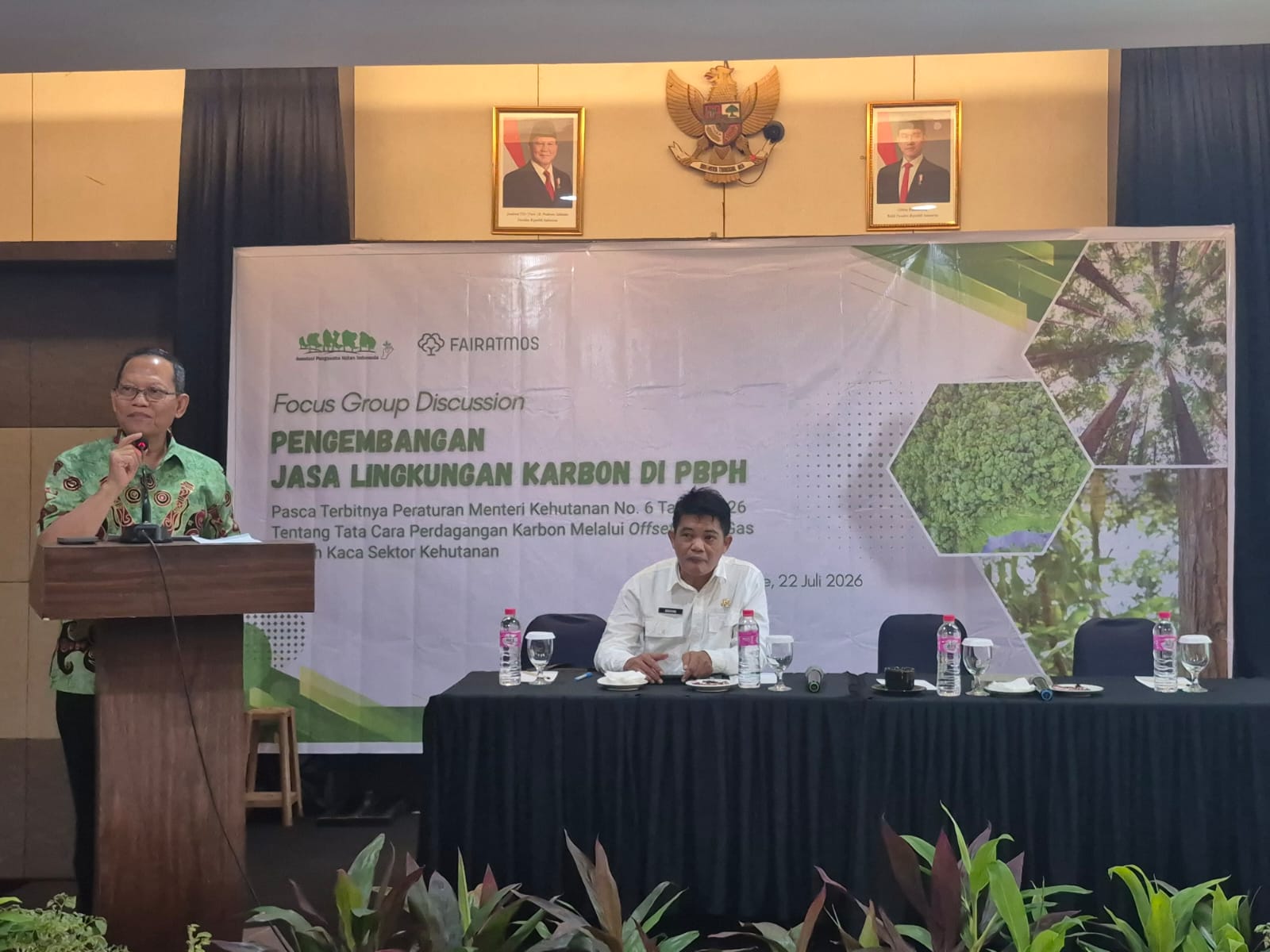
Enviro News Asia, Jakarta — The Asosiasi Pengusaha Hutan Indonesia (APHI) organized an online dissemination session on Indonesia’s Minister of Energy and Mineral Resources Regulation No. 12/2023 to accelerate the implementation of biomass utilization in coal-fired power plants.
The event brought together stakeholders from government institutions, energy companies, and the forestry sector to enhance understanding of technical aspects, pricing schemes, and supply chain readiness for biomass development.
APHI Chairman Soewarso emphasized the importance of cross-sector collaboration in supporting the policy, noting that the regulation serves as a strategic framework to expand renewable energy sourced from forest-based biomass.
“APHI welcomes the issuance of Regulation No. 12/2023 as a key reference for biomass development, particularly in supporting co-firing at coal-fired power plants. Strong collaboration is essential to ensure sustainable biomass supply and create added value for the forestry sector,” he said.
He also highlighted fiscal policy challenges, particularly those related to electricity subsidy mechanisms regulated under Ministry of Finance policies, which previously hindered biomass implementation.
According to Soewarso, revisions introduced through PMK No. 20/2025 now enable biomass to be included in the electricity generation cost component, allowing the biomass pricing scheme under the regulation to be effectively implemented.
“With biomass now recognized as part of the electricity production cost, the pricing formula and subsidy access can be realized, improving the economic feasibility of biomass development,” he added.
Director of Bioenergy at the Directorate General of New and Renewable Energy and Energy Conservation under the Kementerian Energi dan Sumber Daya Mineral, Edi Wibowo, stated that biomass currently contributes approximately 2.64 percent to Indonesia’s national energy mix, with significant potential for further growth.
He explained that the regulation governs biomass standards, supply mechanisms, and pricing schemes, including a ceiling price formula linked to coal prices and adjusted by calorific value factors.
Meanwhile, Biomass Director of PLN Energi Primer Indonesia, Hokkop Situngkir, reported steady progress in biomass co-firing implementation across Indonesia’s power sector.
“Co-firing has been implemented in 52 coal-fired power plants under the PLN Group. Biomass utilization reached around 2.4 million tons in 2025, and approximately 460,000 tons in the first quarter of 2026,” he said.
He noted that Indonesia has vast biomass potential derived from forestry resources, agricultural residues, and industrial waste. However, strengthening supply chains and regulatory support remains critical to ensuring optimal domestic utilization.
The regulation promotes biomass co-firing as part of Indonesia’s broader energy transition strategy, involving key stakeholders such as government regulators, state-owned energy companies, biomass industry players, and forestry businesses supplying raw materials.
Through this initiative, APHI and its partners aim to build a more integrated national biomass ecosystem that supports economic growth, environmental sustainability, and social benefits while advancing the country’s transition toward a cleaner energy mix. (*)