Enviro News Asia, Samarinda — The Indonesian Forest Concessionaires Association (APHI) is accelerating the transformation of Forest Utilization Business License holders (PBPH) toward a Multi-Business Forestry (MUK) model, positioning Kalimantan as a national pilot region for implementation.
Amid global economic pressures, shifting market dynamics, and increasingly complex natural resource governance challenges, APHI views business diversification as essential to ensuring the long-term sustainability of forestry enterprises. The Multi-Business Forestry approach expands beyond timber production to include non-timber forest products, environmental services, carbon trading, ecotourism, and community-based enterprises.
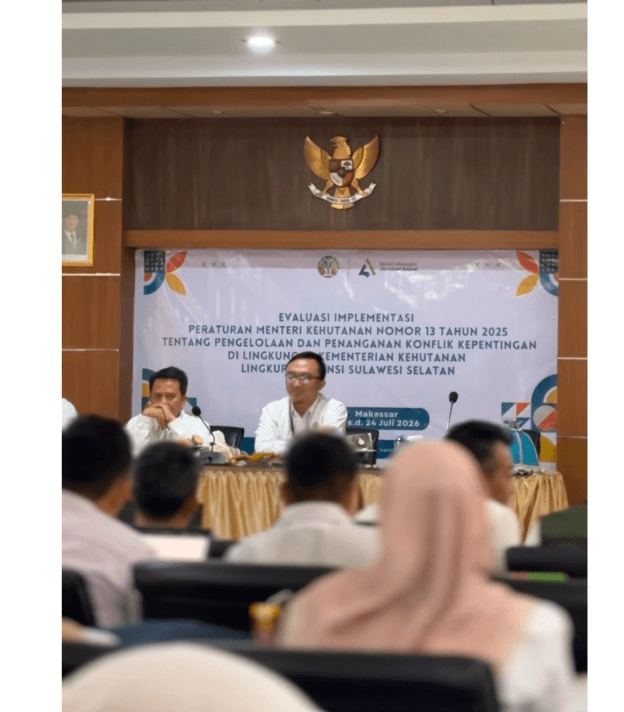
The initiative was discussed during a coordination meeting between APHI and its Regional Commissariats (KOMDA) of East Kalimantan and North Kalimantan in Samarinda on Tuesday (10/2/2026). The meeting was attended by APHI Secretary General Purwadi Soeprihanto, Vice Chair of Public Relations Trisia Megawati, and members from both regions.
APHI Chairman Soewarso described the gathering as a strategic moment to reinforce collective commitment to transforming PBPH operations.
“PBPH can no longer rely solely on timber-based business models. Transitioning to Multi-Business Forestry is no longer optional but mandatory for companies to survive, grow, and continue contributing to the national economy,” Soewarso stated.
He emphasized that Kalimantan holds a strategic role in accelerating implementation, as it hosts the largest concentration of PBPH license holders in Indonesia, totaling approximately 108 PBPH units.
“With the highest number of PBPH members located in Kalimantan, we expect the region to become a national model for integrated and sustainable Multi-Business Forestry implementation,” he said.
According to Soewarso, future forestry business strategies must integrate non-timber products, environmental services, carbon markets, ecotourism, and community partnerships to increase added value while maintaining forest sustainability.
He also stressed that successful implementation requires sound governance, regulatory certainty, and strong synergy between central and regional governments.
“We encourage policies, licensing frameworks, and technical assistance to support the development of multi-business forestry so that forest potential can be utilized optimally, responsibly, and sustainably,” he added.
APHI reaffirmed its commitment to serving as a strategic partner to the government in advancing green and low-carbon economic transformation through strengthened Multi-Business Forestry practices at the operational level.
Chairman of APHI East Kalimantan Regional Commissariat Asrul Anwar expressed readiness to support members in accelerating diversification efforts.
“At the regional level, we continuously encourage members to develop non-timber products, environmental services, and community partnerships to build stronger, more stable, and adaptive business structures,” Asrul said.
Meanwhile, Chairman of APHI North Kalimantan Regional Commissariat Edy Zulkarnaen highlighted the strategic importance of MUK implementation, particularly in border regions.
“Multi-Business Forestry will create new economic opportunities, improve community welfare, and strengthen PBPH competitiveness in responding to global market dynamics,” he stated.
Through this initiative, APHI aims to ensure that the transition toward Multi-Business Forestry becomes more structured, measurable, and scalable—particularly in Kalimantan as the national center of PBPH operations. (*)