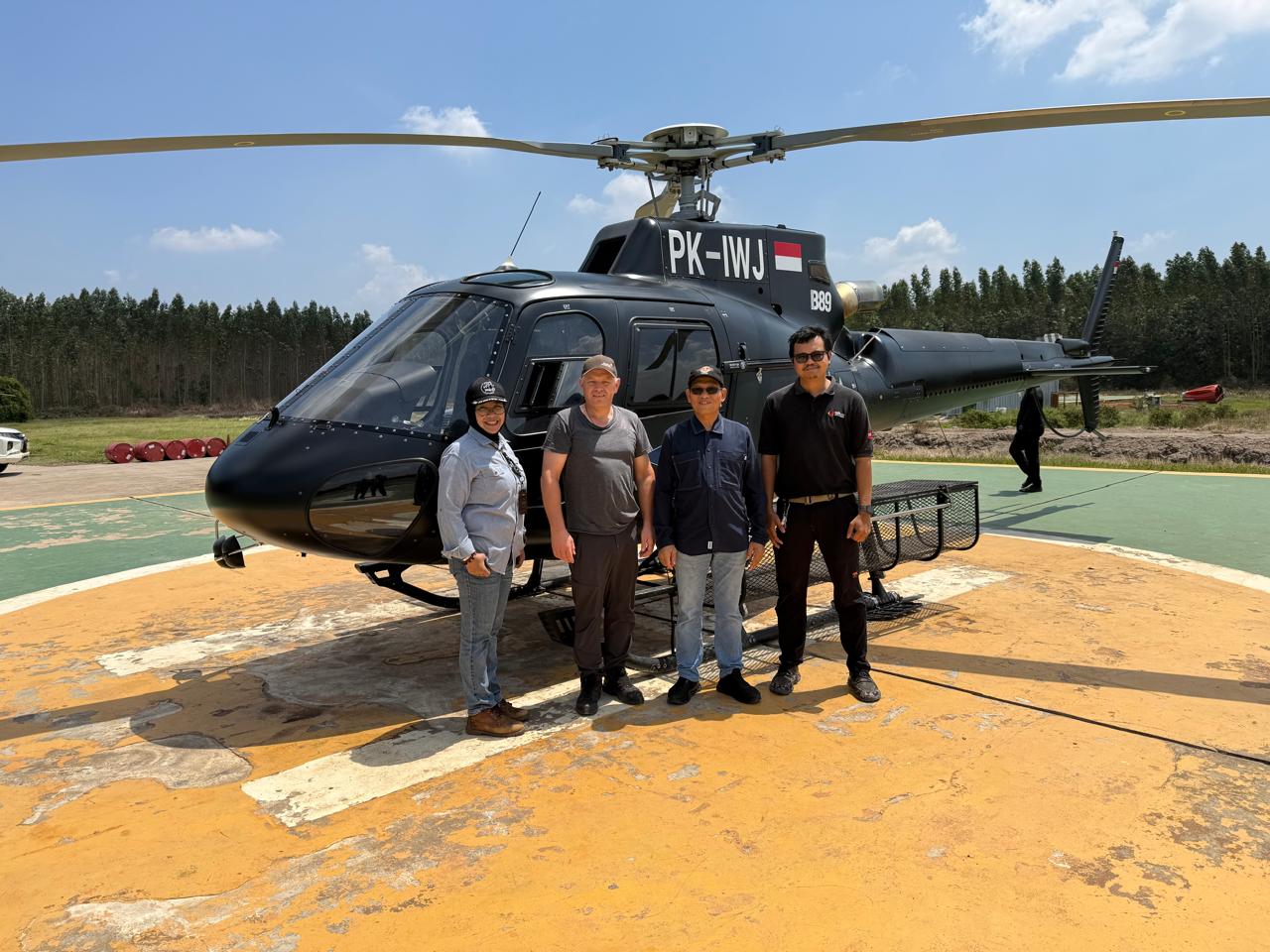
Enviro News Asia, Ogan Komering Ilir — Chairman of the Indonesian Forestry Association (APHI) Soewarso inspected the Sungai Baung Firebase to assess the readiness of facilities, equipment, and personnel ahead of the peak of the 2026 dry season in Ogan Komering Ilir (OKI), South Sumatra.
Sungai Baung Firebase serves as a command center for forest and land fire management operated by APHI members PT Bumi Mekar Hijau (BMH), PT Bumi Andalas Permai (BAP), and PT Sebangun Bumi Andalas Wood Industries (SBA WI), which are partners of APP Group.
During the visit on Saturday (August 8, 2026), Soewarso, accompanied by APHI South Sumatra Regional Chapter Chairman Iwan Setiawan, reviewed hotspot detection systems, personnel and equipment readiness, and rapid response mechanisms for potential fires.
Soewarso said forest and land fire management requires cooperation among the government, businesses, security forces, communities, and other stakeholders, including when fires occur outside company concession areas.
“Forest and land fires cannot be prevented and handled by one party alone. Cross-sector collaboration is essential to ensure fires are detected and handled as early as possible before they spread,” Soewarso said.
Since May 2026, APHI members partnering with APP Group in OKI have assisted firefighting operations in several areas outside their concessions. In early August, joint teams were again deployed to tackle fires in the plantation concession area of PT Bintang Harapan Palma (BHP), which borders PT BMH’s operational area.
Soewarso expressed appreciation for APHI members that have actively participated in firefighting operations outside their concessions.
Hundreds of personnel from PT BMH, PT BAP, and PT SBA WI were deployed alongside Manggala Agni, the Indonesian Military (TNI), the Indonesian National Police (Polri), and the Regional Disaster Management Agency (BPBD). The operation was supported by five helicopters operated by APP Group and two BPBD helicopters, including aircraft used for water bombing to accelerate firefighting efforts and prevent fires from spreading.
Field operations were also supported by satellite monitoring and real-time fire monitoring systems. A total of 20 excavators, 10 operational vehicles, and various firefighting equipment were deployed. Canal blocking infrastructure was also utilized to maintain water availability in fire-prone peatland areas.
Soewarso expressed concern over recurring fires during every dry season in the peatland area of PT BHP. He said the repeated incidents highlighted the need for a more integrated and effective governance approach to prevent forest and land fires in other-use areas (APL) surrounding PBPH concessions.
Such an approach, he said, should include clearer authority, stronger early detection systems, improved peatland water management, adequate personnel readiness, and closer cooperation among the government, companies, and local communities.
Iwan Setiawan said Sungai Baung Firebase functions as an integrated, data-driven coordination center that enables personnel to monitor field conditions and accelerate decision-making.
“The key to forest and land fire management is early prevention. Monitoring systems must provide fast and accurate information so teams can respond immediately,” Iwan said.
Meanwhile, PT BAP Fire Operation Management Head Panji Bintoro said the company operates its fire management system around the clock, supported by satellite imagery, automatic weather stations (AWS), a fire danger rating system (FDRS), and rapid response teams.
The company also operates unmanned aerial vehicles, or drones, equipped with thermal imaging technology and artificial intelligence to detect potential fires within a range of up to seven kilometers.
“Information from various monitoring systems provides the basis for teams to determine the level of risk and the actions that need to be taken immediately in the field,” Panji said.
In addition to technology-based monitoring, prevention efforts include joint patrols with the TNI, public awareness programs, and strengthening early warning systems in villages surrounding operational areas.
During the visit, the APHI delegation also inspected the Baung Central Nursery, which has an annual production capacity of between 48 million and 60 million Eucalyptus and Acacia seedlings on a 42-hectare site.
The seedlings undergo quality control at various stages before being planted as part of sustainable plantation forest management. The nursery also uses paper pots to reduce plastic consumption, support root development, and improve planting success rates.
APHI said strengthening technology, personnel capacity, firefighting infrastructure, and community collaboration would remain important to address the peak of the 2026 dry season and protect forests and surrounding areas from forest and land fires. (*)