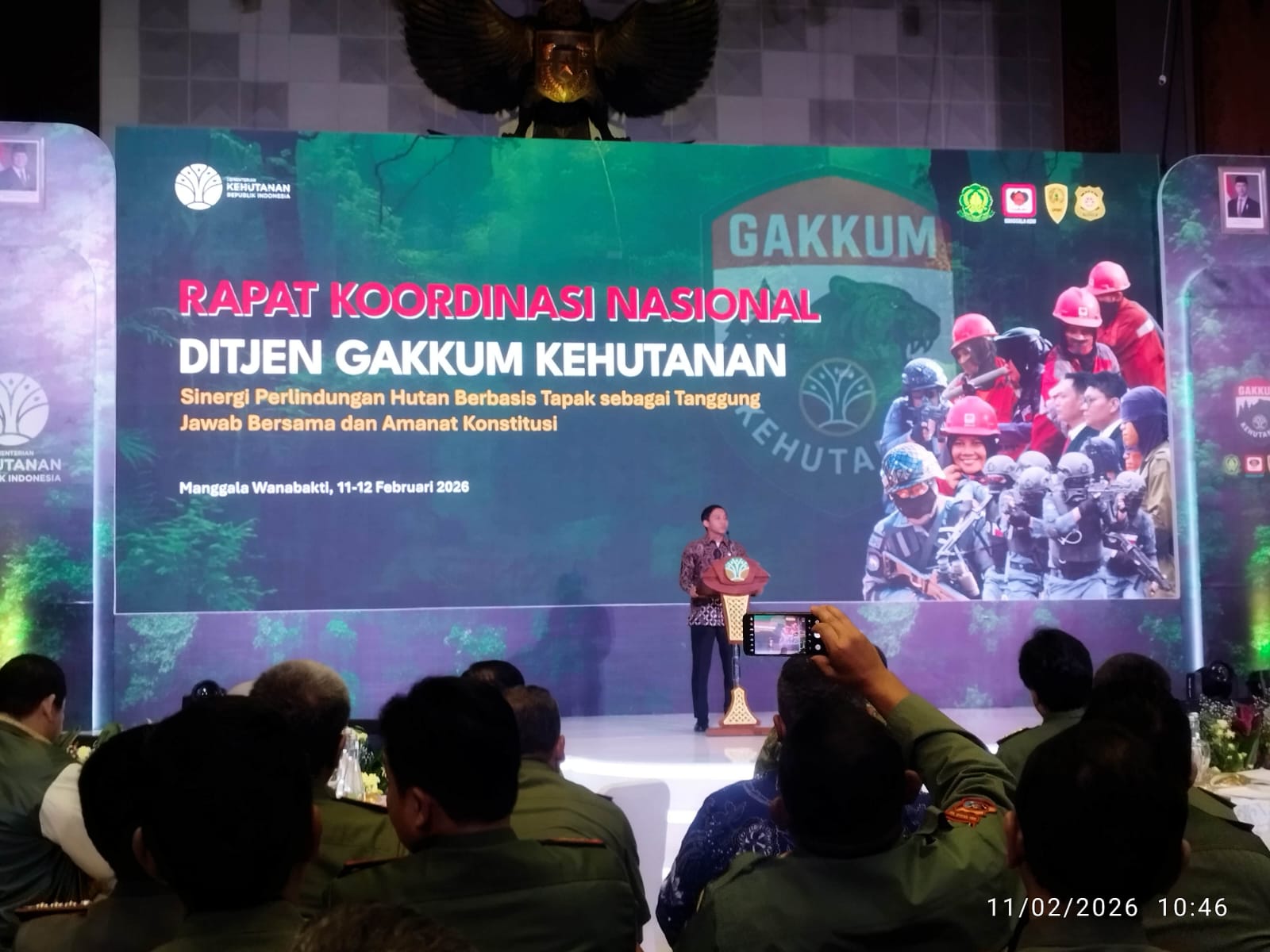
Enviro News Asia, Jakarta — The National Forestry Law Enforcement Coordination Meeting served as a key platform to reinforce Indonesia’s national commitment to restoring order in forest areas and strengthening fair and sustainable natural resource governance.
The forum underscored the importance of comprehensive improvements in forest governance by maintaining a balance between development objectives, environmental conservation, and community welfare. Participants emphasized that effective governance remains essential to ensuring long-term sustainability of Indonesia’s forest resources.
During the discussions, the meeting outlined several strategic measures, including strengthening forest management and protection regulations, enhancing the capacity of law enforcement personnel, and reinforcing the institutional role of regional Forestry Law Enforcement Units at the provincial level.
The forum also highlighted the need to optimize the roles of Forest Rangers, Manggala Agni fire control units, and SPORC task forces in preventing and combating illegal activities such as illegal logging, illegal mining, forest encroachment, and forest and land fires. In addition, participants discussed improving monitoring systems, handling public complaints, strengthening early warning mechanisms, and anticipating potential risks associated with the 2026–2027 El Niño phenomenon.
Association of Indonesian Forest Concessionaires Vice Chair for Legal Affairs, Public Relations, and Cooperation Erwansyah reaffirmed APHI’s commitment to supporting the outcomes of the coordination meeting through enhanced regulatory compliance among its members and stronger implementation of sustainable forestry business practices.
He stated that legal certainty and consistent law enforcement are fundamental to creating a healthy business climate while safeguarding Indonesia’s forest ecosystems.
Erwansyah further emphasized that cross-sectoral synergy remains critical to future forest management. He noted that collaboration between forestry business actors and government institutions, including the Indonesian National Armed Forces, the National Police, the Attorney General’s Office, and regional governments, must continue to be strengthened, particularly in forest fire prevention and forest area protection.
According to Erwansyah, APHI believes that a firm and fair rule-of-law-based approach will provide certainty for the business sector while ensuring that Indonesia’s natural resources and biodiversity are preserved for future generations.
APHI also reiterated its support for government policies that maintain forest utilization as a component of national economic contribution, while upholding sustainability and conservation principles as the foundation of Indonesia’s forest management framework. (*)