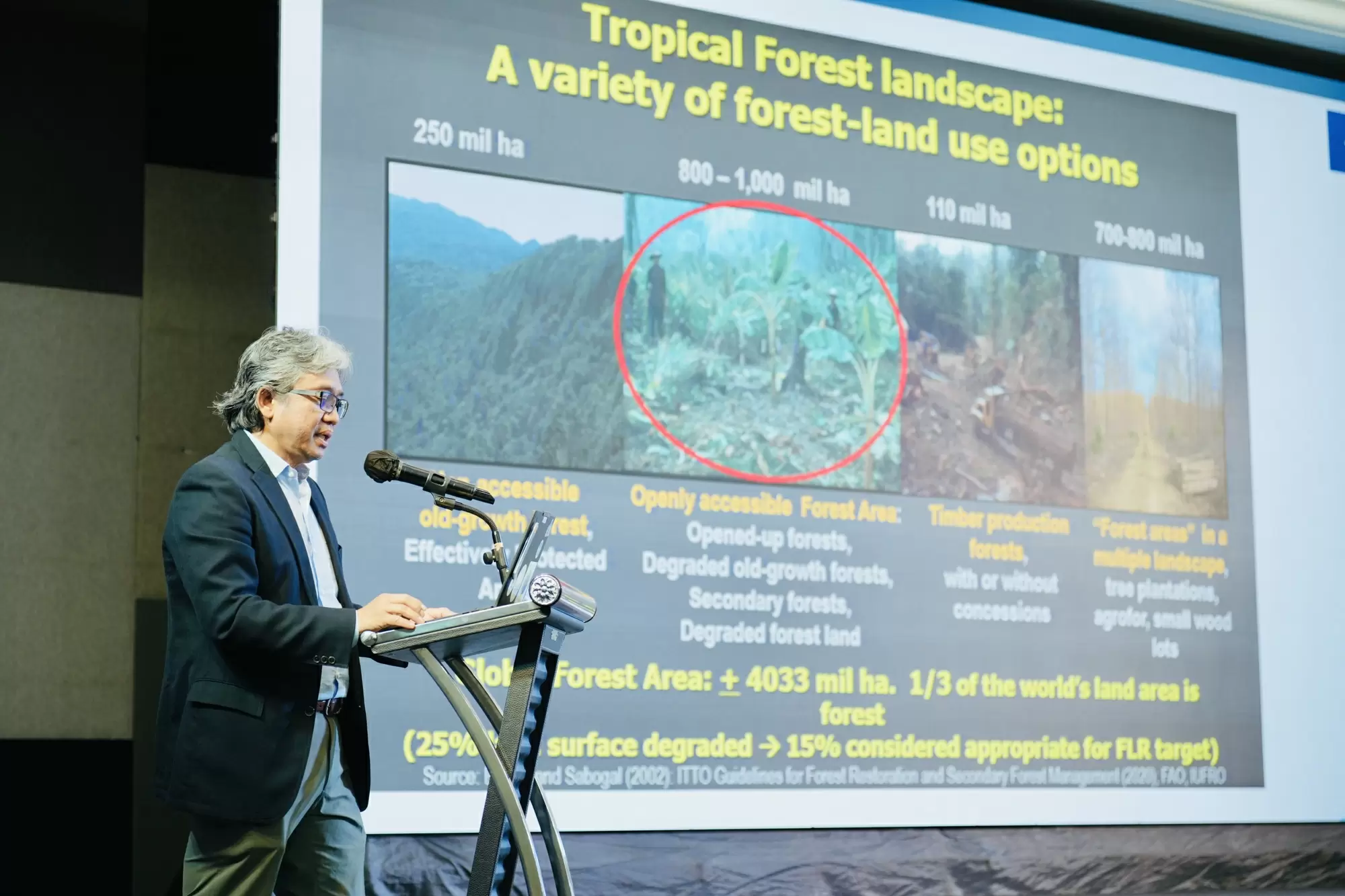
Enviro News Asia, Bali — Empowering local communities and providing meaningful incentives are critical to the long-term success of forest landscape restoration (FLR) efforts, according to the International Tropical Timber Organization (ITTO), as Southeast Asian countries advance plans for an ambitious regional tree-planting initiative.
The message was delivered by ITTO Projects Manager Tetra Yanuariadi during the First Workshop on the Development of the ASEAN Leaders’ Declaration on the One Billion Trees Growing Program and Its Implementation Plan, held in Bali, Indonesia, on 12–13 May 2026.
Speaking on the potential of forest landscape restoration across Southeast Asia, Yanuariadi explained that FLR seeks to restore ecological integrity while simultaneously improving human well-being in deforested and degraded landscapes. He emphasized that successful restoration requires strong stakeholder participation and interventions tailored to local environmental, social, and economic conditions.
Drawing on ITTO’s extensive experience, Yanuariadi noted that the organization has implemented more than 1,200 projects worth approximately US$430 million across tropical regions. These projects have generated valuable lessons on forest restoration and sustainable forest management, many of which are compiled in ITTO’s technical guidelines, including the Guidelines for Forest Landscape Restoration in the Tropics published in 2020.
According to Yanuariadi, forest landscape restoration can play a significant role in reducing deforestation and forest degradation, thereby helping countries address greenhouse gas emissions and climate change while supporting biodiversity conservation and sustainable development goals.
He highlighted that restoration opportunities are often concentrated in degraded forest lands, secondary forests, and degraded old-growth forests. Properly managed restoration efforts can help countries in Southeast Asia achieve both national environmental targets and international climate commitments.
Yanuariadi stressed that incorporating sustainable livelihood components into restoration projects is essential for securing community participation. Approaches such as agroforestry systems and compensation mechanisms for ecosystem restoration can provide economic benefits that encourage local communities to support long-term restoration initiatives.
He also noted that meaningful restoration outcomes often require timeframes that extend beyond the typical three-year project cycle. Building the capacity of local stakeholders, including women and young people, and ensuring communities experience tangible benefits from restoration efforts are key factors for sustaining engagement.
“Communities want to see the products of their forest restoration efforts and involvement, which often yield results long after the completion of a project,” Yanuariadi said.
In addition, he identified several areas requiring further research and policy development, including stronger inclusion of local and non-state actors, integration of social and ecological considerations, incorporation of FLR principles into broader forest policies, and expanded capacity-building programs supported by robust equity measures.
The ASEAN One Billion Trees initiative was endorsed during the 47th ASEAN Ministers on Agriculture and Forestry Meeting in October 2025 as a major regional effort to strengthen forest conservation, climate action, and community empowerment. ASEAN member states have been encouraged to develop national action plans and enhance monitoring systems to support the initiative’s collective goals.
The Bali workshop was organized by the ASEAN Secretariat and the European Union-funded Technical Assistance Facility to the Green Team Europe Initiative, bringing together regional stakeholders to advance the implementation of the One Billion Trees program. (*)