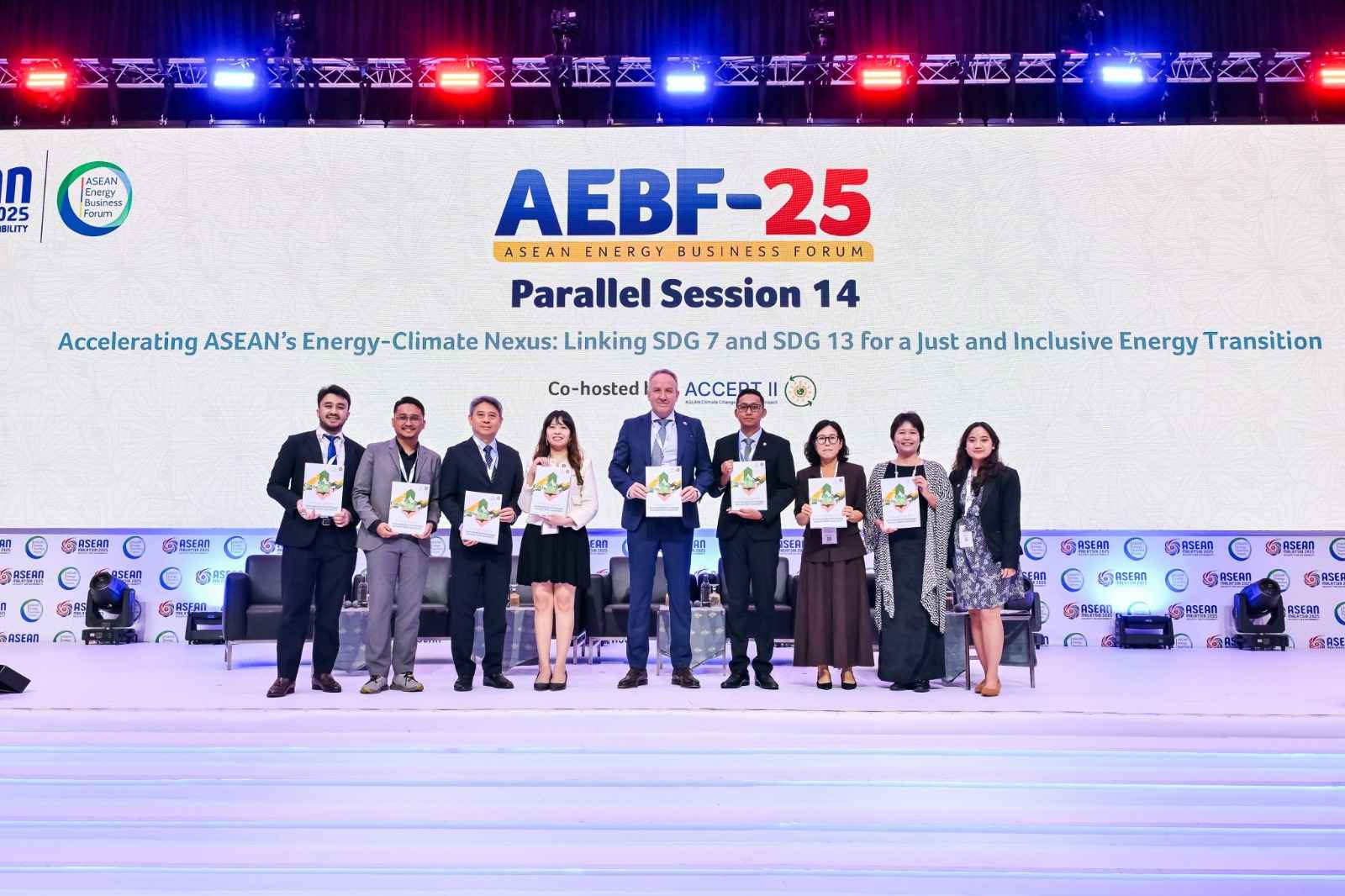
Enviro News Asia, Kuala Lumpur — ASEAN reaffirmed its commitment to clean energy transition and climate action through the launch of a new report titled “Advancing Clean Energy in ASEAN: Leveraging the Interlinkages Between SDG7 and SDG13.” The report was released by the ASEAN Centre for Energy (ACE) under the ASEAN Climate Change and Energy Project (ACCEPT) during the 25th ASEAN Energy Business Forum (AEBF-25) at the Kuala Lumpur Convention Centre (KLCC) on October 17, 2025.
The launch event was attended by Knut Øyvind Granli, Deputy Head of Mission of the Royal Norwegian Embassy in Kuala Lumpur, who described the report as “a significant milestone” in strengthening the integration of climate action and energy transition across the region.
“Aligning climate action with energy access not only accelerates decarbonization but also drives innovation, creates new jobs, and enhances resilience. Norway is proud to support this initiative through the ACCEPT II project,” he said.
As one of the fastest-growing economic regions in the world, ASEAN remains heavily dependent on fossil fuels — the main source of greenhouse gas emissions. Therefore, accelerating the transition to a low-carbon pathway is crucial to achieving Sustainable Development Goal (SDG) 7 on Affordable and Clean Energy and SDG 13 on Climate Action.
The report explores the interlinkages between these two goals while highlighting strategic actions to advance clean energy adoption through policy integration, climate finance, and resilience-building. During the discussion session, experts including Dr. Christopher Len (ISEAS–Yusof Ishak Institute), Ms. Yejin Ha (UNESCAP), Prof. Yuen Yoong Leong (SDSN), and Mr. Muhammad Rizki Kresnawan (ACE) shared their insights.
Representing ACE’s Executive Director, Dr. Zulfikar Yurnaidi emphasized the importance of cross-sectoral collaboration.
“When policy, data, and cooperation move together, ambition can be transformed into real action,” he said.
Concluding the session, ACCEPT II Project Manager Aldilla Noor Rakhiemah underlined that the energy transition must be both just and inclusive.
“No single sector can move forward alone. Governments, industries, academia, and partners must work hand in hand to achieve a low-carbon energy future that benefits all ASEAN communities,” she stated.
The report’s release coincided with the endorsement of the ASEAN Plan of Action for Energy Cooperation (APAEC) 2026–2030 — a regional energy roadmap that will guide ASEAN’s collective direction for the next five years. Moving forward, ACE and ACCEPT will continue to enhance regional dialogue, foster knowledge exchange, and strengthen policy integration to accelerate the clean energy transition in line with global climate commitments. (*)