

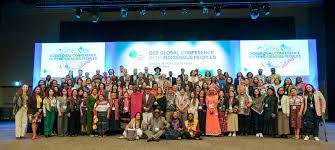
Enviro News Asia, Songdo — The Green Climate Fund (GCF) convened its first Global Conference with Indigenous Peoples, bringing together Indigenous leaders, policymakers, climate practitioners, and partners for a three-day dialogue in Songdo, Republic of Korea.
The conference, held from 8–10 April, opened with a traditional ceremony featuring rainwater blessings from Cameroon, Korea, and Malaysia, alongside an Indigenous prayer from Malaysian Borneo—symbolizing unity and grounding the event in Indigenous values.
In her opening remarks, GCF Executive Director Mafalda Duarte reaffirmed the Fund’s commitment to improving access to climate finance for Indigenous Peoples, who currently receive less than one percent of global climate funding despite their critical role in protecting ecosystems.
“Our engagement with Indigenous Peoples dates back to our first project in 2015 in the Peruvian Amazon,” Duarte said. “Today, Indigenous knowledge is increasingly shaping how we design and deliver climate programmes. Through our Revised Accreditation Framework, we are creating clearer pathways for Indigenous organizations to directly access climate finance.”
The conference also featured contributions from key figures, including Andrea Correa do Lago, Sineia do Vale, and Helen Biangalen-Magata, highlighting the importance of Indigenous participation in global climate governance.
A high-level plenary session on the first day emphasized the value of Indigenous knowledge systems, territorial governance, and locally driven solutions in strengthening climate resilience and mitigation efforts.
Hindou Oumarou Ibrahim, representing Mbororo Indigenous communities across several African countries, underscored the need for tangible outcomes. She called for clear mechanisms that ensure direct access to climate finance for Indigenous Peoples, stressing the importance of moving from consultation to implementation.
Throughout the event, participants explored GCF’s financing instruments, readiness support, accreditation pathways, and Indigenous Peoples Policy. Discussions also drew on lessons from GCF’s Independent Evaluation Unit to improve future engagement.
The conference gathered around 100 participants from over 30 countries, creating a platform for inclusive dialogue, knowledge exchange, and collaboration. Outcomes from the discussions are expected to inform GCF’s future strategies to scale up Indigenous-led climate action and enhance equitable access to climate finance. (*)