

Enviro News Asia, Jakarta — Indonesia’s National Research and Innovation Agency (BRIN) has partnered with PT Alam Semesta Integra to commercialize microalgae-based carbon capture technology designed to support urban decarbonization and climate action.
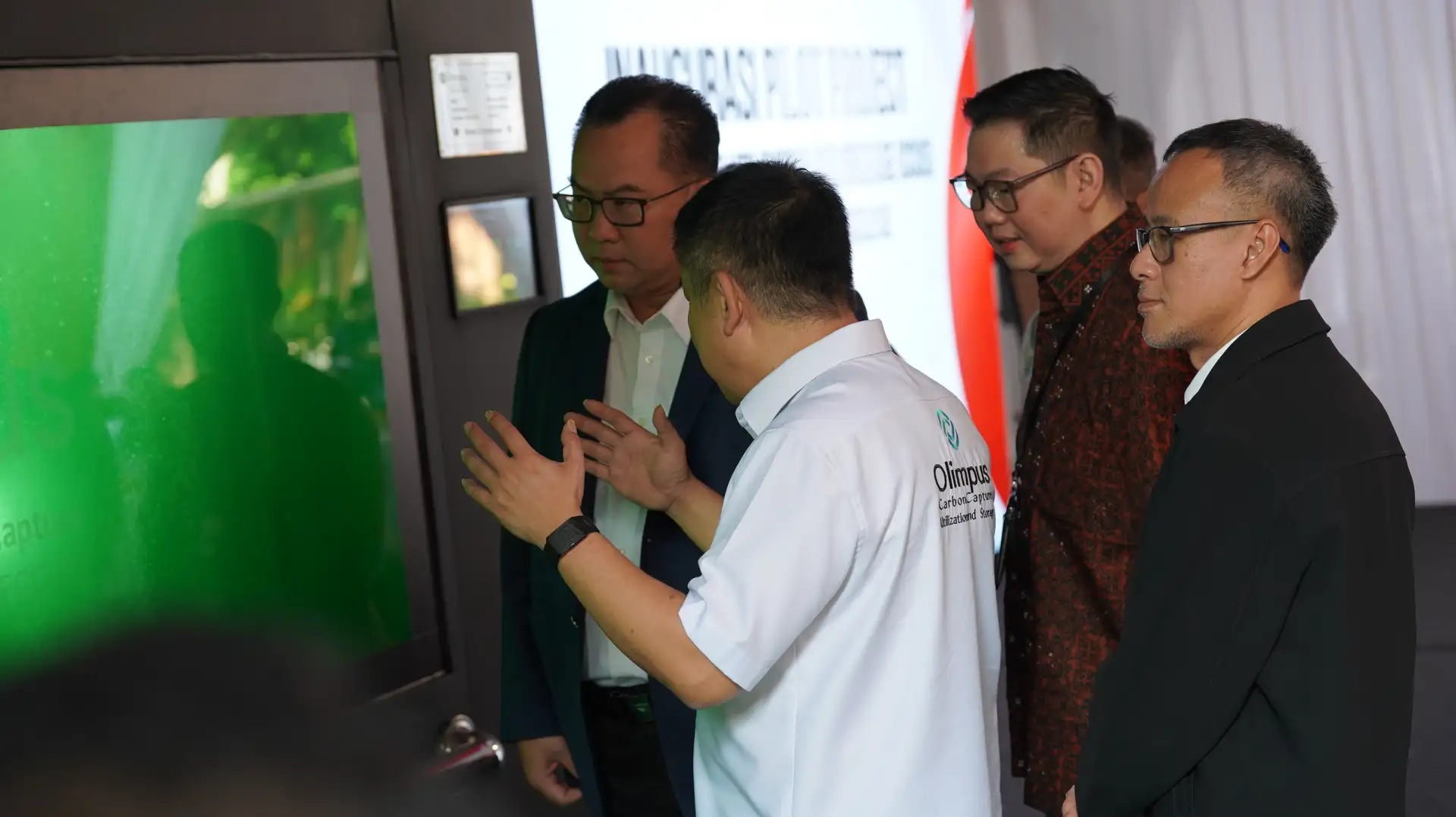
The collaboration has produced the Olimpus Apollo 1.0 pilot project, a microalgae photobioreactor system developed to capture carbon dioxide (CO₂) and convert it into biomass through photosynthesis. The system was inaugurated in Jakarta on October 8, 2026, as part of efforts to bring research innovations into practical use.
BRIN’s Research Center for Limnology and Water Resources began developing the technology in 2021 through an earlier prototype known as FCB2022. The system uses selected local microalgae, Spirulina platensis, and optimizes photosynthesis through strain selection, growth-medium formulation, and real-time monitoring of light intensity, pH and temperature.
BRIN Head Arif Satria said commercialization was essential to ensure research moved beyond laboratories and delivered practical benefits to society.
“Developing carbon dioxide capture technology is one response to the growing number of motor vehicles, particularly in urban areas such as Jakarta,” Arif said during the inauguration. He added that the pilot system was scheduled for installation at BRIN’s Gatot Subroto facility in 2026.
Arif said ecological modernization could help create cleaner, healthier urban environments while addressing climate change. Microalgae absorb CO₂ through photosynthesis, convert it into biomass and release oxygen.
He added that BRIN would continue strengthening cooperation among researchers, industry, government institutions and other stakeholders to ensure research addressed national challenges and generated economic and environmental value.
Modular Technology for Urban Areas
PT Alam Semesta Integra Director Eddy Setiawan said Olimpus was designed to provide a measurable carbon-removal solution for cities, where emissions reduction is increasingly important and space for conventional green infrastructure can be limited.
The modular system is intended for deployment along major roads, in industrial areas and at public facilities, shopping centers, hotels and office buildings.
During operation, the device draws air through a four-direction intake system located at its lower corners before channeling it into the microalgae photobioreactor.
The unit measures approximately four meters long, one meter wide and three meters high, requiring about 2.5 square meters of rooftop space. It is powered by solar panels and the national electricity grid.
Eddy said the partnership with BRIN provided a strong scientific foundation for developing technology suitable for urban environments.
IoT Monitoring and Independent Verification
The Olimpus system incorporates an Internet of Things (IoT) monitoring platform developed in collaboration with telecommunications company Telkomsel. Fourteen sensors measure gas and water-quality parameters every five seconds, with data transmitted and processed in real time.
Telkomsel Vice President of Financial and CMT Account Management Gian Wijoyo said the connectivity system enables data to be stored and displayed on a dashboard, providing information about the device’s operating conditions.
The technology has also undergone independent third-party verification. Yuan Bambang Handayana, president director of PT TÜV SÜD Indonesia, said the verification was conducted on June 28, 2026, under ISO 14064-2, a standard for greenhouse gas reduction projects.
According to the verification results cited by the project, one unit has a carbon-capture capacity equivalent to that of 110 mahogany trees aged more than 15 years. The device requires approximately 2.5 square meters of space, compared with an estimated 5,000 to 10,000 square meters of land for trees providing the stated equivalent capacity.
Yuan emphasized that third-party verification was important for assessing carbon-removal claims, including the amount of carbon captured and any potential leakage. The verification results are intended to support confidence in the technology’s performance before wider deployment.
Supporting Climate Action and the Green Economy
The developers aim to make Olimpus available to publicly listed companies and state-owned enterprises to support environmental, social and governance (ESG) commitments and corporate social responsibility (CSR) programs.
Users are expected to receive monthly emissions-mitigation reports documenting their climate-related activities. The system comes with a three-year warranty, monthly microalgae harvesting to maintain the required culture density, and photobioreactor tank sterilization every three months to prevent biofilm formation.
The pilot project marks a step toward commercializing BRIN research through industry collaboration. Its developers hope the microalgae-based technology will expand carbon-capture applications in urban areas and contribute to Indonesia’s green economy, emissions-reduction efforts and sustainable development.
The inauguration was attended by PT Alam Semesta Integra Director Eddy Setiawan, BRIN Director of Research and Innovation Utilization in Industry Mulyadi Sinung Harjono, acting head of BRIN’s Earth and Maritime Research Organization Luki Subehi, and other officials and industry partners. (*)