Enviro News Asia, Jakarta — Researchers from National Research and Innovation Agency emphasized that the sustainability of mangrove ecosystems is shaped not only by material interactions between humans and nature, but also by spiritual beliefs, oral traditions, and cultural relationships that have been preserved for generations in coastal communities.
The findings were presented by Dedi Supriadi Adhuri during the 99th Cultural Discussion Forum organized by the Center for Research on Society and Culture of BRIN in Jakarta on Monday (25/5).
Dedi explained that his research, published in an international scientific journal under the title Entangled Ecologies: Oral Traditions, Spirits, and the Sustainability of Mangrove Landscapes in Southeast Seram Island, Indonesia, reveals how local ecological knowledge has helped maintain mangrove ecosystems for centuries despite continuous human use.
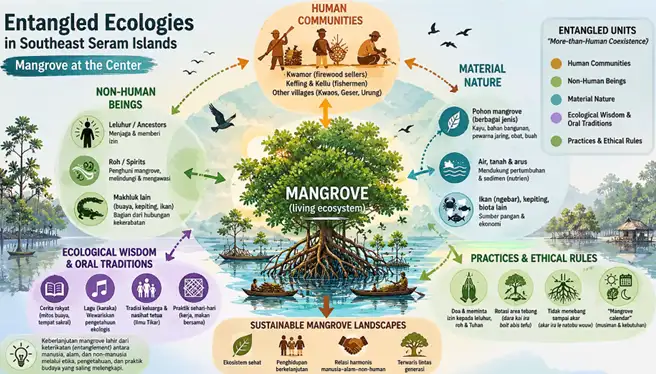
According to him, conventional conservation approaches often place humans at the center of environmental management, while many Indonesian coastal communities understand nature as part of a broader interconnected system involving humans, ecosystems, ancestral spirits, sacred spaces, and customary laws.
He noted that mangrove forests in regions such as Maluku, Papua, and North Sulawesi remain relatively preserved because communities apply traditional ecological practices, including restrictions on cutting mangroves to the roots, rotational harvesting systems, and seasonal mangrove management based on natural cycles.
Dedi described this relationship through the concept of “entanglement,” which refers to the interconnected relationship between humans, plants, animals, materials, and spiritual entities within coastal societies.
He explained that mangroves are not viewed merely as vegetation or economic resources, but as part of local origin stories, myths, rituals, and customary regulations that guide community behavior toward environmental sustainability.
The research also highlighted the “more-than-human” approach, which recognizes nature as an active force influencing human behavior and environmental ethics rather than a passive object controlled solely by humans.
Dedi stated that the approach could contribute to global conservation agendas such as the “30 by 30” target, which aims to protect 30 percent of the world’s land and marine areas by 2030. He stressed that modern conservation policies should engage more closely with local and Indigenous knowledge systems that have long demonstrated ecological sustainability.
Representing the Head of the Center for Research on Society and Culture at BRIN, Ari Nurlia said the study demonstrates how ecological sustainability can endure for centuries through the interconnected relationship between communities, nature, and nonmaterial entities.
She explained that ecological knowledge in coastal communities is transmitted through folklore, rituals, songs, and everyday cultural practices that shape environmental ethics and sustainable resource management.
Ari added that interdisciplinary approaches combining modern science, anthropology, and Indigenous ecological practices are important for enriching environmental and social research while strengthening recognition of local knowledge as part of global solutions to the ecological crisis. (*)