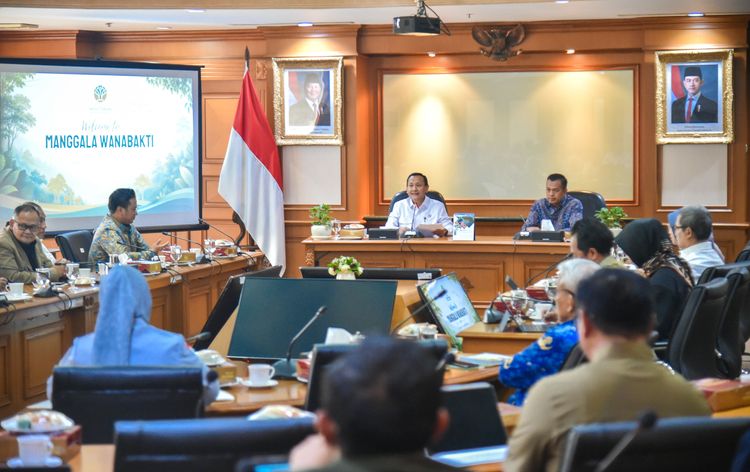
Enviro News Asia, Nabire — The Ministry of Forestry of Indonesia, in collaboration with the Government of Central Papua Province, strengthened the foundation for the formulation of the Subnational Work Plan for Indonesia’s FOLU Net Sink 2030 through Workshop I held in Nabire on Thursday.
The workshop marked a critical phase in ensuring that the provincial-level operational document is realistic, measurable, and aligned with the ecological and socio-economic characteristics of Central Papua. The process aims to translate national climate mitigation commitments into actionable strategies at the subnational level.
Head of the Central Papua Provincial Office for Environment, Forestry, and Land Affairs, Yan Richard Pugu, stated that the workshop served as a platform to harmonize perspectives and clarify the direction of regional implementation. He emphasized the importance of providing structured guidance and concrete examples of potential activities to be incorporated into the Subnational Work Plan.
Central Papua holds approximately 5.7 million hectares of forest area, with mitigation action directives covering 3.6 million hectares. Most of this area falls under High Conservation Value protection (RO 11), highlighting the province’s significant potential contribution to safeguarding ecologically critical landscapes under the FOLU Net Sink 2030 framework.
Discussions also addressed on-the-ground governance dynamics, including adjustments to forest management planning. A proposal to establish 10 Forest Management Units (KPH) was revised to three units in response to regional fiscal constraints, a consideration that will be reflected in the final Subnational Work Plan.
During technical sessions, expert Mujetahid presented the spatial direction of the FOLU Net Sink 2030 as the basis for prioritizing mitigation actions in Central Papua. Another expert, Paulus Mandibondibo, outlined the framework for preparing the Subnational Work Plan to ensure systematic structure, integration with regional development planning, and alignment with national policies.
The forum underscored the importance of protecting remaining natural forests, promoting regeneration of degraded forest areas, strengthening social forestry schemes, and ensuring effective implementation of the Monitoring, Reporting, and Verification (MRV) system. Social forestry and customary forest schemes were positioned as key instruments for executing mitigation actions at the local level.
In conclusion, participants emphasized the alignment of Central Papua’s mitigation targets and action plans with Indonesia’s national FOLU Net Sink 2030 objectives as a foundational step toward strengthening climate action planning at the regional level. (*)