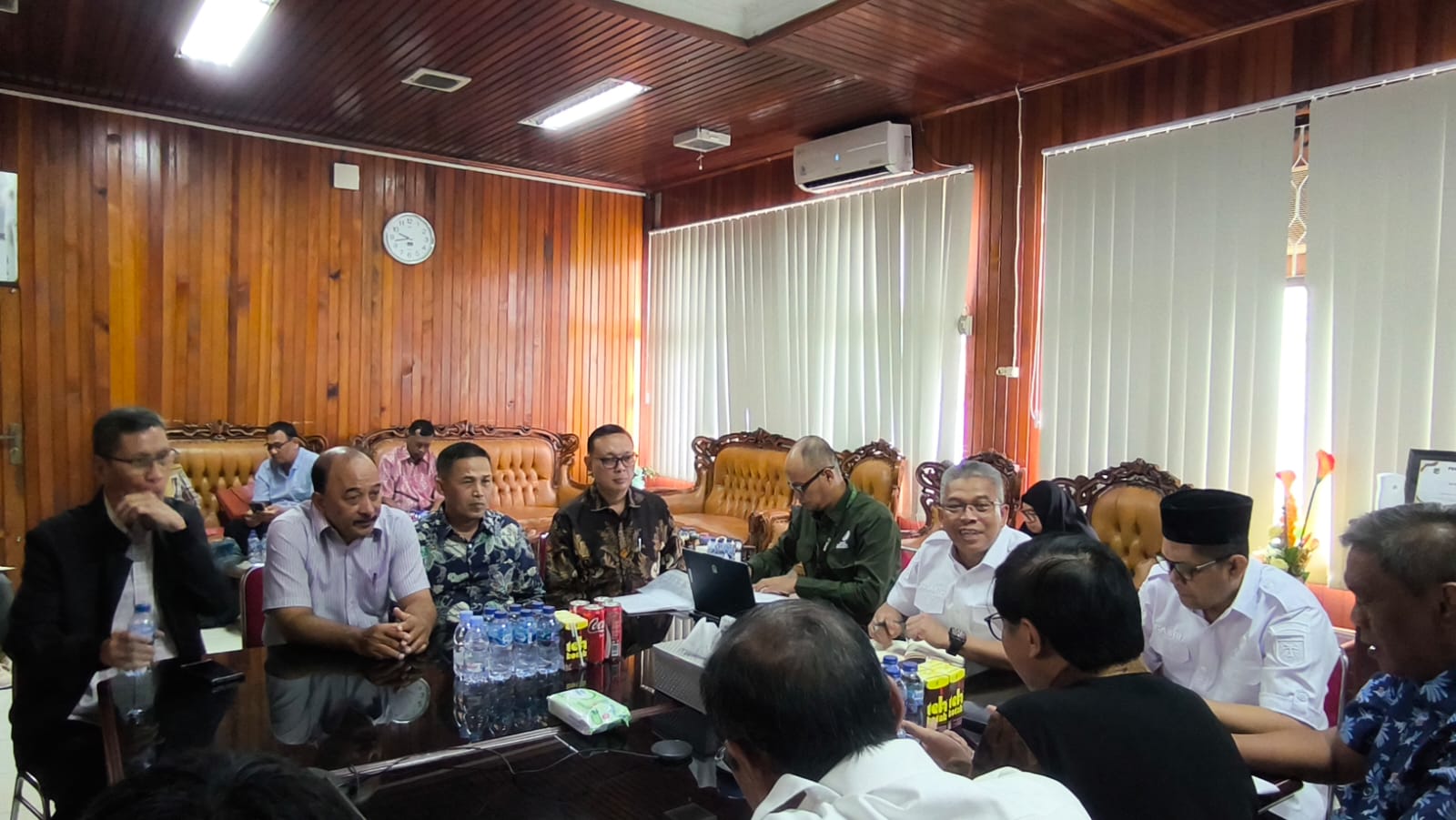
Enviro News Asia, Palu — The Central Sulawesi Provincial Forestry Office held a coordination meeting with Forest Utilization Business Permit (PBPH) holders across Central Sulawesi to address challenges facing the forestry industry and to explore measures to create a more conducive business climate.
The meeting took place at the office of the Head of the Central Sulawesi Provincial Forestry Office in Palu on Wednesday (11 February 2026). It was attended by Head of the Forestry Office Susanto Wibowo, accompanied by Head of Forest Planning and Utilization Division Basri, and a representative of Forest Production Management Agency Region XIV, Haryono.
Representatives from the Association of Indonesian Forest Concessionaires were also present, including Tjipta Purwita and Chair of APHI Central Sulawesi Regional Committee, Riswara, alongside PBPH business operators in the province.
Susanto Wibowo said the gathering served as an open dialogue platform between regulators and industry players to identify on-the-ground challenges and jointly formulate constructive solutions.
He noted that discussions highlighted the high cost of production in Central Sulawesi, while log prices in local and inter-island markets remain relatively low. This imbalance has led to timber price distortions that threaten the long-term viability of PBPH operations.
Susanto reaffirmed the provincial government’s commitment to optimizing Central Sulawesi’s forest potential in a sustainable manner to enhance contributions to Non-Tax State Revenue and regional income.
He added that sustainable forest management, including the development of multi-business forestry models, is essential to improving efficiency and increasing economic returns from the sector.
Meanwhile, PBPH operators called for provincial policies that could help narrow price disparities in the domestic log market and provide long-term business certainty.
APHI representative Tjipta Purwita emphasized that such coordination meetings should be institutionalized as a regular communication mechanism between regulators and industry players.
He also pointed to global trade dynamics, including allegations of dumping and raw material subsidies against Indonesia’s panel and pulp industries in certain export markets, as a signal for upstream policy evaluation.
Tjipta suggested reviewing existing regulations on log export restrictions to help correct domestic price distortions, while simultaneously strengthening law enforcement against illegal logging to support healthier timber prices.
He further urged the acceleration of regulatory improvements to the Timber Legality and Sustainability Verification System to ensure certification processes function effectively, and proposed policies promoting the use of certified timber in government construction projects through the national e-catalog procurement system.
Chair of APHI Central Sulawesi Regional Committee Riswara expressed optimism that, with appropriate policy support, PBPH activities in Central Sulawesi could regain momentum and contribute more substantially to regional development and community welfare.
The meeting concluded in an open and constructive atmosphere, with a shared commitment to strengthen collaboration between local government and forestry businesses in advancing productive, legal, and sustainable forest management in Central Sulawesi. (*)