Enviro News Asia, Bonn — The incoming COP31 Presidency led by Türkiye and Australia has unveiled a series of new climate targets aimed at accelerating global electrification, reducing waste generation, and strengthening urban resilience, underscoring a shift from climate pledges to implementation.
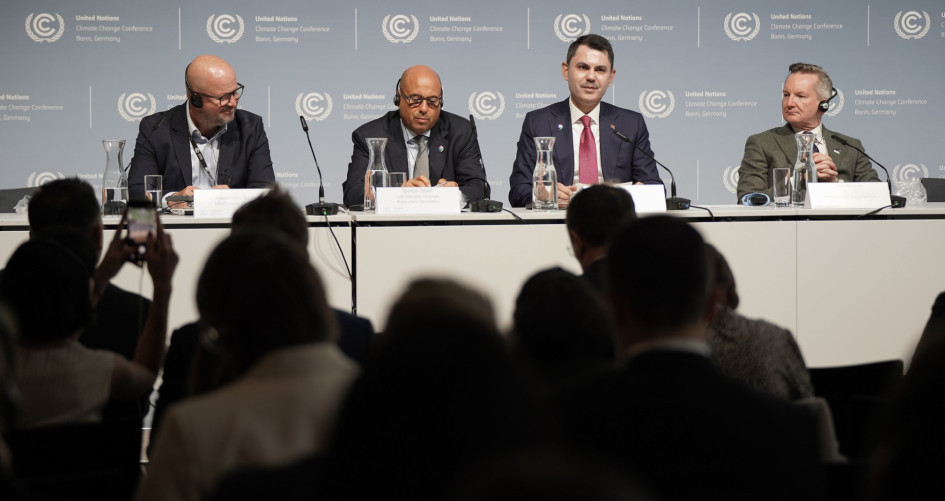
The announcements were made during the United Nations June Climate Meetings in Bonn, Germany, as part of the launch of the COP31 Global Climate Action Agenda. The initiative seeks to translate existing commitments into concrete actions across energy, cities, food systems, industry, education, and waste management.
COP31 President-Designate and Türkiye’s Minister of Environment, Urbanization and Climate Change, Murat Kurum, said the world had entered a critical period in which accelerating implementation had become more important than setting new goals.
“In climate action, the time for simply setting out goals is behind us. The task before us now is to accelerate implementation,” Kurum said.
Under the new agenda, the COP31 Presidency aims to raise the share of final global energy demand met by electricity from just over 20 percent today to 35 percent by 2035, accelerating the transition toward cleaner and more secure energy systems.
Another target seeks to halve the growth of global waste by 2035, placing zero-waste practices and methane reduction at the center of climate action. In the building sector, the Presidency aims to reduce energy consumption intensity by at least 25 percent by 2035 to create more efficient and climate-resilient cities.
The agenda also promotes green industrialization and circular economy practices by increasing the global circular material use rate to at least 15 percent by 2035.
Kurum emphasized that climate action should extend beyond negotiation halls and become visible in cities, agricultural systems, industries, and everyday life.
Australia’s Minister for Climate Change and Energy and President of COP31 Negotiations, Chris Bowen, described the action agenda as a timely response to mounting geopolitical and energy challenges.
“The answer to improved energy reliability and energy sovereignty is also the answer for emissions reduction — that is more electrification, more renewable energy, reliable and affordable energy, which is also best for the climate,” Bowen said.
He stressed that while the Action Agenda and formal negotiations are separate processes, they are complementary and can mutually reinforce progress on emissions reduction and the transition away from fossil fuels.
UN Climate Change Executive Secretary Simon Stiell welcomed the initiative, describing electrification as a “global game-changer” capable of boosting economies, creating jobs, improving living standards, and combating climate change.
Stiell noted that renewable energy and battery technologies offer enhanced energy security and lower costs for households and businesses. He added that scaling up electrification would reduce dependence on coal, oil, and gas while supporting innovation and creating new industries.
He also highlighted the importance of reducing waste and developing resilient cities as essential measures for cutting carbon and methane emissions while protecting communities from increasingly frequent and severe climate-related disasters.
The COP31 Global Climate Action Agenda builds upon the six thematic pillars introduced during COP30 in Brazil and seeks to accelerate implementation by mobilizing governments, investors, businesses, cities, and civil society. (*)