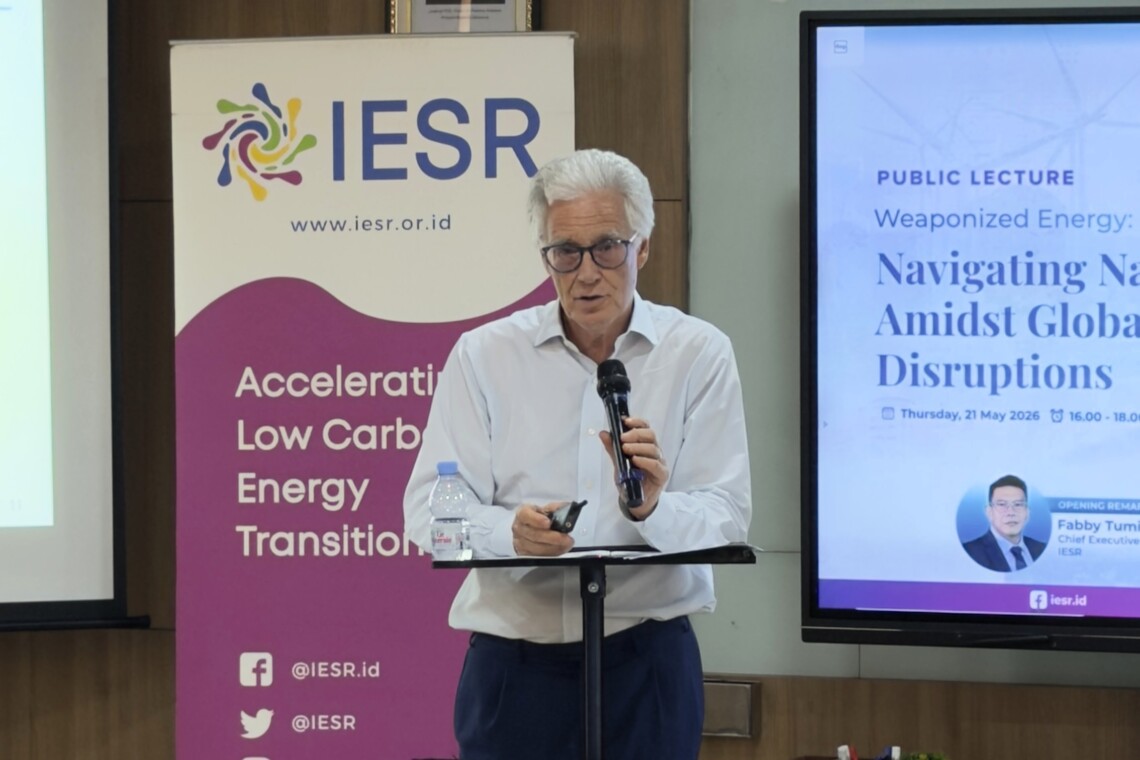
Enviro News Asia, Jakarta — Energy transition is increasingly being viewed as a critical component of national security as recurring geopolitical conflicts continue disrupting global oil supply chains and threatening economic stability, experts said during a public lecture in Jakarta on Thursday.
The discussion, titled Weaponized Energy: Navigating National Survival Amidst Global Supply Disruptions, highlighted the growing vulnerability of countries heavily dependent on imported fossil fuels, particularly amid tensions surrounding the Strait of Hormuz and other strategic energy corridors.
Chief Executive Officer of the Institute for Essential Services Reform, Fabby Tumiwa, stated that Indonesia must position energy transition as part of its national security agenda to reduce dependence on imported oil and gas supplies.
According to Fabby, repeated geopolitical conflicts over the past decade have disrupted global oil distribution networks, affecting Indonesia through rising fuel import costs, weakening exchange rates, and increasing energy subsidy burdens.
He emphasized the importance of developing strategic energy reserves, diversifying energy supply chains, and maximizing Indonesia’s renewable energy potential during international negotiations and long-term national planning.
Fabby also underlined the urgency of building an interconnected electricity grid system across Indonesia as part of a broader risk management strategy to strengthen national energy resilience.
Chair of the Energy Transitions Commission, Adair Turner, explained that large-scale integration of renewable energy into national power systems is technically feasible and increasingly necessary.
He noted that fossil fuel reserves remain concentrated in limited geographic regions, creating long and vulnerable supply chains, while renewable energy sources such as solar power are widely available across most countries.
According to Adair, countries need to adopt a new energy paradigm focused on maximizing locally available renewable resources to improve long-term energy security.
He cited examples from Europe, including the United Kingdom, where electricity generation is increasingly dominated by renewable sources such as solar and wind power, supported by nuclear energy imports and limited thermal generation.
Adair also pointed to Germany, where renewable energy from solar and wind has at times supplied up to 97–98 percent of the country’s electricity mix, demonstrating that high shares of variable renewable energy can operate while maintaining grid stability.
The discussion concluded that dependence on imported fossil fuels represents a significant macroeconomic vulnerability and that accelerating renewable energy development is essential not only for climate goals but also for safeguarding national economic and energy security. (*)