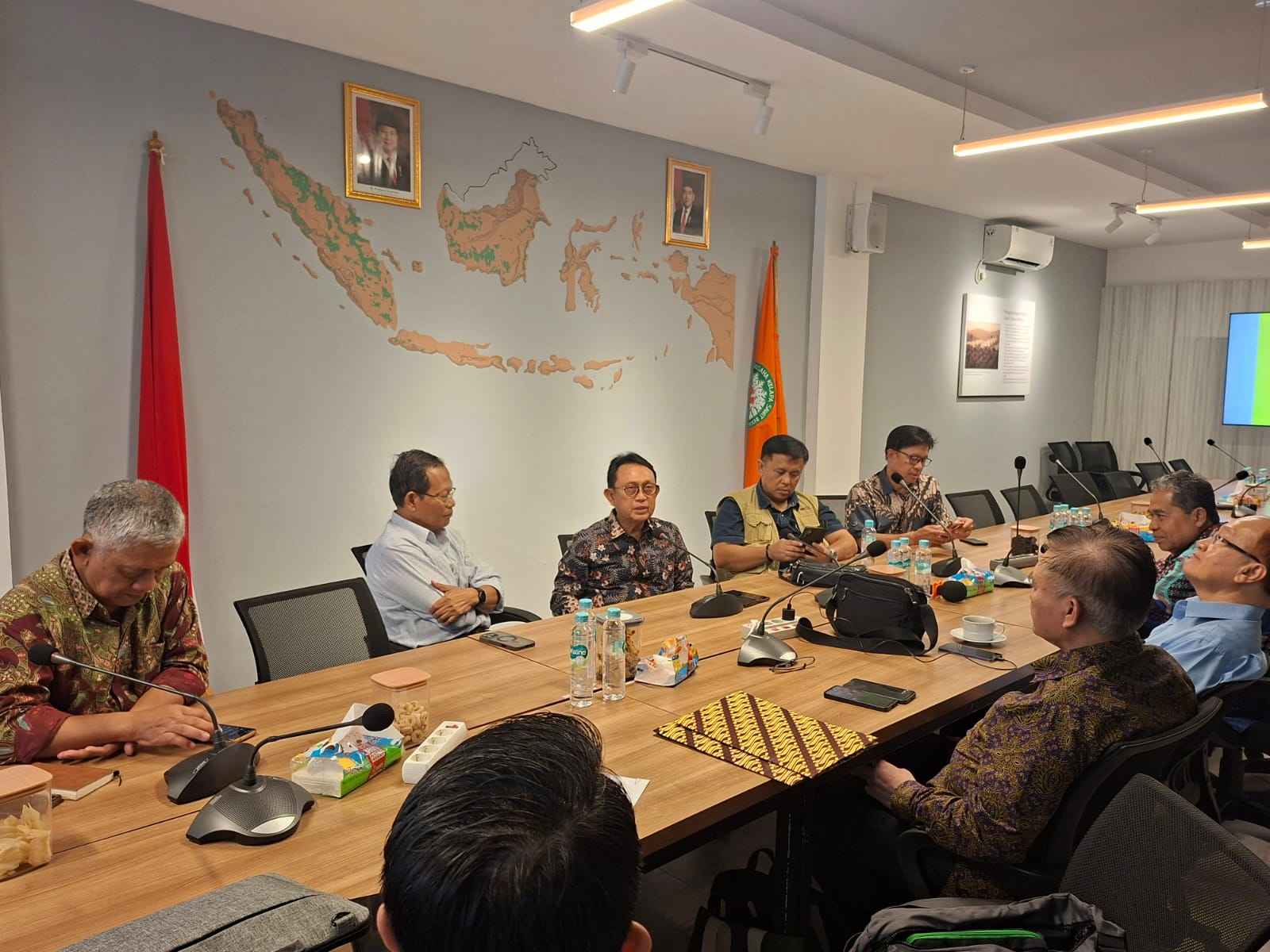
Enviro News Asia, Jakarta — The Constitutional Court (MK) of the Republic of Indonesia has once again held a plenary session for Case Number 147/PUU-XXII/2024 and Case Number 181/PUU-XXII/2024, concerning the judicial review of Law Number 18 of 2013 on the Prevention and Eradication of Forest Destruction (UU P3H), as amended by Article 37 point 20 of Law Number 6 of 2023 on Job Creation (UU Ciptaker), against the 1945 Constitution of the Republic of Indonesia (UUD NRI 1945).
The agenda of the session was to hear statements from the House of Representatives (DPR), as well as from expert witnesses and petitioners’ witnesses.
As stated in the official press release of the Constitutional Court of the Republic of Indonesia, Case Number 147/PUU-XXII/2024 presented expert witnesses Maruarar Siahaan and Budi Mulyanto, and witnesses Johari Ginting and Faizal Azmi Nasution.
Meanwhile, Case Number 181/PUU-XXII/2024 featured expert witness Grahat Nagara and witnesses including Parubahan Hasibuan and Nasaruddin Dasopang.
Maruarar Siahaan asserted that forest area designation through mere appointment is unconstitutional.
According to him, the appointment of forest areas is only one stage in the process of forest area formalization and not the final step in the forest area establishment process, as previously ruled by the Constitutional Court in its decision reviewing Law 41/1999 on Forestry.
Such provisions must take into account the possible existence of individual or customary (ulayat) rights within forest areas planned for designation.
If such rights are present, boundary demarcation and mapping must exclude those areas from the designated forest zone to prevent harm to affected communities.
“In determining forest areas, you cannot rely on appointment alone,” Maruarar said during the plenary session at the Constitutional Court, Jakarta, on Friday (May 23, 2025).
A similar view was expressed by Prof. Budi Mulyanto. He stated that to date, the forestry sector has not completed the formalization of forest areas and has instead relied on the appointment stage alone on paper, as if appointment and final determination carried the same legal certainty.
He explained that forest area formalization under Law 41/1999 involves four stages: appointment, boundary demarcation, mapping, and official designation.
The state may appoint, but this is insufficient without also conducting boundary demarcation and mapping.
The purpose of boundary demarcation is to avoid violations of citizens’ constitutional rights before the area is officially designated as forest. If an area is to be designated, any existing community rights—such as land ownership—must be resolved beforehand. If such rights still exist, then the formalization process is invalid.
“Appointment alone is not concrete—it’s just a concept. ‘But there is a designation map, sir.’ Yes, but that map is only at a 1:500,000 scale—1 millimeter on the map equals 500,000 millimeters on the ground,” Budi explained.
Meanwhile, in a Q&A session, Grahat Nagara stated that to this day there is no accurate data on how many people live in forest areas and control land within them.
“The only official government data on forest area use is when it is used for oil palm plantations, totaling 3.3 million hectares,” said Grahat.
Before adjourning the session, Chief Justice Suhartoyo announced that the hearing would resume on Wednesday, June 18, 2025, at 10:30 AM WIB. The agenda will be to hear expert and witness testimony from the President. The Constitutional Court will again summon the DPR to present its statement.