

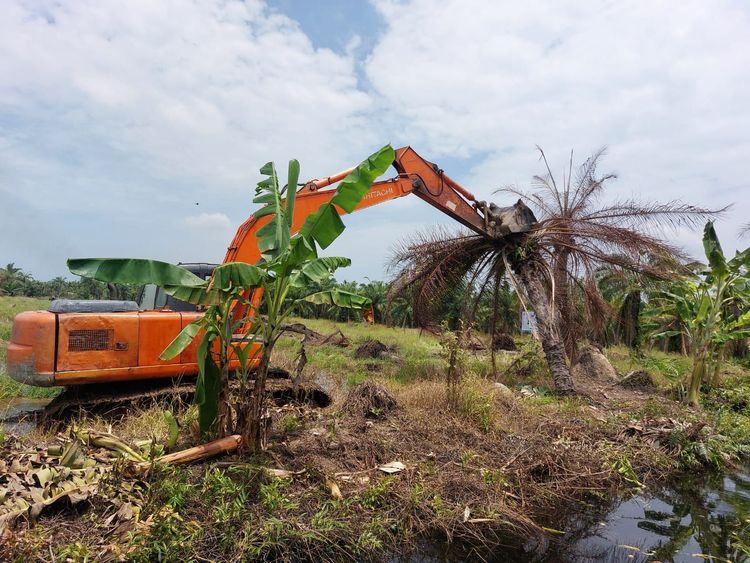
Enviro News Asia, Jakarta — Indonesia’s Kementerian Kehutanan has launched an operation to remove illegal oil palm plantations covering 102 hectares within the Suaka Margasatwa Karang Gading dan Langkat Timur Laut, as part of efforts to restore degraded mangrove ecosystems.
The operation, initiated on April 2, is conducted through the Directorate General of Law Enforcement (Gakkum) and the Directorate General of Natural Resources and Ecosystem Conservation (KSDAE), in collaboration with the Satgas Penertiban Kawasan Hutan Garuda.
The enforcement action forms part of a broader target to rehabilitate 389 hectares of mangrove ecosystems between 2025 and 2026. The initiative is supported by the Mangrove for Coastal Resilience (M4CR) program and international cooperation with KfW Development Bank.
Rudianto Saragih Napitu, Director of Forestry Criminal Enforcement at Gakkum, stated that the operation reflects the government’s firm commitment to protecting forest areas from illegal occupation. He emphasized that enforcement efforts are being carried out alongside ecosystem restoration and community empowerment initiatives.
The operation involves the active participation of 14 local forest farmer groups, ensuring community-based protection of the area following the removal of illegal oil palm trees and the replanting of mangroves.
Dody Triwinarto, Commander of the task force, highlighted the role of local communities as strategic partners in safeguarding forest ecosystems and confirmed that personnel would oversee the restoration process until ecological functions are fully restored.
Meanwhile, Sapto Aji Prabowo from KSDAE noted that the conservation area holds significant biodiversity value, serving as a habitat for protected species such as the Tuntong Laut and various migratory birds.
He stressed that restoring the ecosystem is essential to reestablish its role as a life-support system, carbon sink, and coastal protection barrier.
The operation also involved regional stakeholders, including the North Sumatra Natural Resources Conservation Agency, local environmental authorities, and law enforcement institutions, reinforcing cross-sector collaboration in protecting coastal ecosystems. (*)