

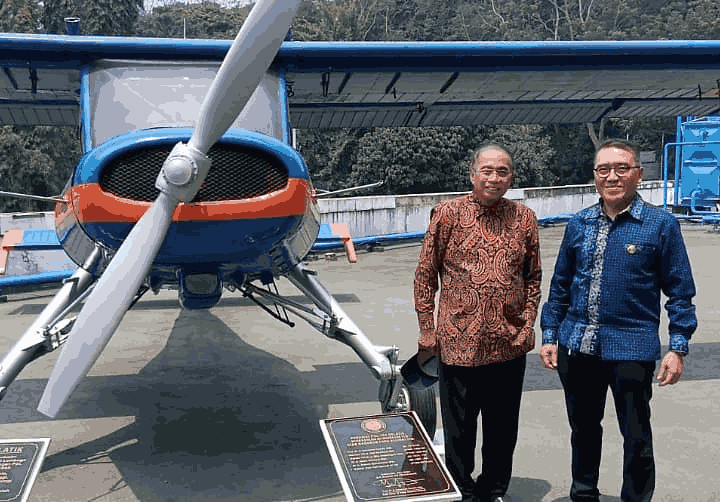
Enviro News Asia, Bandung — The PZL-104 Gelatik has become an important part of Indonesia’s aviation history after one of the aircraft was handed over to the Institut Teknologi Bandung (ITB) Museum to be preserved as a historical artifact.
On Wednesday, September 2, 2026, Indonesian Ambassador to the United States and ITB alumnus Indroyono Soesilo handed over the PZL-104 Gelatik to ITB Vice Rector Dr. Andryanto Rikrik Kusmara in Bandung. The aircraft will be preserved as part of the museum’s collection, together with historical documents and photographs documenting its development and use.
The Gelatik represents Indonesia’s early efforts to develop a domestic aviation industry through technology transfer and international cooperation.
The aircraft was Indonesia’s version of the PZL-104 Wilga, a light utility aircraft developed in Poland. In the early 1960s, Indonesia began assembling and producing the aircraft through cooperation with Poland.
The initiative was led by the Aviation Industry Preparatory Institute (LAPIP), established in 1961 under the leadership of Air Commodore Nurtanio. LAPIP worked with CEKOP, Poland’s foreign trade organization, and PZL Warszawa-Okęcie, the aircraft manufacturer.
Production of the PZL-104 Wilga was subsequently carried out in Bandung. President Soekarno gave the Indonesian version the name “Gelatik,” after a small and agile bird.
The Gelatik was a single-engine, high-wing aircraft equipped with fixed landing gear. Its short take-off and landing (STOL) capability made it suitable for Indonesia’s geographical conditions, particularly when many regions had only limited aviation infrastructure.
With a capacity of approximately four people, the aircraft could perform a wide range of missions, including training, liaison flights, aerial observation, agricultural activities, glider towing, parachuting and light transportation.
The aircraft was designed primarily for flexibility and operational capability rather than high speed. The PZL-104 Wilga had a maximum speed of about 195 kilometers per hour and a range of approximately 670 kilometers.
By the mid-1970s, Indonesia had produced 44 Gelatik aircraft. The program helped establish the foundation for the development of the Nurtanio Aviation Industry Institute (LIPNUR), which was later transformed into PT Industri Pesawat Terbang Nurtanio (IPTN) in 1976.
The company was renamed PT Industri Pesawat Terbang Nusantara (IPTN) in 1985 and eventually became PT Dirgantara Indonesia, Indonesia’s state-owned aircraft manufacturer.
The Gelatik also played a role in aviation education. On October 14, 1979, IPTN President Director B.J. Habibie handed over five Gelatik aircraft to Director General of Higher Education Prof. Doddy Tisna Amidjaja.
The five aircraft were subsequently donated to five universities: ITB, Universitas Gadjah Mada, Universitas Syiah Kuala in Aceh, Universitas Mulawarman in East Kalimantan, and Universitas Cenderawasih in Papua.
The handover, held at Husein Sastranegara Air Base in Bandung, was intended to support education and introduce aviation technology to university students.
The Gelatik belonging to ITB had been stored at the Husein Sastranegara Air Base hangar since 1993. In June 2026, a group of ITB alumni began efforts to preserve the aircraft at the ITB Museum.
The preservation initiative involved several figures, including Indroyono Soesilo, Tedi Rizalihadi, Gita Amperiawan, Idwan Soehardi, Ridwan Djamaluddin and Heri Heryadi.
The September 2 handover included not only the aircraft but also historical documents and photographs. The collection therefore preserves both the physical aircraft and the record of its development, use and contribution to Indonesia’s aviation technology.
For ITB, preserving the Gelatik is part of an effort to maintain an important artifact connected to education, technology and Indonesia’s early aviation ambitions.
The aircraft serves as a reminder that the development of Indonesia’s aviation industry began with relatively modest steps: technology transfer, international cooperation, human-resource development and the determination of early Indonesian engineers and aviation pioneers to master aircraft technology.
Preserved at the ITB Museum, the Gelatik is expected to provide future generations with a tangible link to the formative years of Indonesia’s national aviation industry.