

Enviro News Asia, Jakarta – Efforts to mitigate the climate crisis and the growing importance of carbon economic value have prompted the Indonesian government to strengthen emission reduction measures across sectors, including businesses. In 2025, the government issued Presidential Regulation No. 110/2025 on Carbon Economic Value Instruments and Greenhouse Gas (GHG) Emission Control, replacing the previous regulation.
This policy emphasizes the measurement of mitigation actions by businesses to assess both emission reductions and increases in greenhouse gas absorption. In this context, energy management—covering reduction, measurement, monitoring, and evaluation—has become a critical competency for energy managers.
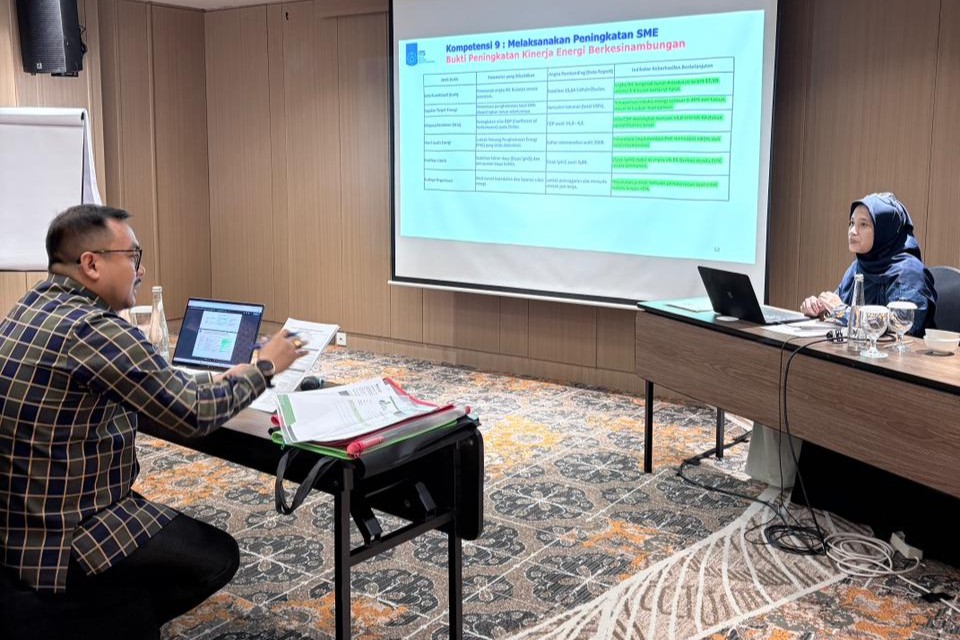
The Institute for Essential Services Reform (IESR), as part of the Sustainable Energy Transition in Indonesia (SETI) consortium, supports capacity building for energy managers. One of its initiatives includes competency assessment and certification training conducted in Surabaya in February 2026.
Among the required competencies, monitoring and evaluating energy management performance play a decisive role in determining the success or failure of implementation.
Energy managers are expected to master four key elements in evaluating energy management systems:
1. Evaluation of Legal and Other Requirements
Energy managers must collect and analyze data related to applicable legal and regulatory requirements, as well as other relevant standards, using established methodologies. The evaluation results must be properly documented.
2. Periodic Evaluation of Energy Management Systems
Regular evaluations should be conducted at defined intervals, based on established criteria, scope, and organizational needs, to ensure continuous improvement.
3. Preparation of Inputs for Management Review
Evaluation results must be compiled to reflect current conditions, organizational needs, and the alignment between planned and actual performance. Compliance assessments should also be included as part of the review inputs.
4. Ensuring Implementation of Management Review by Top Management
Energy managers are responsible for communicating the results of evaluations and management reviews to relevant stakeholders, ensuring that decisions are effectively implemented.
These competencies highlight the strategic role of energy managers not only in ensuring regulatory compliance but also in driving efficiency, sustainability, and measurable emission reductions within organizations. (*)